Mississippi Science ZOO.8.9
The Standard
- ZOO.8
- Students will understand the structure and function of phylum Chordata, classes Amphibia and Reptilia, and how they demonstrate the characteristics of living things.
Identify the amniotic egg as the major derived characteristic of reptiles.
2026 Mississippi College- and Career-Readiness Standards for Science · Phylum Chordata, Classes Amphibia, and Reptilia
Teacher's field guide
What This Standard Means
What Students Need to Do
- Students identify the amniotic egg as a trait reptiles share that amphibians lack. They explain how its membranes help an embryo develop on land.
What Mastery Looks Like
- Given a turtle egg diagram, students point to the amnion and explain how its fluid protects the embryo. They can explain why a turtle egg can develop in a land nest while most frog eggs need water.
Common Misconceptions
- Students may focus only on the shell and miss the membranes inside. They may think only reptiles have an amnion, or that every reptile lays eggs.
How to Assess It
- Show sketches of a frog egg and a turtle egg. Ask: Which has an amnion, and how does it help the embryo develop on land?
Lesson moves
Ways to Teach It
Give pairs cutouts of an embryo, amnion, yolk sac, and shell; have them assemble a turtle egg and label each part's job.
Ask: Why can a turtle embryo develop in a land nest while most frog embryos need water? Require students to name two egg structures.
Hand out diagrams of frog, turtle, chicken, and mouse embryos; students sort them by whether an amnion is present.
Show a photo of a turtle nest on a beach; have students explain how the buried eggs support embryos without a pond.
Free download
Printable ZOO.8.9 Worksheet
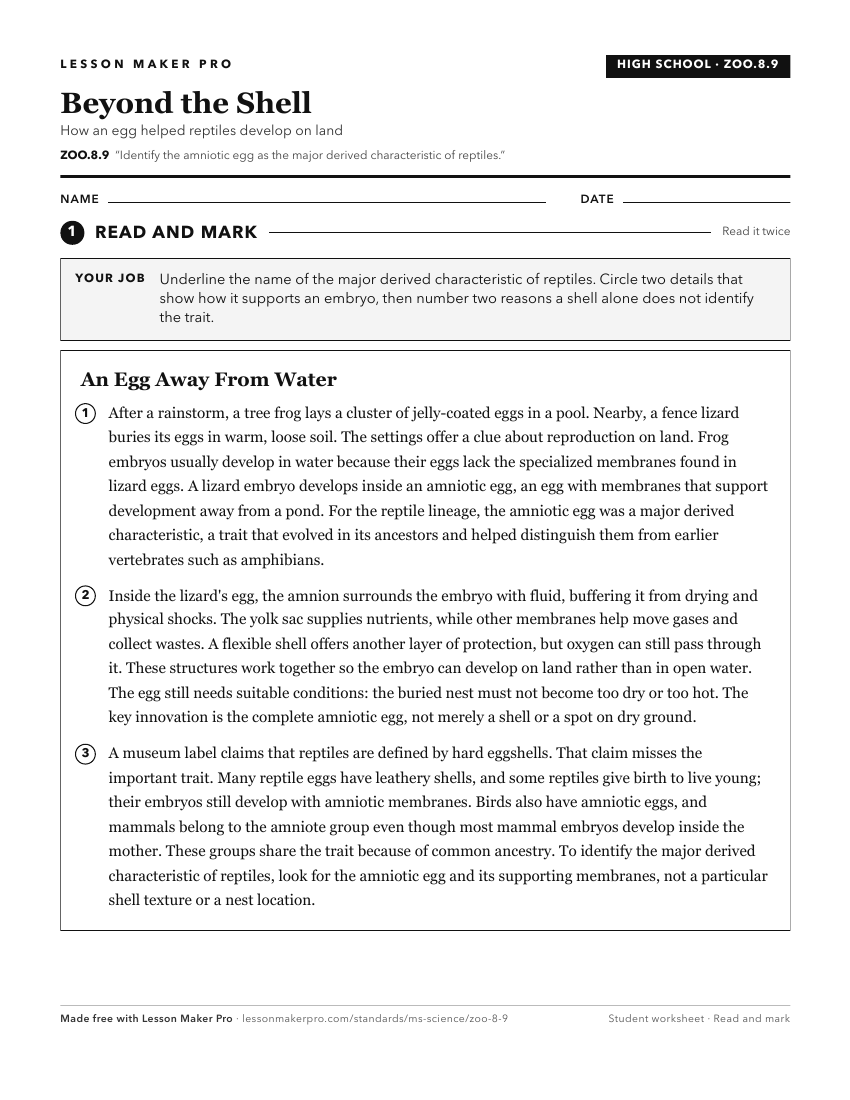
A ready-to-print activity worksheet aligned to ZOO.8.9, with an answer key for the teacher on its own page. No account needed.
PDF, US Letter, prints cleanly in black and white.
Download the worksheetKeep exploring
Related Standards
- ZOO.8.7
Compare and contrast living and extinct reptiles.
- MAQ.7.4
Differentiate various life cycles found among animals (e.g., egg, tadpole, and adult stages of the amphibian life cycle; leathery eggs on land in reptiles; hard...
- L.2.1.3
Compare and contrast physical characteristics that distinguish between classes of vertebrates (i.e., reptiles compared to amphibians).
- ZOO.8.3
Describe adaptations that have led to reptiles living on land successfully.
Turn this exact standard into a lesson
Grade, subject, topic, and the complete standard are prefilled. Create one free, no account needed.
Also for this standard:Make a WorksheetMake a QuizMake a Sub Lesson