Mississippi Science ZOO.8.1
The Standard
- ZOO.8
- Students will understand the structure and function of phylum Chordata, classes Amphibia and Reptilia, and how they demonstrate the characteristics of living things.
Understand the evolution of tetrapods and the development of the structure and function of body systems and life cycles.
2026 Mississippi College- and Career-Readiness Standards for Science · Phylum Chordata, Classes Amphibia, and Reptilia
Teacher's field guide
What This Standard Means
What Students Need to Do
- Students trace shared bones from lobe-finned fish fins to early four-limbed animals. They compare how frogs and lizards breathe, protect their bodies, and reproduce. They explain how these traits affect life on land.
What Mastery Looks Like
- Given a fish fin and salamander limb diagram, students identify matching bones and explain how limbs helped early tetrapods move on land. They explain why frog tadpoles develop in water while lizards hatch without an aquatic larval stage. They connect a lizard's scaly skin and shelled eggs to life on land.
Common Misconceptions
- Students may think a living frog evolved into a lizard, rather than both sharing older ancestors. They may think adult frogs still have gills or that lizard eggs must develop in water.
How to Assess It
- On an exit ticket, show a lobe-finned fish fin, a salamander forelimb, and frog and lizard eggs. Ask students to mark one matching bone pair and explain which eggs need pond water.
Lesson moves
Ways to Teach It
Have pairs trace and color matching bones on printed diagrams of a lobe-finned fish fin and salamander forelimb.
Ask students to write: Why can lizard eggs develop on land while frog eggs usually need water?
Sort cards showing tadpole gills, adult lungs, moist skin, dry scales, and shelled eggs into frog, lizard, or both.
Show photos of a pond and a damp garden bed; ask where frog eggs and lizard eggs could develop and why.
Free download
Printable ZOO.8.1 Worksheet
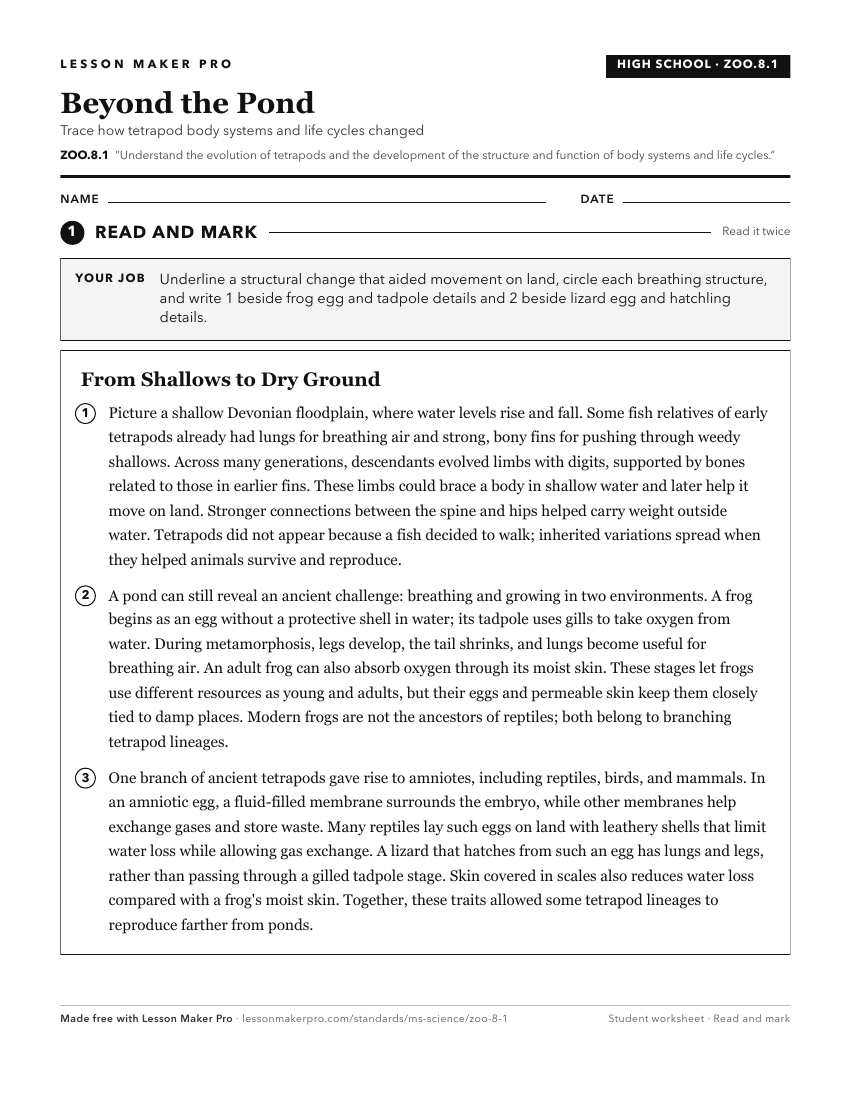
A ready-to-print activity worksheet aligned to ZOO.8.1, with an answer key for the teacher on its own page. No account needed.
PDF, US Letter, prints cleanly in black and white.
Download the worksheetKeep exploring
Related Standards
- ZOO.7
Students will understand the structure and function of phylum Chordata, classes Chondrichthyes and Osteichthyes, and how they demonstrate the characteristics of...
- ZOO.8
Students will understand the structure and function of phylum Chordata, classes Amphibia and Reptilia, and how they demonstrate the characteristics of living th...
- ZOO.9
Students will understand the structure and function of phylum Chordata, class Aves, and how they demonstrate the characteristics of living things.
- ZOO.8.8
Explain the importance of tetrapod evolution.
Turn this exact standard into a lesson
Grade, subject, topic, and the complete standard are prefilled. Create one free, no account needed.
Also for this standard:Make a WorksheetMake a QuizMake a Sub Lesson