Mississippi Science ZOO.9
Standard Cluster
Students will understand the structure and function of phylum Chordata, class Aves, and how they demonstrate the characteristics of living things. Trace the evolutionary history of modern birds beginning with the theropods. Relate how today’s birds have adapted to changing environments. Describe the fossil evidence that indicates that birds evolved from two-legged dinosaurs called theropods. Define the term endothermic and describe how birds regulate body temperature in extreme environments. Enrichment: Use an engineering design process to model biomimicry of endothermic temperature regulation to meet a sustainable need. * Explain how birds of prey use their keen sense of sight to locate and attack prey. Describe how corvids use their intellect for problem solving and locating food storage. Explain the importance of the evolution of flight and feathers, including the morphological and physiological adaptations needed to sustain flight. Enrichment: Use an engineering design process to utilize a bird’s flight adaptations in the development of a flying aircraft (e.g., glider, plane). * Demonstrate how different adaptations of the bird beak and feet allow them to feed and survive in different environments. Enrichment: Based on an understanding of biomimicry, use an engineering design process to develop a tool based on a bird’s beak/feet to meet a human need. * Describe the parenting behavior used by different birds to incubate their eggs and care for hatchlings. Enrichment: Use an engineering design process to design and construct an incubator for hatching abandoned eggs. * Explain the reasons for bird migration and the innate behavior of migratory birds. Dissect representative taxa and compare their internal and external anatomy and complexity.
2026 Mississippi College- and Career-Readiness Standards for Science · Phylum Chordata, Class Aves
Cluster contents
Standards in This Cluster
ZOO.9 is a cluster heading. These are the individual standards under it.
- ZOO.9.1
Trace the evolutionary history of modern birds beginning with the theropods. Relate how today’s birds have adapted to changing environments.
- ZOO.9.2
Describe the fossil evidence that indicates that birds evolved from two-legged dinosaurs called theropods.
- ZOO.9.3
Define the term endothermic and describe how birds regulate body temperature in extreme environments.
- ZOO.9.4
Enrichment: Use an engineering design process to model biomimicry of endothermic temperature regulation to meet a sustainable need. *
- ZOO.9.5
Explain how birds of prey use their keen sense of sight to locate and attack prey.
- ZOO.9.6
Describe how corvids use their intellect for problem solving and locating food storage.
- ZOO.9.7
Explain the importance of the evolution of flight and feathers, including the morphological and physiological adaptations needed to sustain flight.
- ZOO.9.8
Enrichment: Use an engineering design process to utilize a bird’s flight adaptations in the development of a flying aircraft (e.g., glider, plane). *
- ZOO.9.9
Demonstrate how different adaptations of the bird beak and feet allow them to feed and survive in different environments.
- ZOO.9.10
Enrichment: Based on an understanding of biomimicry, use an engineering design process to develop a tool based on a bird’s beak/feet to meet a human need. *
- ZOO.9.11
Describe the parenting behavior used by different birds to incubate their eggs and care for hatchlings.
- ZOO.9.12
Enrichment: Use an engineering design process to design and construct an incubator for hatching abandoned eggs. *
- ZOO.9.13
Explain the reasons for bird migration and the innate behavior of migratory birds.
- ZOO.9.14
Dissect representative taxa and compare their internal and external anatomy and complexity.
Teacher's field guide
What This Cluster Means
What Students Need to Do
- Students use fossils and body structures to trace birds back to theropod dinosaurs. They compare bird anatomy in dissected specimens and explain how birds produce body heat, fly, and feed. They describe how birds find food, migrate, and care for young.
What Mastery Looks Like
- A student identifies shared features in a theropod fossil and a bird skeleton, then locates the heart and lungs in a dissected specimen. They explain how feathers help with flight and insulation, and how a beak and feet suit a particular food source. They can explain how a hawk spots prey, a crow finds stored food, and a goose survives a seasonal change.
Common Misconceptions
- Students may think all feathered dinosaurs flew or that feathers produce heat. They may assume all birds eat the same food or that migration routes are learned only from parents.
How to Assess It
- Show a labeled feathered theropod fossil and a hawk skeleton. Ask students to name two shared features, then explain how one hawk feature helps it hunt.
Lesson moves
Ways to Teach It
Set out tweezers, clothespins, rice, and rubber bands; have students test which tool picks up each food and match results to bird beaks.
Show an Archaeopteryx fossil and a chicken skeleton; ask, "Which shared traits support a theropod ancestor?"
Give pairs cards with hawk eyesight, crow food caching, goose migration, and snowy owl insulation; have them match each adaptation to a survival problem.
Wrap two jars of warm water in cotton and foil, compare temperatures after 15 minutes, then sketch a reusable jacket inspired by bird insulation.
Free download
Printable ZOO.9 Worksheet
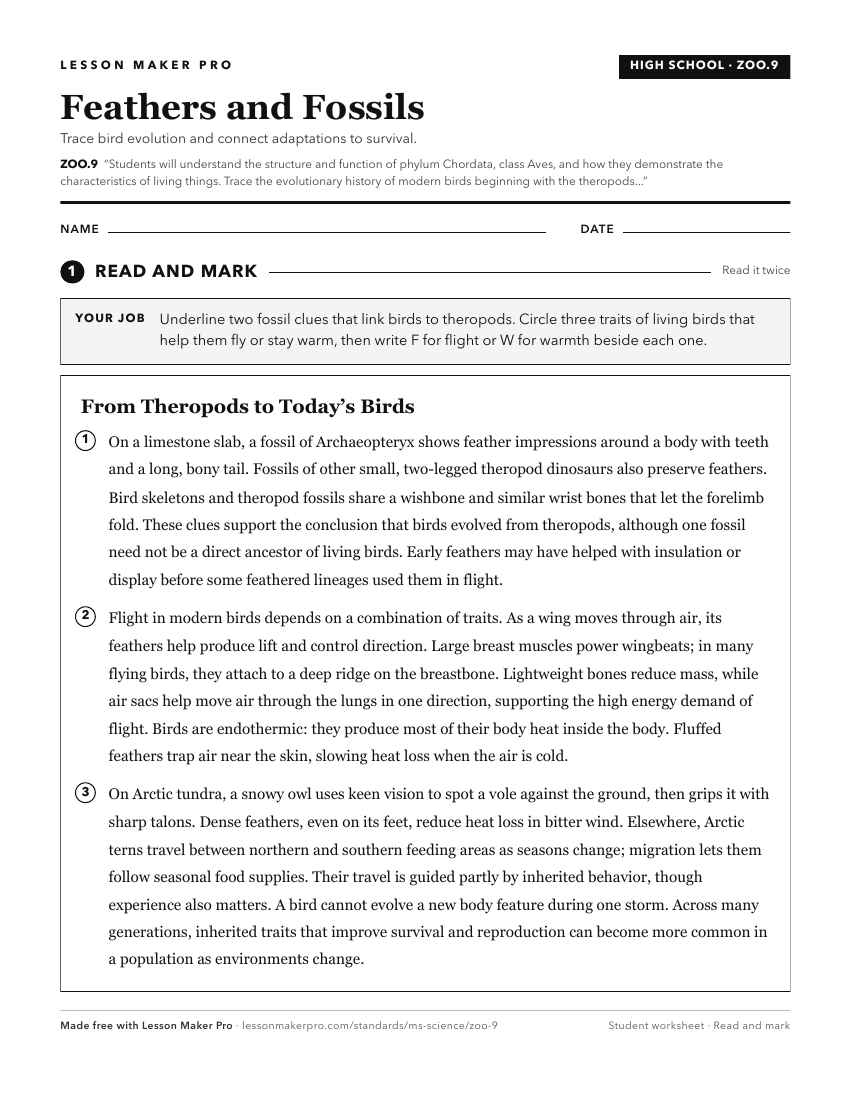
A ready-to-print activity worksheet aligned to ZOO.9, with an answer key for the teacher on its own page. No account needed.
PDF, US Letter, prints cleanly in black and white.
Download the worksheetKeep exploring
Related Standards
- ZOO.7
Students will understand the structure and function of phylum Chordata, classes Chondrichthyes and Osteichthyes, and how they demonstrate the characteristics of...
- ZOO.10
Students will understand the structure and function of phylum Chordata, class Mammalia, and how they demonstrate the characteristics of living things.
- ZOO.8
Students will understand the structure and function of phylum Chordata, classes Amphibia and Reptilia, and how they demonstrate the characteristics of living th...
- ZOO.5
Students will understand the basic structure and function of phylum Arthropoda, and how they demonstrate the characteristics of living things.
Turn this cluster into a lesson
Grade, subject, topic, and the complete cluster are prefilled. Create one free, no account needed.
Also for this cluster:Make a WorksheetMake a QuizMake a Sub Lesson