Mississippi Science ZOO.9.10
The Standard
- ZOO.9
- Students will understand the structure and function of phylum Chordata, class Aves, and how they demonstrate the characteristics of living things.
Enrichment: Based on an understanding of biomimicry, use an engineering design process to develop a tool based on a bird’s beak/feet to meet a human need. *
2026 Mississippi College- and Career-Readiness Standards for Science · Phylum Chordata, Class Aves
Teacher's field guide
What This Standard Means
What Students Need to Do
- Students choose a human task and study how a bird's beak or foot handles a similar task. They build a tool that uses that feature, test it, and revise it.
What Mastery Looks Like
- A student can show how curved hawk talons inspired the gripping parts of a litter grabber. They can report how many bottle caps it picked up in five tries and change the grip based on the results.
Common Misconceptions
- Students may copy a bird's shape without thinking about how it works. They may call a tool successful after one try or change its look without using test results.
How to Assess It
- Ask students to sketch a tool for picking up bottle caps without bending. Have them label the bird feature it copies, describe a five-try test, and name one change they would make if it dropped a cap.
Lesson moves
Ways to Teach It
Build a claw from cardboard strips, string, and rubber bands, using hawk toes as a model; test five bottle-cap pickups and adjust the grip.
Show photos of a duck's webbed foot and a hawk's talons; ask which better guides a litter grabber and why.
Give pairs bird beak and foot photo cards and tool-job cards; match each feature to a job, then defend one match.
Show a store-bought reacher and ask students to sketch a hawk-toe grip change for picking up dropped keys without bending.
Free download
Printable ZOO.9.10 Worksheet
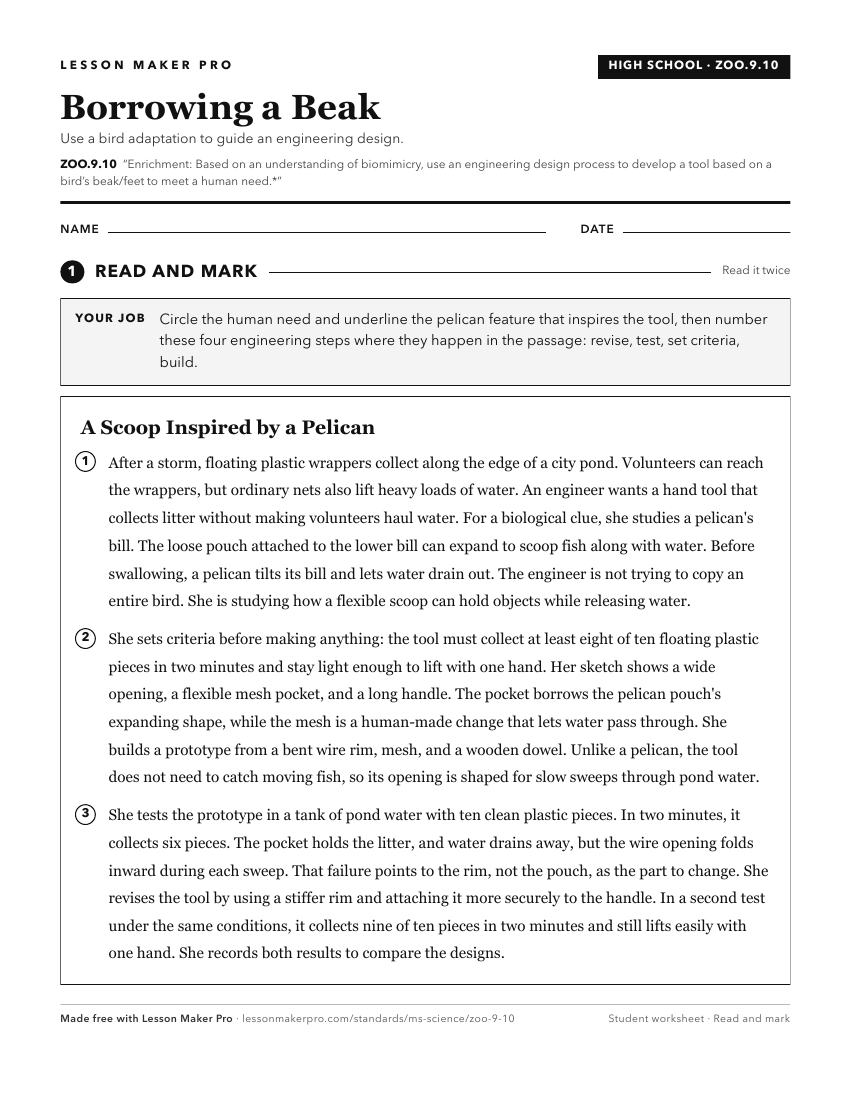
A ready-to-print activity worksheet aligned to ZOO.9.10, with an answer key for the teacher on its own page. No account needed.
PDF, US Letter, prints cleanly in black and white.
Download the worksheetKeep exploring
Related Standards
- ZOO.5.3
Enrichment: Use an engineering design process to develop a biomimicry of an arthropod’s exoskeleton to meet a human need. *
- ZOO.8.6
Enrichment: Use an engineering design process to model biomimicry of ectothermic temperature regulation or chemosensory detection to meet a societal need. *
- BOT.4.6
Enrichment: Use an engineering design process to design and conduct an investigation that uses biomimicry to provide a plant-based solution to an environmental ...
- BIO.5.9
Enrichment: Use an engineering design process to investigate and model current technological uses of biomimicry to address solutions to real-world problems. *
Turn this exact standard into a lesson
Grade, subject, topic, and the complete standard are prefilled. Create one free, no account needed.
Also for this standard:Make a WorksheetMake a QuizMake a Sub Lesson