Mississippi Science ZOO.5.3
The Standard
- ZOO.5
- Students will understand the basic structure and function of phylum Arthropoda, and how they demonstrate the characteristics of living things.
Enrichment: Use an engineering design process to develop a biomimicry of an arthropod’s exoskeleton to meet a human need. *
2026 Mississippi College- and Career-Readiness Standards for Science · Phylum Arthropoda
Teacher's field guide
What This Standard Means
What Students Need to Do
- Students identify a useful feature of an arthropod’s outer shell, such as the overlapping plates on a pill bug. They use that feature to build, test, and improve something a person could use.
What Mastery Looks Like
- A student can explain how overlapping plates could protect an elbow without stopping it from bending. They set targets for movement and protection, test a model, and use the results to change it.
Common Misconceptions
- Some students copy the animal’s shape without using a feature that solves the human problem. Others make the shell thicker and more rigid without checking whether the joint can still bend.
How to Assess It
- Exit ticket: Sketch an elbow guard based on a pill bug’s overlapping plates. Label the cyclist’s need, a bend test, a protection test, and one change if the guard fails.
Lesson moves
Ways to Teach It
Tape overlapping cardboard plates onto a hinged paper finger, then check whether it bends and withstands a dropped eraser.
Show a photo of a curled pill bug; ask students which shell feature could help a knee guard bend, and why.
Race to sort cards labeled overlapping plates, thick shell, blocked joint, and added weight into helpful features or design problems; defend one choice.
Show a cyclist’s elbow pad and a pill bug photo; have students sketch plates that protect an elbow without blocking movement.
Free download
Printable ZOO.5.3 Worksheet
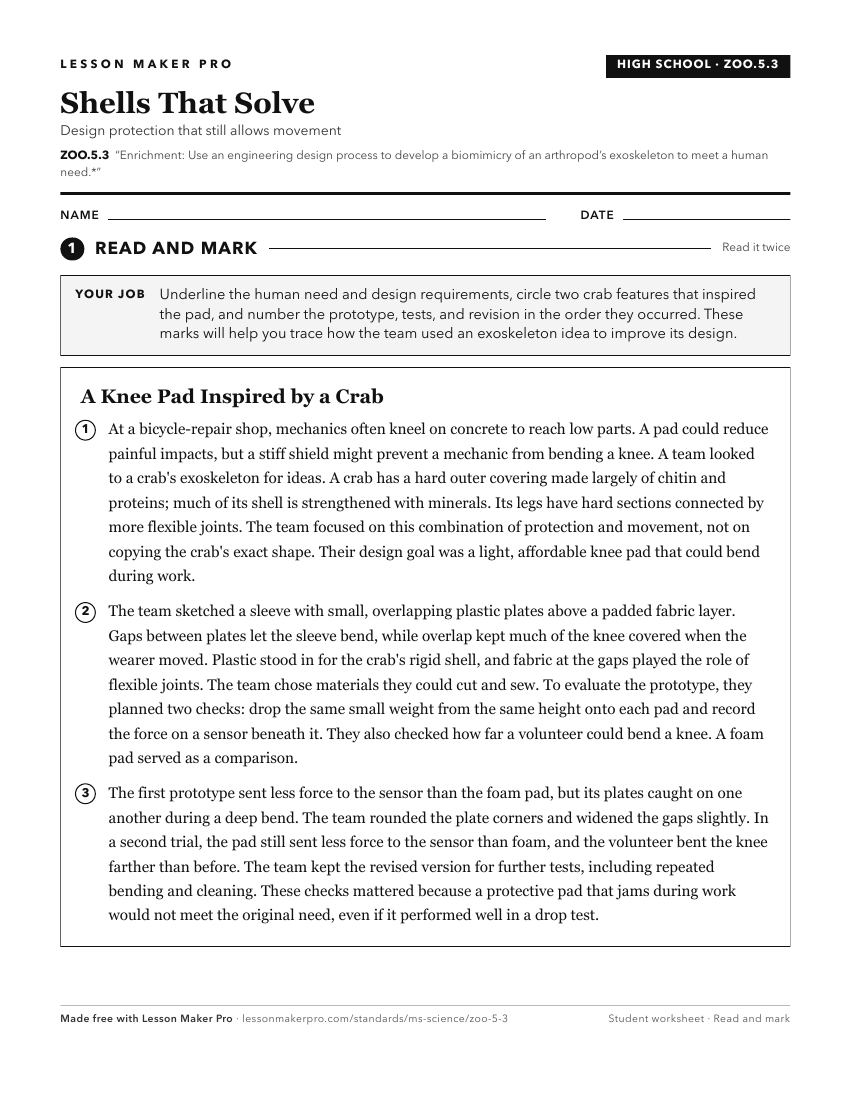
A ready-to-print activity worksheet aligned to ZOO.5.3, with an answer key for the teacher on its own page. No account needed.
PDF, US Letter, prints cleanly in black and white.
Download the worksheetKeep exploring
Related Standards
- ZOO.2.8
Enrichment: Utilize an engineering design process to create a simulated nematocyst, including possible biomimicry use. *
- ZOO.8.6
Enrichment: Use an engineering design process to model biomimicry of ectothermic temperature regulation or chemosensory detection to meet a societal need. *
- ZOO.9.10
Enrichment: Based on an understanding of biomimicry, use an engineering design process to develop a tool based on a bird’s beak/feet to meet a human need. *
- BIO.5.9
Enrichment: Use an engineering design process to investigate and model current technological uses of biomimicry to address solutions to real-world problems. *
Turn this exact standard into a lesson
Grade, subject, topic, and the complete standard are prefilled. Create one free, no account needed.
Also for this standard:Make a WorksheetMake a QuizMake a Sub Lesson