Mississippi Science ZOO.8.6
The Standard
- ZOO.8
- Students will understand the structure and function of phylum Chordata, classes Amphibia and Reptilia, and how they demonstrate the characteristics of living things.
Enrichment: Use an engineering design process to model biomimicry of ectothermic temperature regulation or chemosensory detection to meet a societal need. *
2026 Mississippi College- and Career-Readiness Standards for Science · Phylum Chordata, Classes Amphibia, and Reptilia
Teacher's field guide
What This Standard Means
What Students Need to Do
- Students study how lizards move between sun and shade to control body temperature. They set a temperature goal and a material limit, then build, test, and revise a bus shelter model with movable shade.
What Mastery Looks Like
- A student can explain how a movable shelter shade copies the lizard's behavior. They compare its temperature with an unshaded model and use the readings to improve their design.
Common Misconceptions
- Some students think lizards make heat internally like mammals. Others think a design works because it resembles an animal, without testing whether it lowers the temperature.
How to Assess It
- Exit ticket: A lizard moves under a rock when it gets too hot. Sketch one change to a bus shelter based on that behavior, and name a measurement that would show whether it works.
Lesson moves
Ways to Teach It
Build two cardboard bus shelters, add a movable paper shade to one, and compare thermometer readings outside in sunlight after ten minutes.
Ask: If a lizard avoids midday sun, how should a bus stop shade move as the sun crosses the sky?
Give teams three shelter readings, 31°C, 28°C, and 26°C, with costs of $2, $4, and $8; choose a design under $5 and 29°C.
Show a bus stop photo with a west arrow; have students draw an afternoon shade that leaves room for wheelchairs.
Free download
Printable ZOO.8.6 Worksheet
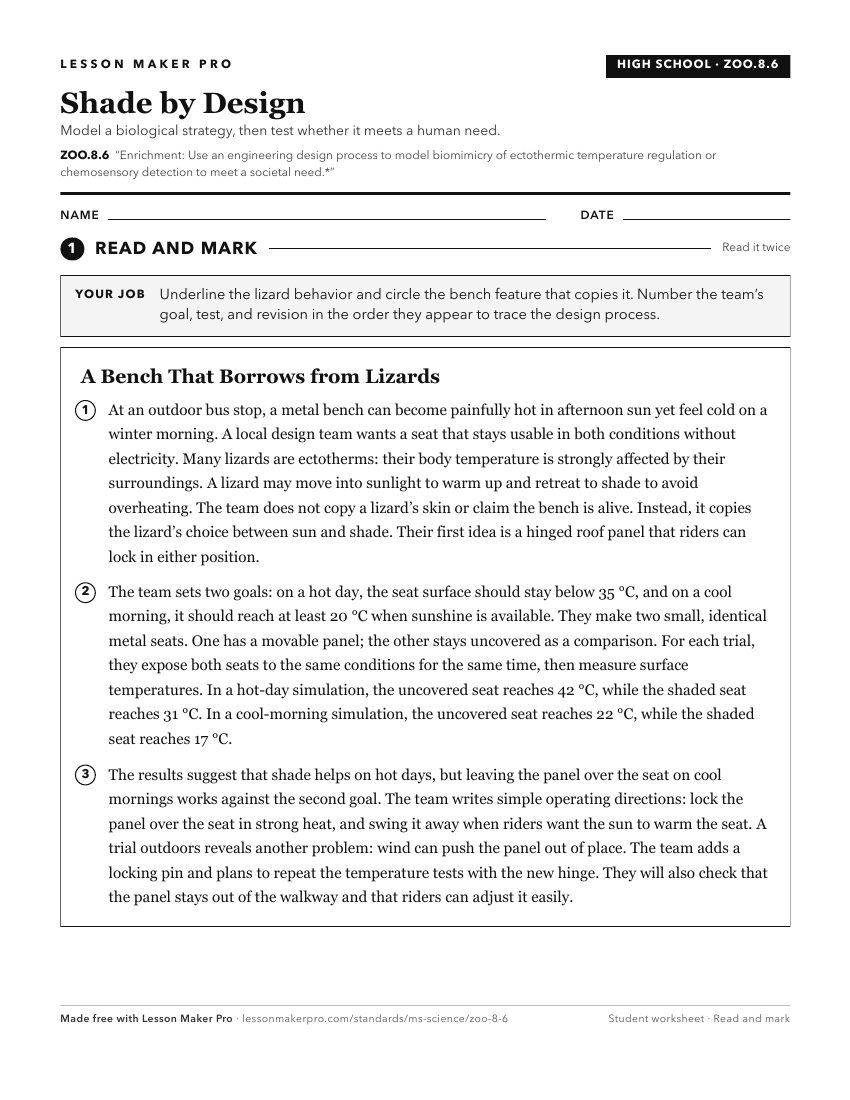
A ready-to-print activity worksheet aligned to ZOO.8.6, with an answer key for the teacher on its own page. No account needed.
PDF, US Letter, prints cleanly in black and white.
Download the worksheetKeep exploring
Related Standards
- ZOO.5.3
Enrichment: Use an engineering design process to develop a biomimicry of an arthropod’s exoskeleton to meet a human need. *
- ZOO.9.4
Enrichment: Use an engineering design process to model biomimicry of endothermic temperature regulation to meet a sustainable need. *
- ZOO.9.10
Enrichment: Based on an understanding of biomimicry, use an engineering design process to develop a tool based on a bird’s beak/feet to meet a human need. *
- BIO.5.9
Enrichment: Use an engineering design process to investigate and model current technological uses of biomimicry to address solutions to real-world problems. *
Turn this exact standard into a lesson
Grade, subject, topic, and the complete standard are prefilled. Create one free, no account needed.
Also for this standard:Make a WorksheetMake a QuizMake a Sub Lesson