Mississippi Science ZOO.9.4
The Standard
- ZOO.9
- Students will understand the structure and function of phylum Chordata, class Aves, and how they demonstrate the characteristics of living things.
Enrichment: Use an engineering design process to model biomimicry of endothermic temperature regulation to meet a sustainable need. *
2026 Mississippi College- and Career-Readiness Standards for Science · Phylum Chordata, Class Aves
Teacher's field guide
What This Standard Means
What Students Need to Do
- Students explain how birds make body heat and how feathers trap air to slow heat loss. They build a cup sleeve from reused materials. They test it against a bare cup and revise it using temperature readings.
What Mastery Looks Like
- A student can name a need, such as keeping food warm without electricity, and set a material limit. They test two cups with the same amount of water at the same starting temperature. They use the results to explain a design change.
Common Misconceptions
- Students may say feathers produce heat, rather than hold in heat made by the bird. They may assume a tighter wrap is always better, even when it squeezes out trapped air. Some compare cups with different starting temperatures and mistake the difference for better insulation.
How to Assess It
- Exit ticket: Two cups start at 40°C. After 15 minutes, the bare cup is 32°C and the wrapped cup is 36°C. Ask which cup lost less heat, why the wrap helped, and what they would test next.
Lesson moves
Ways to Teach It
Wrap one of two identical cups of warm water in loose scrap fabric, leave the other bare, and compare temperatures after 15 minutes.
Ask, 'Do feathers make heat or slow heat loss?' Have students write a claim backed by their cup readings.
Give pairs sleeve test results showing 2°C, 4°C, and 6°C drops; ask them to pick a design and justify it.
Compare a down jacket and a space heater; ask which keeps a person warm without electricity and what happens to body heat.
Free download
Printable ZOO.9.4 Worksheet
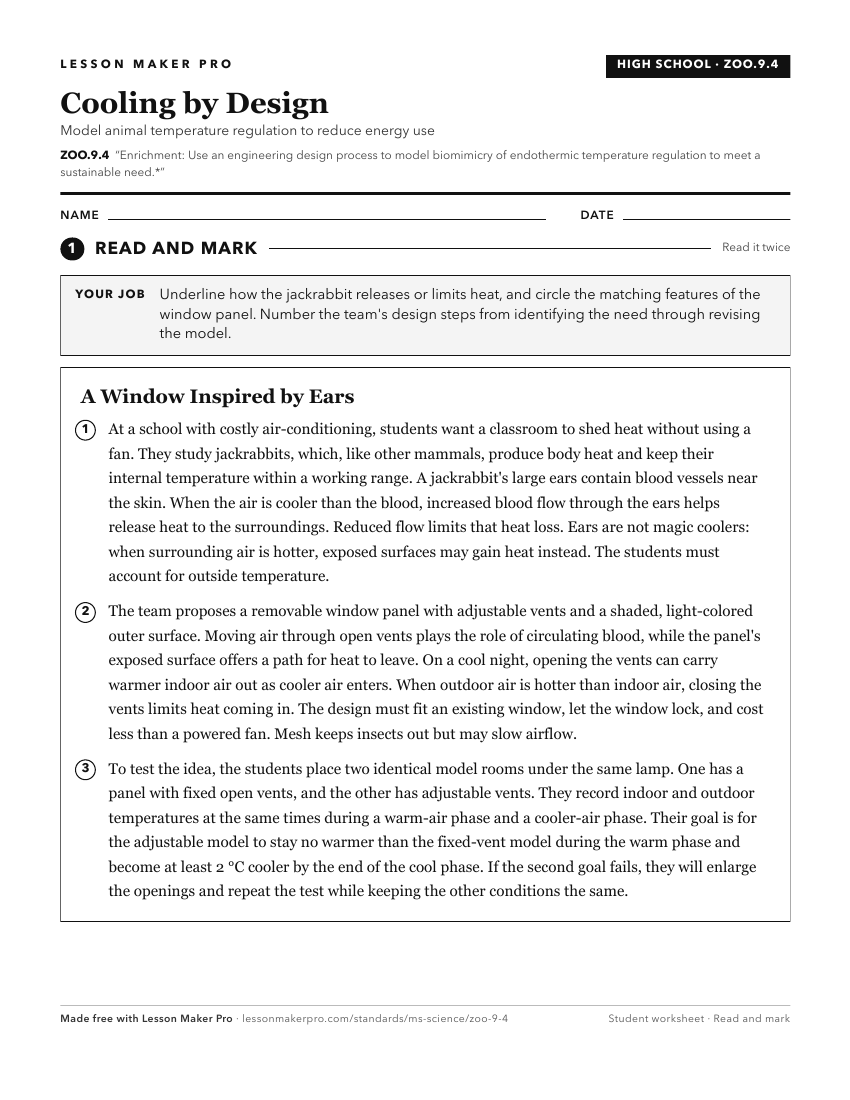
A ready-to-print activity worksheet aligned to ZOO.9.4, with an answer key for the teacher on its own page. No account needed.
PDF, US Letter, prints cleanly in black and white.
Download the worksheetKeep exploring
Related Standards
- ZOO.5.3
Enrichment: Use an engineering design process to develop a biomimicry of an arthropod’s exoskeleton to meet a human need. *
- ZOO.8.6
Enrichment: Use an engineering design process to model biomimicry of ectothermic temperature regulation or chemosensory detection to meet a societal need. *
- BOT.4.6
Enrichment: Use an engineering design process to design and conduct an investigation that uses biomimicry to provide a plant-based solution to an environmental ...
- BIO.5.9
Enrichment: Use an engineering design process to investigate and model current technological uses of biomimicry to address solutions to real-world problems. *
Turn this exact standard into a lesson
Grade, subject, topic, and the complete standard are prefilled. Create one free, no account needed.
Also for this standard:Make a WorksheetMake a QuizMake a Sub Lesson