Mississippi Science ZOO.9.13
The Standard
- ZOO.9
- Students will understand the structure and function of phylum Chordata, class Aves, and how they demonstrate the characteristics of living things.
Explain the reasons for bird migration and the innate behavior of migratory birds.
2026 Mississippi College- and Career-Readiness Standards for Science · Phylum Chordata, Class Aves
Teacher's field guide
What This Standard Means
What Students Need to Do
- Students explain how seasonal changes in food and breeding conditions lead birds to migrate. They describe how inherited behavior helps birds start the trip and choose a direction, while environmental cues help with timing and navigation.
What Mastery Looks Like
- Given a young warbler migrating without adults, a student can explain why it leaves and how it knows to start. They can name a navigation cue, such as the sun or Earth's magnetic field, and distinguish inherited behavior from a route learned by following other birds.
Common Misconceptions
- Students may think birds migrate only because they get cold, or that every species flies south. Some think adults must teach every bird its route, or that inherited behavior means birds use no environmental cues.
How to Assess It
- Ask: “A young warbler raised without migrating adults flies south in fall. What seasonal benefit might it gain, and why can it begin the trip without being taught?”
Lesson moves
Ways to Teach It
On a map, mark a ruby-throated hummingbird's eastern U.S. breeding range and Central American winter range with sticky notes, then trace the route.
Ask students to write: “Which parts of a young bird's first migration might be inherited, and which might it learn?”
Give pairs cards marked “shorter days,” “more insects,” “magnetic field,” and “adult guide” to sort into timing, benefit, navigation, or learning.
Use a local bird sightings chart and a daylight calendar to predict when swallows return, then check the chart.
Free download
Printable ZOO.9.13 Worksheet
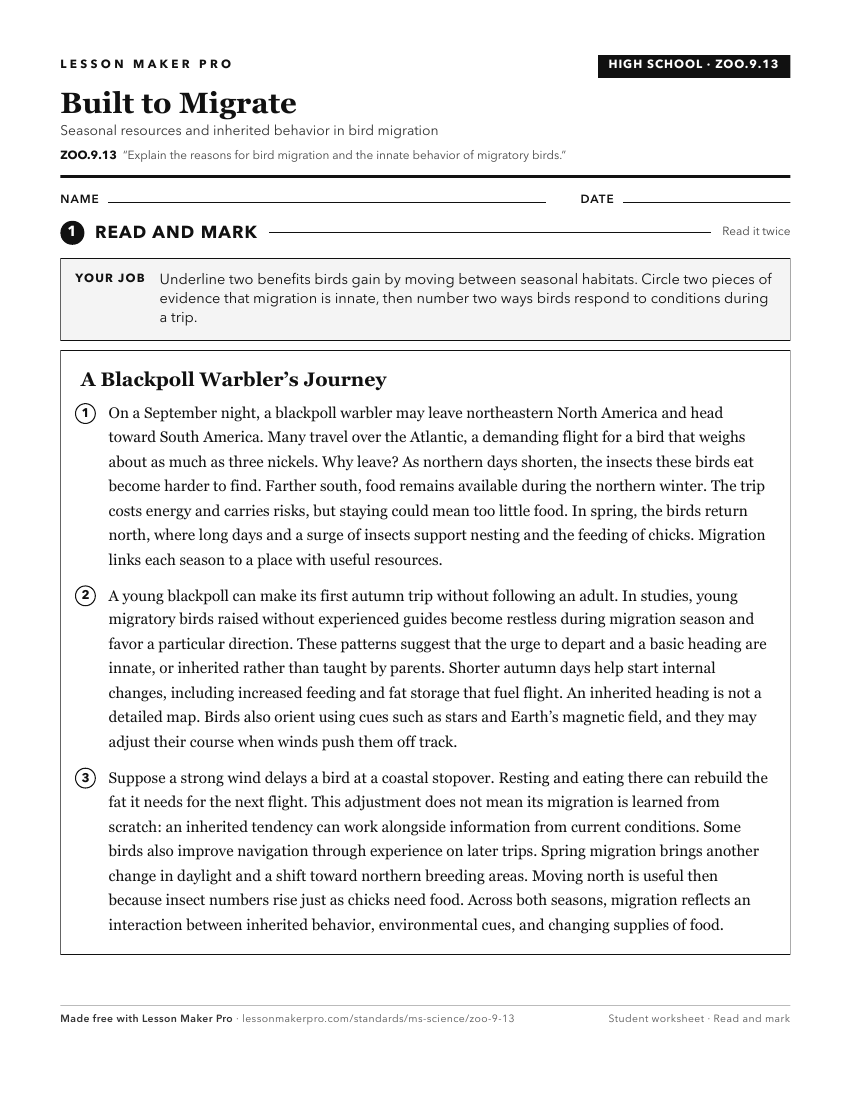
A ready-to-print activity worksheet aligned to ZOO.9.13, with an answer key for the teacher on its own page. No account needed.
PDF, US Letter, prints cleanly in black and white.
Download the worksheetKeep exploring
Related Standards
- ZOO.9.1
Trace the evolutionary history of modern birds beginning with the theropods. Relate how today’s birds have adapted to changing environments.
- ZOO.9.7
Explain the importance of the evolution of flight and feathers, including the morphological and physiological adaptations needed to sustain flight.
- ZOO.9.11
Describe the parenting behavior used by different birds to incubate their eggs and care for hatchlings.
- ZOO.9.9
Demonstrate how different adaptations of the bird beak and feet allow them to feed and survive in different environments.
Turn this exact standard into a lesson
Grade, subject, topic, and the complete standard are prefilled. Create one free, no account needed.
Also for this standard:Make a WorksheetMake a QuizMake a Sub Lesson