Mississippi Science ZOO.9.9
The Standard
- ZOO.9
- Students will understand the structure and function of phylum Chordata, class Aves, and how they demonstrate the characteristics of living things.
Demonstrate how different adaptations of the bird beak and feet allow them to feed and survive in different environments.
2026 Mississippi College- and Career-Readiness Standards for Science · Phylum Chordata, Class Aves
Teacher's field guide
What This Standard Means
What Students Need to Do
- Students use the shape of a bird's bill and toes to predict what it eats and where it moves easily. They check their predictions against photos or observations.
What Mastery Looks Like
- Given an unfamiliar bird photo, a student points to a bill or foot feature and explains what it helps the bird do. They can explain why a different shape would make that task harder.
Common Misconceptions
- Students may think webbed feet help a bird grip branches as well as they help it swim. They may guess a bird's food from bill length alone, without looking at its shape.
How to Assess It
- Show a photo of a duck on water. Ask students to explain how its bill and feet help it reach and collect food.
Lesson moves
Ways to Teach It
Use spoons and clothespins to gather rice, then compare a fork and a spatula pushing water to model unwebbed and webbed feet.
Show photos of a duck and a woodpecker; ask, 'Which could feed in a pond, and what do its bill and feet tell you?'
Deal bird, food, and habitat cards; have pairs make matches and explain how each bird's bill and feet support their choices.
Study a photo of ducks at a local pond; point out how their feet help them swim and their bills collect food.
Free download
Printable ZOO.9.9 Worksheet
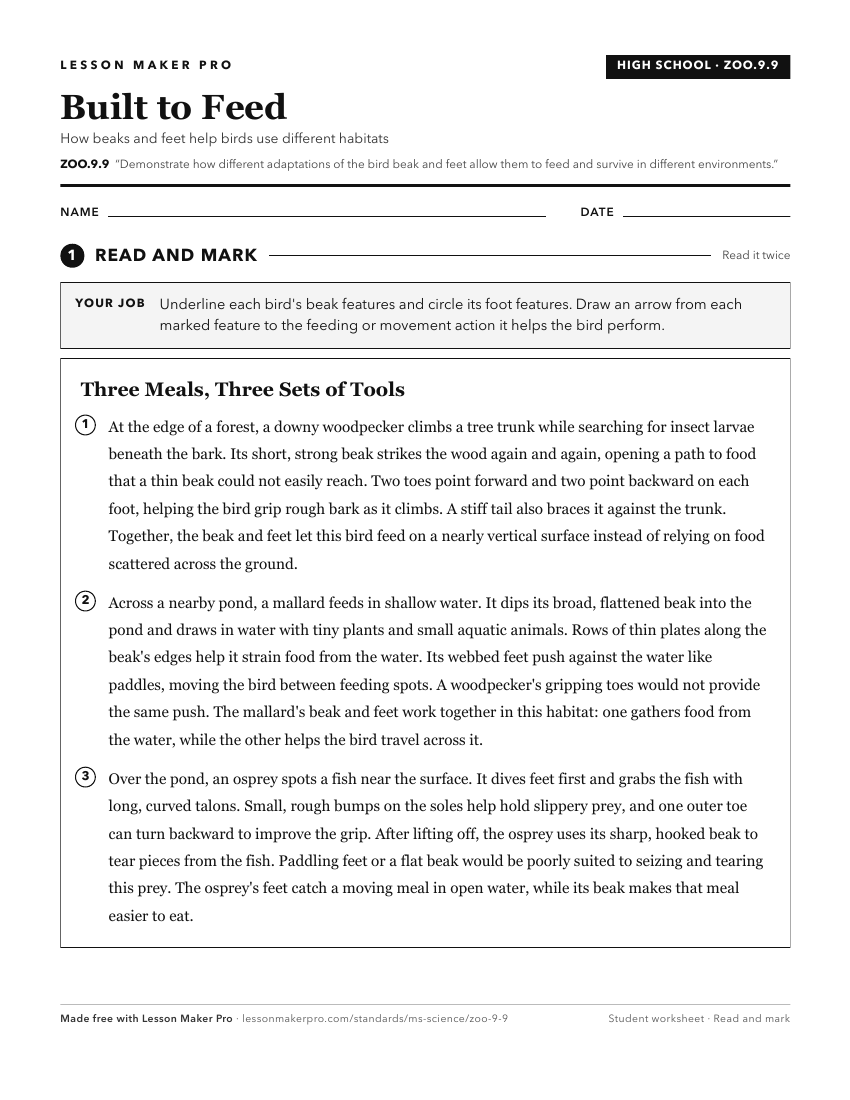
A ready-to-print activity worksheet aligned to ZOO.9.9, with an answer key for the teacher on its own page. No account needed.
PDF, US Letter, prints cleanly in black and white.
Download the worksheetKeep exploring
Related Standards
- ZOO.9.1
Trace the evolutionary history of modern birds beginning with the theropods. Relate how today’s birds have adapted to changing environments.
- L.2.4.1
Evaluate and communicate findings from informational text or other media to describe how plants and animals use adaptations to survive (e.g., ducks use webbed f...
- L.2.4
Students will demonstrate an understanding of the ways animals adapt to their environment in order to survive.
- L.3.1.3
Obtain and communicate examples of physical features or behaviors of vertebrates and invertebrates and how these characteristics help them survive in particular...
Turn this exact standard into a lesson
Grade, subject, topic, and the complete standard are prefilled. Create one free, no account needed.
Also for this standard:Make a WorksheetMake a QuizMake a Sub Lesson