Mississippi Science ZOO.10
Standard Cluster
Students will understand the structure and function of phylum Chordata, class Mammalia, and how they demonstrate the characteristics of living things. Understand the characteristics and behaviors that distinguish mammals from other phyla and use characteristics and behaviors to distinguish the major orders, including primates. Explain how human impact has changed the environments of other organisms. Describe the characteristics of the first true mammal. Distinguish between monotremes, marsupials, and eutherians, and describe the importance and differences in the placenta in marsupials and eutherians. Describe characteristics that make primates unique, including investigating how the center of gravity relates to the evolution of bipedalism. Dissect representative taxa and compare their internal and external anatomy and complexity. Explain how human impacts have changed the environment of aquatic and terrestrial organisms (e.g., habitat destruction, urbanization, and climate change). Enrichment: Use an engineering design process to develop a possible solution to an environmental issue that currently exists in an ecosystem. *
2026 Mississippi College- and Career-Readiness Standards for Science · Phylum Chordata, Class Mammalia
Cluster contents
Standards in This Cluster
ZOO.10 is a cluster heading. These are the individual standards under it.
- ZOO.10.1
Understand the characteristics and behaviors that distinguish mammals from other phyla and use characteristics and behaviors to distinguish the major orders, in...
- ZOO.10.2
Describe the characteristics of the first true mammal.
- ZOO.10.3
Distinguish between monotremes, marsupials, and eutherians, and describe the importance and differences in the placenta in marsupials and eutherians.
- ZOO.10.4
Describe characteristics that make primates unique, including investigating how the center of gravity relates to the evolution of bipedalism.
- ZOO.10.5
Dissect representative taxa and compare their internal and external anatomy and complexity.
- ZOO.10.6
Explain how human impacts have changed the environment of aquatic and terrestrial organisms (e.g., habitat destruction, urbanization, and climate change).
- ZOO.10.7
Enrichment: Use an engineering design process to develop a possible solution to an environmental issue that currently exists in an ecosystem. *
Teacher's field guide
What This Cluster Means
What Students Need to Do
- Students identify chordates by shared body features and mammals by hair, milk production, and other traits. They describe early mammals and compare mammal orders and reproductive groups. They compare anatomy, study how primates balance on two legs, and explain how development and warming change habitats.
What Mastery Looks Like
- A student sorts a platypus, kangaroo, and human by reproductive group and explains how marsupial and eutherian placentas differ. They label shared organs in frog and rat specimens and identify primates by grasping hands and forward-facing eyes. They mark where a standing human's weight is balanced over the feet and predict how a new road could affect a local mammal.
Common Misconceptions
- Students may call every animal with a backbone a mammal or assume all mammals give live birth. They may think marsupials have no placenta, all primates walk upright, or roads affect only animals struck by cars.
How to Assess It
- Show students a platypus, kangaroo, and human. Ask them to name each reproductive group and explain how the two placentas differ.
Lesson moves
Ways to Teach It
Dissect preserved frog and rat specimens, then label their hearts, lungs, and external coverings on a comparison sheet.
Compare side-view human and chimp skeleton drawings; mark where each body balances and explain how foot position affects upright walking.
Sort picture cards of a bat, fox, squirrel, lemur, platypus, and kangaroo by mammal order and reproductive group.
Use a local road expansion map to identify lost habitat, then sketch a wildlife crossing and a way to test its use.
Free download
Printable ZOO.10 Worksheet
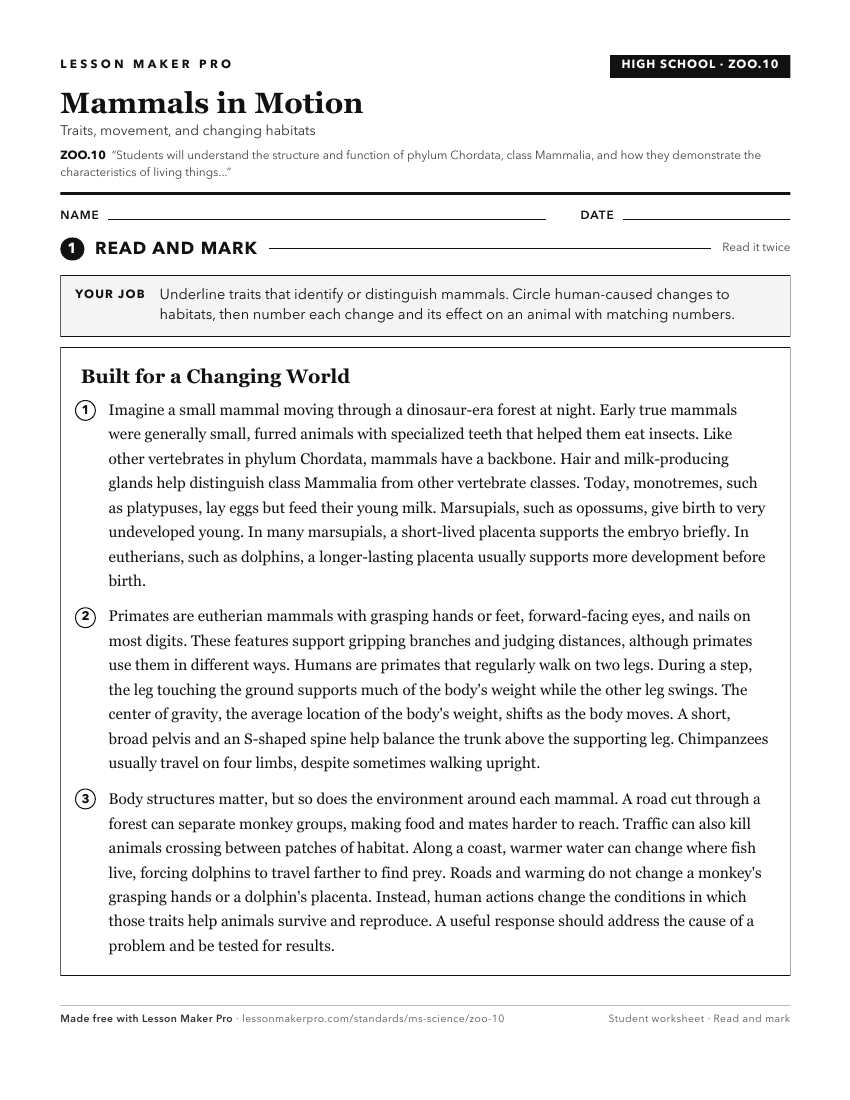
A ready-to-print activity worksheet aligned to ZOO.10, with an answer key for the teacher on its own page. No account needed.
PDF, US Letter, prints cleanly in black and white.
Download the worksheetKeep exploring
Related Standards
- ZOO.7
Students will understand the structure and function of phylum Chordata, classes Chondrichthyes and Osteichthyes, and how they demonstrate the characteristics of...
- ZOO.8
Students will understand the structure and function of phylum Chordata, classes Amphibia and Reptilia, and how they demonstrate the characteristics of living th...
- ZOO.9
Students will understand the structure and function of phylum Chordata, class Aves, and how they demonstrate the characteristics of living things.
- ZOO.6
Students will understand the structure and function of phylum Echinodermata, and how they demonstrate the characteristics of living things.
Turn this cluster into a lesson
Grade, subject, topic, and the complete cluster are prefilled. Create one free, no account needed.
Also for this cluster:Make a WorksheetMake a QuizMake a Sub Lesson