Mississippi Science ZOO.10.4
The Standard
- ZOO.10
- Students will understand the structure and function of phylum Chordata, class Mammalia, and how they demonstrate the characteristics of living things.
Describe characteristics that make primates unique, including investigating how the center of gravity relates to the evolution of bipedalism.
2026 Mississippi College- and Career-Readiness Standards for Science · Phylum Chordata, Class Mammalia
Teacher's field guide
What This Standard Means
What Students Need to Do
- Students identify traits primates share, such as grasping hands and forward-facing eyes. They explain how the human pelvis, spine, and legs help balance body weight during walking on two legs.
What Mastery Looks Like
- A student can identify shared primate traits in human and chimpanzee images. They can explain how the human pelvis and legs help keep body weight over the supporting foot while walking.
Common Misconceptions
- Students may think all primates walk on two legs, or that grasping hands belong only to humans. They may think walking upright only requires standing tall, without changes to the pelvis, spine, and legs.
How to Assess It
- Show human and chimpanzee skeleton diagrams. Ask students to name two shared primate traits and explain how the human pelvis and legs help with balance while walking.
Lesson moves
Ways to Teach It
Have students stand with feet together and lean forward until they must step, then sketch where body weight falls relative to their feet.
Show human and chimpanzee skeleton diagrams and ask, 'Which features do they share, and which help humans walk upright?'
Give pairs feature cards, such as forward-facing eyes and short pelvis; have them sort shared primate traits from human walking adaptations.
Show a photo of someone carrying a heavy backpack and ask why they lean forward to stay balanced.
Free download
Printable ZOO.10.4 Worksheet
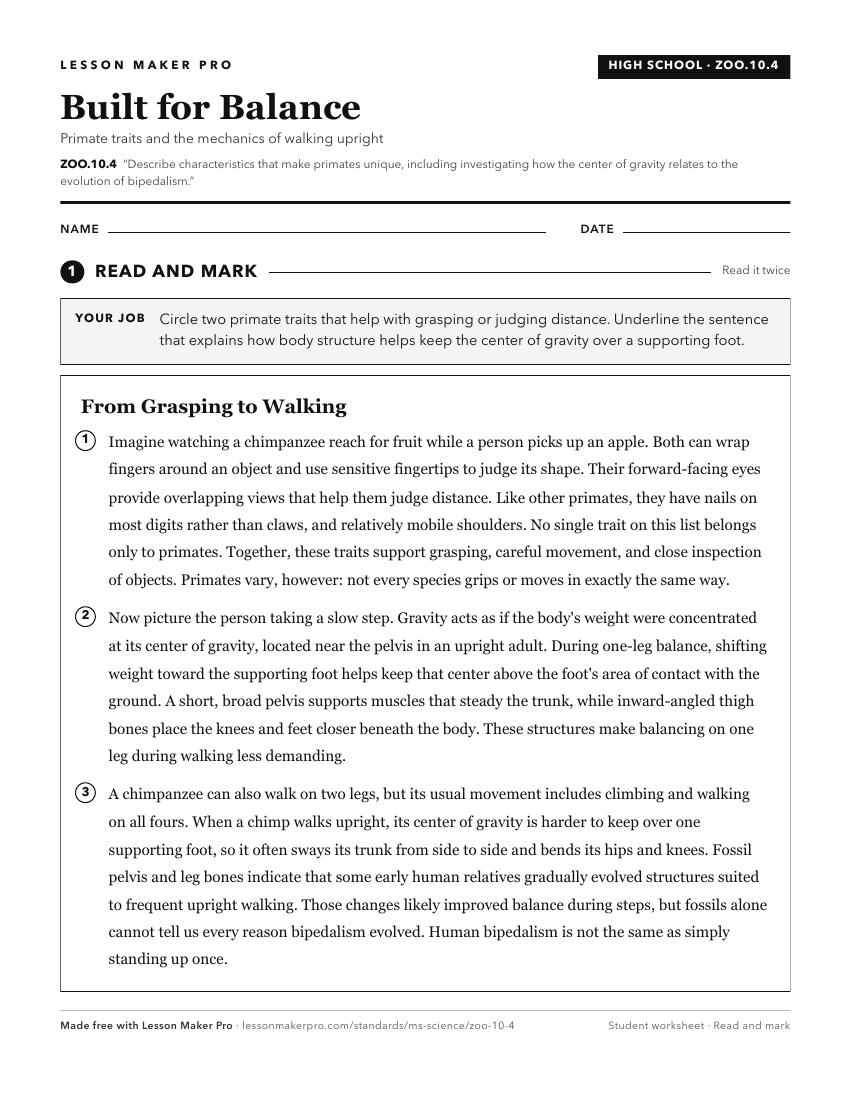
A ready-to-print activity worksheet aligned to ZOO.10.4, with an answer key for the teacher on its own page. No account needed.
PDF, US Letter, prints cleanly in black and white.
Download the worksheetKeep exploring
Related Standards
- L.K.1B.1
Develop and use models to exemplify how animals use their body parts to (a) obtain food and other resources, (b) protect themselves, and (c) move from place to ...
- ZOO.3.6
Examine how the unique characteristics of cephalopods lead to survival.
- BIO.4.2
Evaluate empirical evidence of common ancestry and biological evolution, including comparative anatomy (e.g., homologous structures and embryological similariti...
- ZOO.10.1
Understand the characteristics and behaviors that distinguish mammals from other phyla and use characteristics and behaviors to distinguish the major orders, in...
Turn this exact standard into a lesson
Grade, subject, topic, and the complete standard are prefilled. Create one free, no account needed.
Also for this standard:Make a WorksheetMake a QuizMake a Sub Lesson