Mississippi Science ZOO.3.6
The Standard
- ZOO.3
- Students will understand the structure and function of phylum Mollusca, and how they adapt to their environments.
Examine how the unique characteristics of cephalopods lead to survival.
2026 Mississippi College- and Career-Readiness Standards for Science · Phylum Mollusca
Teacher's field guide
What This Standard Means
What Students Need to Do
- Students connect cephalopod features to survival problems. They explain how color change, ink, jet propulsion, and sharp vision can help these animals avoid predators or catch prey.
What Mastery Looks Like
- A student can explain why an octopus changing color is harder to spot on a reef. They can also explain how a squid escapes by pushing water backward.
Common Misconceptions
- Students may think ink poisons predators, rather than briefly blocking their view. They may also assume every cephalopod makes ink, though nautiluses do not.
How to Assess It
- Exit ticket: A squid spots a pursuing fish. Name two squid traits and explain how each could help it escape.
Lesson moves
Ways to Teach It
Tape an inflated balloon to a straw on a string, release it, and link its motion to a squid pushing water backward.
Ask, “Why might camouflage help an octopus on a reef but be less useful to a squid chased in open water?”
Give pairs feature and scenario cards, such as “ink cloud” and “fish chasing squid”; have them match the cards and explain each pairing.
Play an aquarium clip of an octopus changing color; pause when it blends into rocks and ask what a predator would see.
Free download
Printable ZOO.3.6 Worksheet
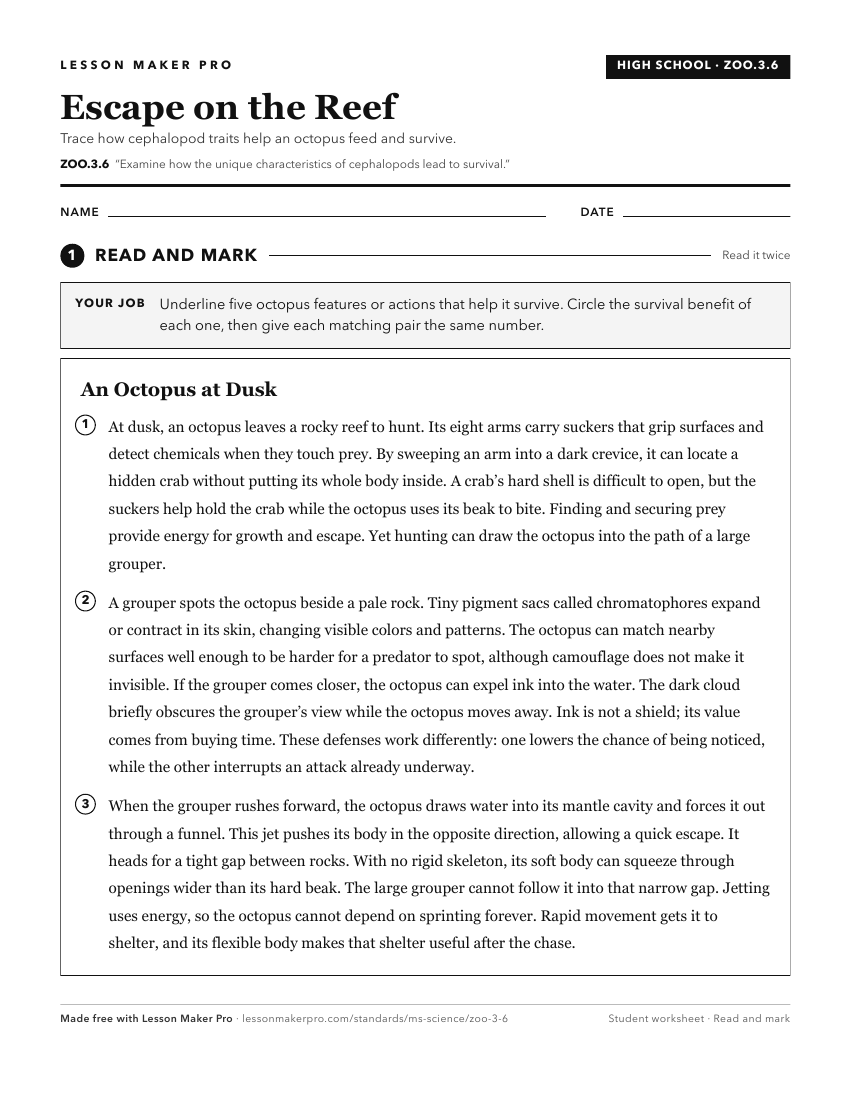
A ready-to-print activity worksheet aligned to ZOO.3.6, with an answer key for the teacher on its own page. No account needed.
PDF, US Letter, prints cleanly in black and white.
Download the worksheetKeep exploring
Related Standards
- ZOO.3.5
Develop a dichotomous key to contrast characteristics of gastropods, bivalves, and cephalopods.
- MAQ.4.2
Recognize representative examples of plants and animals that would be specifically adapted to the aquatic ecosystems and identify adaptations necessary to survi...
- ZOO.3.7
Create a model comparing the anatomy of gastropods, bivalves, and cephalopods.
- ZOO.9.9
Demonstrate how different adaptations of the bird beak and feet allow them to feed and survive in different environments.
Turn this exact standard into a lesson
Grade, subject, topic, and the complete standard are prefilled. Create one free, no account needed.
Also for this standard:Make a WorksheetMake a QuizMake a Sub Lesson