Mississippi Science ZOO.3.5
The Standard
- ZOO.3
- Students will understand the structure and function of phylum Mollusca, and how they adapt to their environments.
Develop a dichotomous key to contrast characteristics of gastropods, bivalves, and cephalopods.
2026 Mississippi College- and Career-Readiness Standards for Science · Phylum Mollusca
Teacher's field guide
What This Standard Means
What Students Need to Do
- Students compare the body features of snails, clams, and squid. They write paired choices that lead a reader to gastropods, bivalves, or cephalopods, then test the key with more animals.
What Mastery Looks Like
- Their key sends a clam to bivalves by its two hinged shell halves. It sends a slug to gastropods by its crawling foot and a nautilus to cephalopods by its arms. Students can spot and fix a wrong route.
Common Misconceptions
- Students may sort by shells alone, which puts shell-less slugs and shelled nautiluses in the wrong groups. They may write choices like “lives in water” that fit more than one group.
How to Assess It
- Show pictures of a clam, slug, squid, and nautilus. Ask students to write a two-choice key for the three groups and trace the nautilus through it.
Lesson moves
Ways to Teach It
Give pairs a hinged clam shell, a snail shell, and photos of a slug, squid, and nautilus to build and test a key.
Write two sentences explaining why a shelled nautilus groups with squid, not snails, using its arms as evidence.
Swap keys with a partner, test each against slug and nautilus pictures, and revise any choice that fails.
Show photos of whole clams and squid from a seafood market, then use the key to label each and cite the visible clues.
Free download
Printable ZOO.3.5 Worksheet
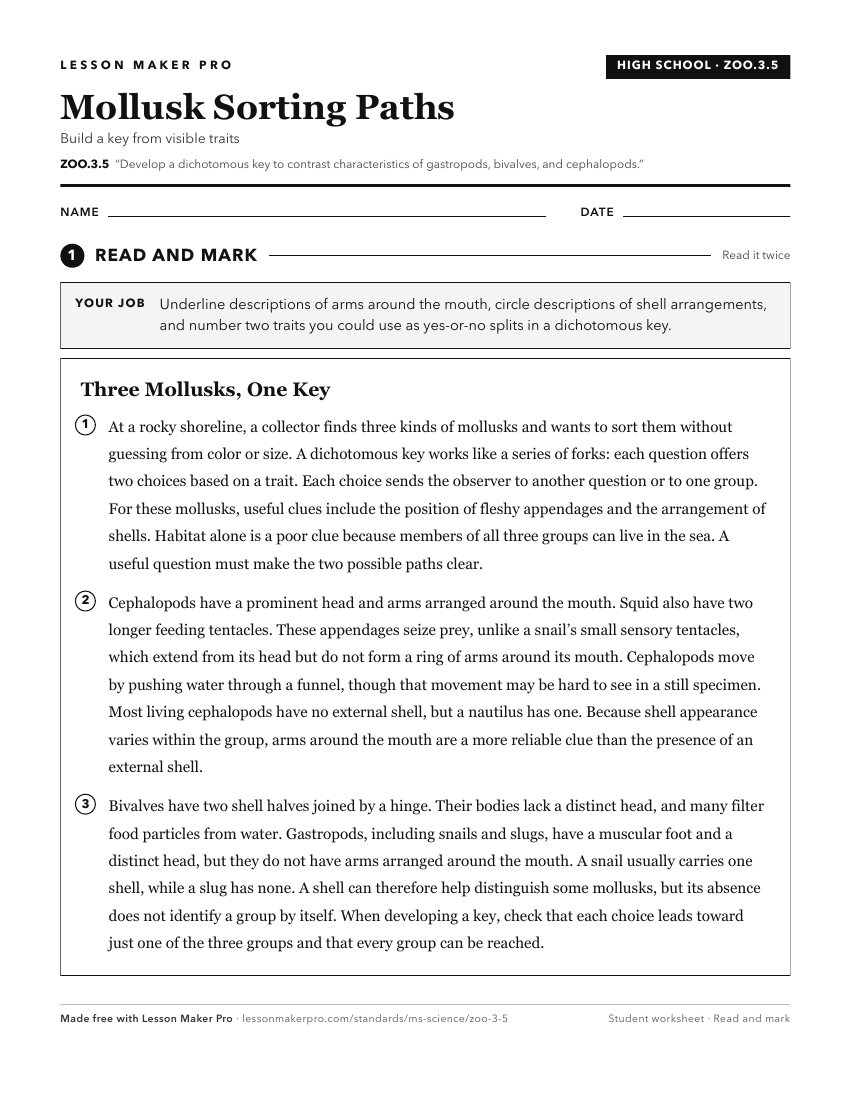
A ready-to-print activity worksheet aligned to ZOO.3.5, with an answer key for the teacher on its own page. No account needed.
PDF, US Letter, prints cleanly in black and white.
Download the worksheetKeep exploring
Related Standards
- MAQ.7.3
Utilize a dichotomous key to identify select aquatic vertebrates.
- ZOO.1.1
Develop and use dichotomous keys to distinguish animals from protists, plants, and fungi.
- ZOO.3.7
Create a model comparing the anatomy of gastropods, bivalves, and cephalopods.
- MAQ.6.3
Develop a dichotomous classification key to be used in the identification of sample aquatic invertebrates.
Turn this exact standard into a lesson
Grade, subject, topic, and the complete standard are prefilled. Create one free, no account needed.
Also for this standard:Make a WorksheetMake a QuizMake a Sub Lesson