Mississippi Science ZOO.3.7
The Standard
- ZOO.3
- Students will understand the structure and function of phylum Mollusca, and how they adapt to their environments.
Create a model comparing the anatomy of gastropods, bivalves, and cephalopods.
2026 Mississippi College- and Career-Readiness Standards for Science · Phylum Mollusca
Teacher's field guide
What This Standard Means
What Students Need to Do
- Build a labeled model of a snail, clam, and squid. Show the mantle, foot, shell, and feeding parts on each, including parts that have changed or are absent.
What Mastery Looks Like
- Their model shows a snail’s crawling foot and radula, a clam’s two shells and digging foot, and a squid’s arms, funnel, and beak. They label the mantle on all three and show the squid’s shell inside its body.
Common Misconceptions
- Students may give the squid an outer shell like a clam’s. They may miss that a squid’s arms and funnel are modified foot parts, or give the clam a radula even though it filter-feeds.
How to Assess It
- On an exit ticket, have students draw a three-panel model of a snail, clam, and squid. Ask them to label each mantle and foot, then mark the shell and feeding structure on each.
Lesson moves
Ways to Teach It
Use paper cutouts to build side-by-side snail, clam, and squid models with sticky labels for the mantle, foot, shell, and feeding parts.
Ask students to write two sentences explaining how a squid’s funnel and a clam’s foot are related, using their models as evidence.
Give teams three anatomy diagrams with misplaced labels for mantle, foot, shell, radula, and beak, then have them correct the labels.
Compare a clam shell and a calamari ring photo, then label the clam’s outer shell and the squid’s mantle on the images.
Free download
Printable ZOO.3.7 Worksheet
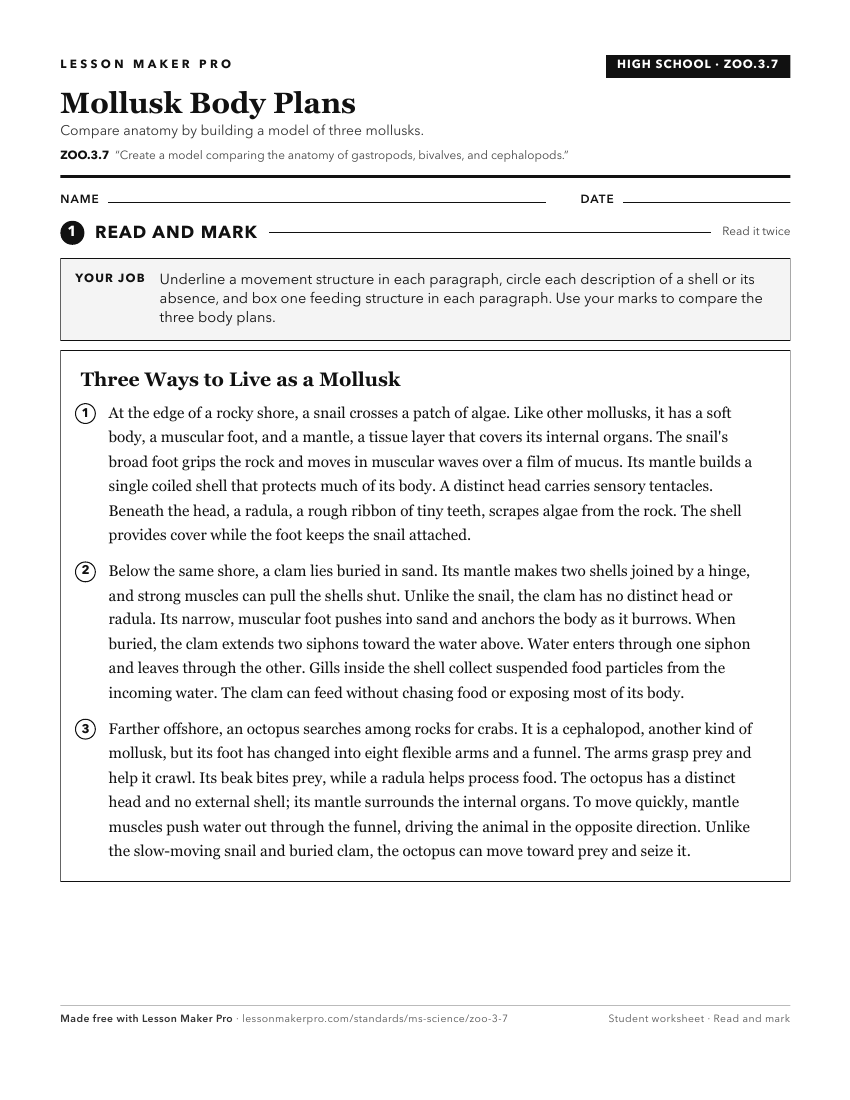
A ready-to-print activity worksheet aligned to ZOO.3.7, with an answer key for the teacher on its own page. No account needed.
PDF, US Letter, prints cleanly in black and white.
Download the worksheetKeep exploring
Related Standards
- MAQ.6.6
Dissect representative taxa (e.g., clam and squid), collect data, compare their internal and external anatomy, analyze, explain, and communicate results.
- ZOO.4.4
Create a model comparing acoelomate, pseudocoelomate, and eucoelomate body plans of Platyhelminthes, Nematoda, and Annelida.
- ZOO.3.5
Develop a dichotomous key to contrast characteristics of gastropods, bivalves, and cephalopods.
- ZOO.2.10
Create a digital or physical model illustrating the anatomy of a cnidarian, citing similarities and differences between polyps and medusas.
Turn this exact standard into a lesson
Grade, subject, topic, and the complete standard are prefilled. Create one free, no account needed.
Also for this standard:Make a WorksheetMake a QuizMake a Sub Lesson