Mississippi Science ZOO.10.3
The Standard
- ZOO.10
- Students will understand the structure and function of phylum Chordata, class Mammalia, and how they demonstrate the characteristics of living things.
Distinguish between monotremes, marsupials, and eutherians, and describe the importance and differences in the placenta in marsupials and eutherians.
2026 Mississippi College- and Career-Readiness Standards for Science · Phylum Chordata, Class Mammalia
Teacher's field guide
What This Standard Means
What Students Need to Do
- Students sort mammals by whether they lay eggs or give birth to live young. They compare how long marsupial and eutherian young develop in the uterus. They explain how the placenta brings nutrients and oxygen to the young and carries waste away.
What Mastery Looks Like
- A student identifies a platypus, opossum, and dog by reproductive group and gives a clue for each choice. They explain that an opossum's yolk-sac placenta works briefly, while a dog's chorioallantoic placenta supports exchange for a longer pregnancy.
Common Misconceptions
- Students may think marsupials have no placenta or that all marsupials have pouches. Some think the placenta only supplies food, missing oxygen and waste exchange. Others assume monotremes give birth to live young because they produce milk.
How to Assess It
- Exit ticket: Name the mammal group for a platypus, kangaroo, and dog, and state which have a placenta. Explain one difference between the kangaroo's and dog's placentas.
Lesson moves
Ways to Teach It
Use two paper circles labeled mother and embryo; move oxygen, nutrient, and waste tokens through a paper placenta between them.
Ask students to write: Why does a kangaroo joey need a pouch after birth? Link your answer to pregnancy length and placenta function.
Play a matching game: pair platypus, opossum, and dog cards with egg laying, short-lived placenta, and longer-lasting placenta cards.
Show photos of a kangaroo joey in a pouch and a newborn calf; have students explain why their development at birth differs.
Free download
Printable ZOO.10.3 Worksheet
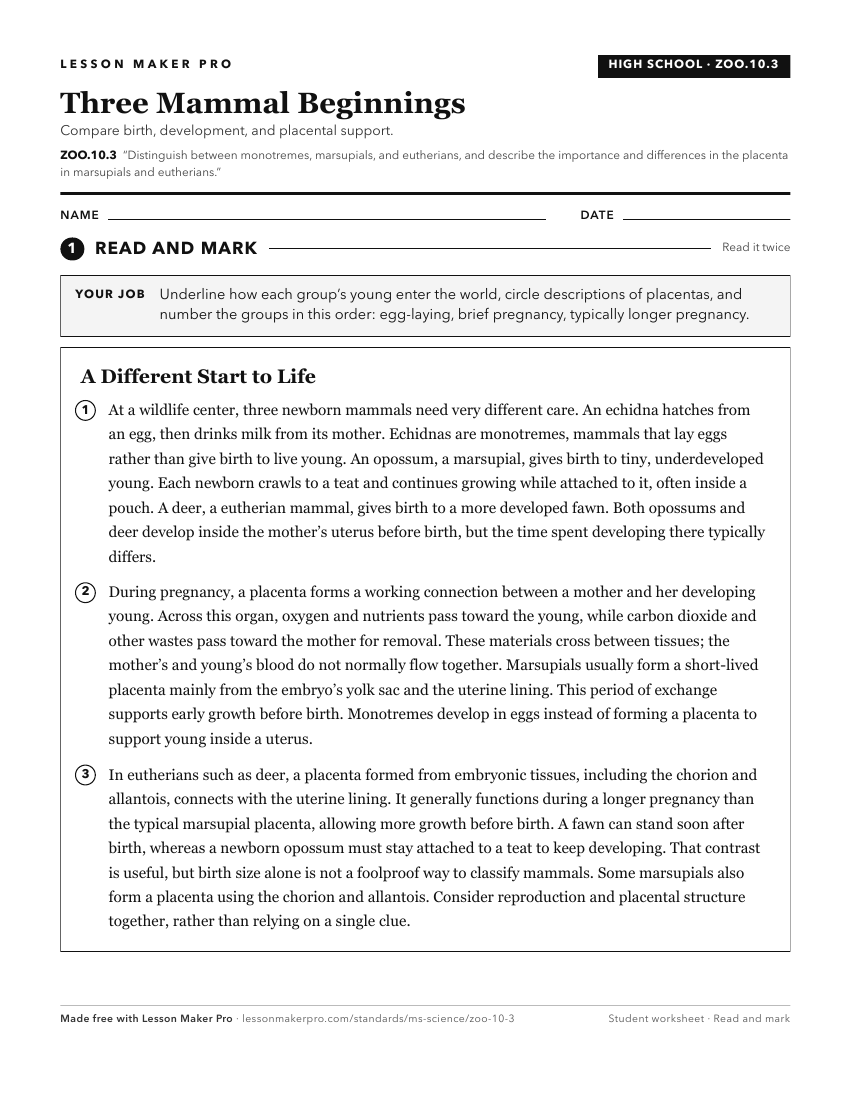
A ready-to-print activity worksheet aligned to ZOO.10.3, with an answer key for the teacher on its own page. No account needed.
PDF, US Letter, prints cleanly in black and white.
Download the worksheetKeep exploring
Related Standards
- MAQ.7.4
Differentiate various life cycles found among animals (e.g., egg, tadpole, and adult stages of the amphibian life cycle; leathery eggs on land in reptiles; hard...
- ZOO.10.1
Understand the characteristics and behaviors that distinguish mammals from other phyla and use characteristics and behaviors to distinguish the major orders, in...
- L.4.2.1
Compare and contrast life cycles of familiar plants and animals.
- L.2.1.3
Compare and contrast physical characteristics that distinguish between classes of vertebrates (i.e., reptiles compared to amphibians).
Turn this exact standard into a lesson
Grade, subject, topic, and the complete standard are prefilled. Create one free, no account needed.
Also for this standard:Make a WorksheetMake a QuizMake a Sub Lesson