Mississippi Science ZOO.7
Standard Cluster
Students will understand the structure and function of phylum Chordata, classes Chondrichthyes and Osteichthyes, and how they demonstrate the characteristics of living things. Students will understand why evolutionary changes lead to the diversity of fish and how they have adapted to the different aquatic environments. Compare and contrast the characteristics of class Chondrichthyes and Osteichthyes. Identify specific fish species and characteristics that differentiate class Chondrichthyes (e.g., sharks, skates, and rays). Describe how the body and jaw design of sharks make them adept predators. Label and describe functions of the anatomical features of bony fish, including internal organs, lateral line system, operculum, swim bladder, and external fins. Research, analyze, and communicate the effects of urbanization and continued expansion by humans on the biodiversity of fish species (e.g., overfishing, and invasive species). Dissect representative taxa and compare their internal and external anatomy and complexity. Enrichment: Use an engineering design process to design a “balloon fish” that has neutral buoyancy (i.e., does not sink or float). Report which materials were used to create the “fish,” and predict which materials should be added to make the “fish” sink and which materials would make the “fish” float. *
2026 Mississippi College- and Career-Readiness Standards for Science · Phylum Chordata, Classes Chondrichthyes and Osteichthyes
Cluster contents
Standards in This Cluster
ZOO.7 is a cluster heading. These are the individual standards under it.
- ZOO.7.1
Students will understand why evolutionary changes lead to the diversity of fish and how they have adapted to the different aquatic environments.
- ZOO.7.2
Compare and contrast the characteristics of class Chondrichthyes and Osteichthyes.
- ZOO.7.3
Identify specific fish species and characteristics that differentiate class Chondrichthyes (e.g., sharks, skates, and rays).
- ZOO.7.4
Describe how the body and jaw design of sharks make them adept predators.
- ZOO.7.5
Label and describe functions of the anatomical features of bony fish, including internal organs, lateral line system, operculum, swim bladder, and external fins...
- ZOO.7.6
Research, analyze, and communicate the effects of urbanization and continued expansion by humans on the biodiversity of fish species (e.g., overfishing, and inv...
- ZOO.7.7
Dissect representative taxa and compare their internal and external anatomy and complexity.
- ZOO.7.8
Enrichment: Use an engineering design process to design a “balloon fish” that has neutral buoyancy (i.e., does not sink or float). Report which materials were u...
Teacher's field guide
What This Cluster Means
What Students Need to Do
- Students compare sharks, skates, and rays with bony fish by looking at skeletons, gills, and buoyancy. They label fish organs and explain how fins, jaws, and senses help fish survive. They explain how inherited traits suit different waters and how human activity changes fish diversity.
What Mastery Looks Like
- A student labels a perch's operculum, swim bladder, lateral line, fins, and digestive organs, then explains what each does. They sort sharks, skates, rays, and perch by skeleton and gill structure, and explain how a shark's body and jaws help it catch prey. They use a fish count to explain a possible effect of runoff or overfishing.
Common Misconceptions
- Students may say sharks are not fish because they lack bones, or assume every fish has a swim bladder. They may mistake the lateral line for a fin or call the operculum a gill. Some blame fish declines only on predators, missing runoff, invasive species, and overfishing.
How to Assess It
- Show students sketches of a shark and a perch. Ask them to name two differences, label the perch's operculum and swim bladder, and explain how one shark feature helps it hunt.
Lesson moves
Ways to Teach It
Build a balloon fish with tape and paper clips, then adjust its mass in a tub until it hovers without sinking or floating.
Compare a shark and perch sketch; ask students which body and jaw features help each catch prey in its habitat.
Give pairs photo cards of a shark, skate, ray, and perch; have them sort cartilage versus bone and cite gill and body clues.
Show a stream count with six fish species before construction and three after; ask students how runoff might explain the change.
Free download
Printable ZOO.7 Worksheet
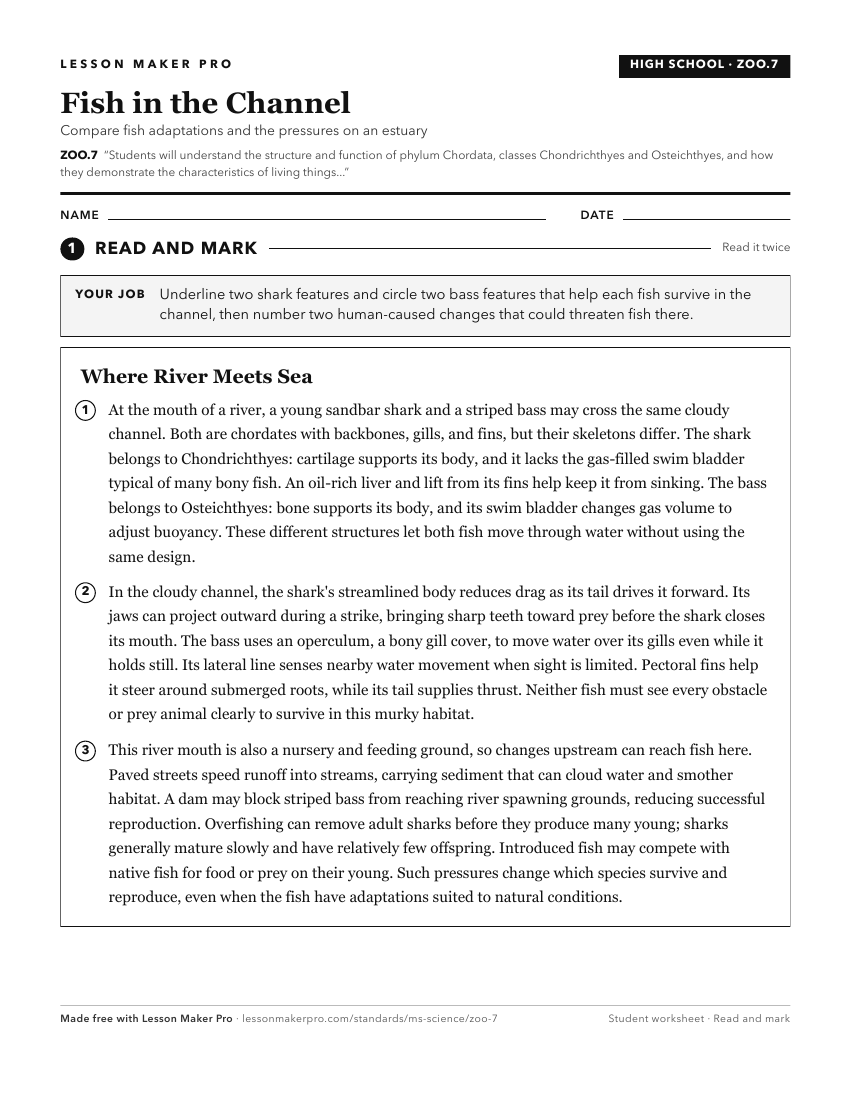
A ready-to-print activity worksheet aligned to ZOO.7, with an answer key for the teacher on its own page. No account needed.
PDF, US Letter, prints cleanly in black and white.
Download the worksheetKeep exploring
Related Standards
- ZOO.10
Students will understand the structure and function of phylum Chordata, class Mammalia, and how they demonstrate the characteristics of living things.
- ZOO.8
Students will understand the structure and function of phylum Chordata, classes Amphibia and Reptilia, and how they demonstrate the characteristics of living th...
- ZOO.9
Students will understand the structure and function of phylum Chordata, class Aves, and how they demonstrate the characteristics of living things.
- ZOO.6
Students will understand the structure and function of phylum Echinodermata, and how they demonstrate the characteristics of living things.
Turn this cluster into a lesson
Grade, subject, topic, and the complete cluster are prefilled. Create one free, no account needed.
Also for this cluster:Make a WorksheetMake a QuizMake a Sub Lesson