Mississippi Science ZOO.7.3
The Standard
- ZOO.7
- Students will understand the structure and function of phylum Chordata, classes Chondrichthyes and Osteichthyes, and how they demonstrate the characteristics of living things.
Identify specific fish species and characteristics that differentiate class Chondrichthyes (e.g., sharks, skates, and rays).
2026 Mississippi College- and Career-Readiness Standards for Science · Phylum Chordata, Classes Chondrichthyes and Osteichthyes
Teacher's field guide
What This Standard Means
What Students Need to Do
- Students use photos and a field guide to identify fish such as whale sharks, spotted eagle rays, and little skates. They tell these fish from bony fish by checking gill openings and skeleton type.
What Mastery Looks Like
- A student can identify a whale shark by its white spot pattern and a spotted eagle ray by its wing-shaped fins. They can point to exposed gill slits and explain that both have skeletons made of cartilage.
Common Misconceptions
- Students may call a ray a bony fish because it looks unlike a shark. They may mistake the openings behind a ray's eyes for gill slits, which are on its underside.
How to Assess It
- Show photos of a whale shark, the underside of a spotted eagle ray, and a yellow perch. Give students a name bank, then ask them to name each fish, circle the cartilaginous fish, and mark the gill slits or gill cover.
Lesson moves
Ways to Teach It
Give pairs clay and photo cards to model a whale shark, spotted eagle ray, and yellow perch, marking gill slits or covers.
Ask: Why does a spotted eagle ray belong with sharks rather than yellow perch? Require two clues from photos and a field guide.
Play a photo ID relay with whale shark, spotted eagle ray, little skate, and yellow perch cards; each student names one and cites a field mark.
Use aquarium species pages to write visitor labels for a whale shark and spotted eagle ray, naming visible marks and gill openings.
Free download
Printable ZOO.7.3 Worksheet
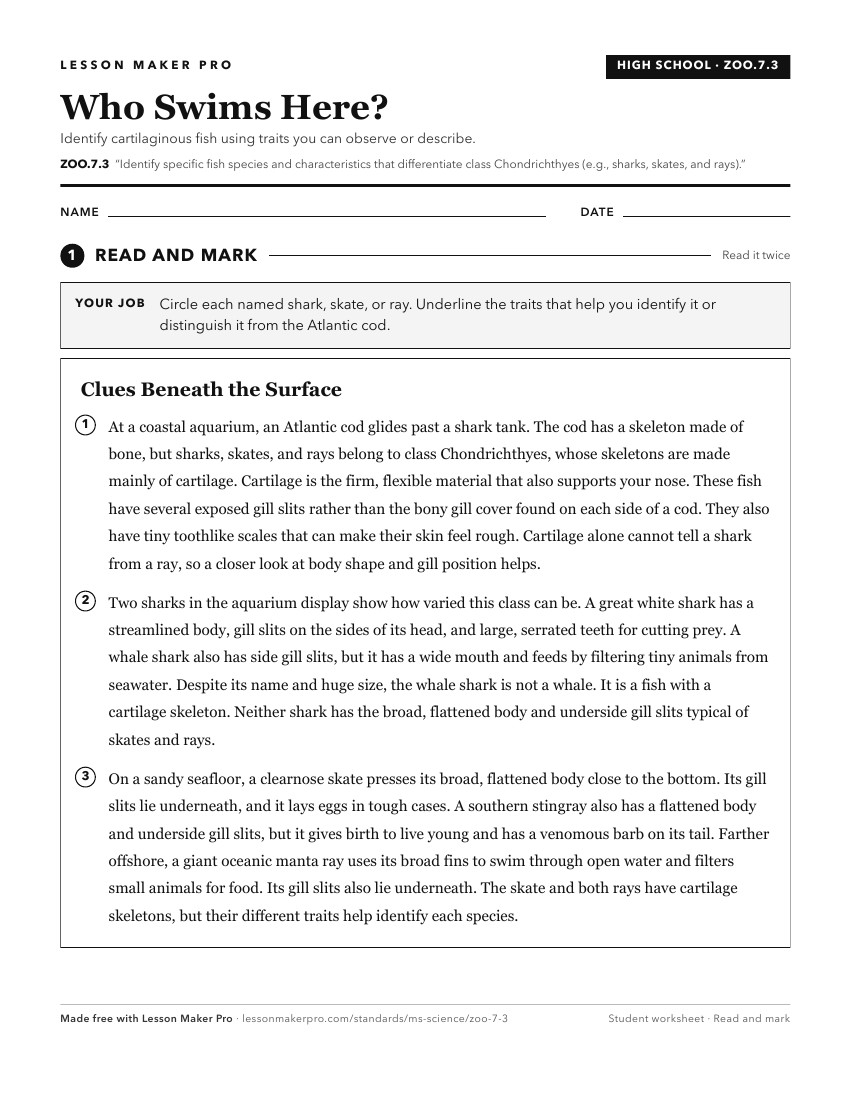
A ready-to-print activity worksheet aligned to ZOO.7.3, with an answer key for the teacher on its own page. No account needed.
PDF, US Letter, prints cleanly in black and white.
Download the worksheetKeep exploring
Related Standards
- MAQ.7.1
Characterize aquatic representatives of the following taxa: Hemichordata, Urochordata, Cephalochordata, and Vertebrata (including Agnatha, Chondrichthyes, Ostei...
- ZOO.7
Students will understand the structure and function of phylum Chordata, classes Chondrichthyes and Osteichthyes, and how they demonstrate the characteristics of...
- ZOO.7.2
Compare and contrast the characteristics of class Chondrichthyes and Osteichthyes.
- MAQ.7.5
Dissect representative taxa (e.g., shark, fish); collect data; compare their internal and external anatomy; and analyze, explain, and communicate results.
Turn this exact standard into a lesson
Grade, subject, topic, and the complete standard are prefilled. Create one free, no account needed.
Also for this standard:Make a WorksheetMake a QuizMake a Sub Lesson