Mississippi Science ZOO.4.5
The Standard
- ZOO.4
- Students will describe the evolution of structure and function of phylum Platyhelminthes, phylum Nematoda, and phylum Annelida.
Describe the evolutionary importance of the segmented body plans of annelids.
2026 Mississippi College- and Career-Readiness Standards for Science · Phyla Platyhelminthes, Nematoda, and Annelida
Teacher's field guide
What This Standard Means
What Students Need to Do
- Students identify the repeated sections of an annelid and explain how those sections help it crawl and burrow. They explain how some sections can take on different jobs, giving annelids more ways to live.
What Mastery Looks Like
- A student can explain how an earthworm anchors some sections with bristles while muscles shorten others to move through soil. They can identify the clitellum as a group of sections with a job in reproduction.
Common Misconceptions
- Some students think an earthworm's rings are only surface markings, not parts with repeated muscles and organs. Others think all worms have segments. They may assume insects descended from earthworms because both have segmented bodies.
How to Assess It
- Show an earthworm diagram and ask: "How do its segments help it burrow, and what job does its clitellum do?"
Lesson moves
Ways to Teach It
Have pairs stuff a sock with three small sponges, mark segment boundaries, and squeeze one section at a time to model separate muscle action.
Ask students to write how an earthworm's bristles and moving sections help it burrow differently from a roundworm.
Give pairs earthworm, bristle worm, roundworm, and planarian picture cards to sort by segmentation and explain their choices.
Show a photo of earthworm tunnels in garden soil and ask how burrowing earthworms make channels for rainwater and roots.
Free download
Printable ZOO.4.5 Worksheet
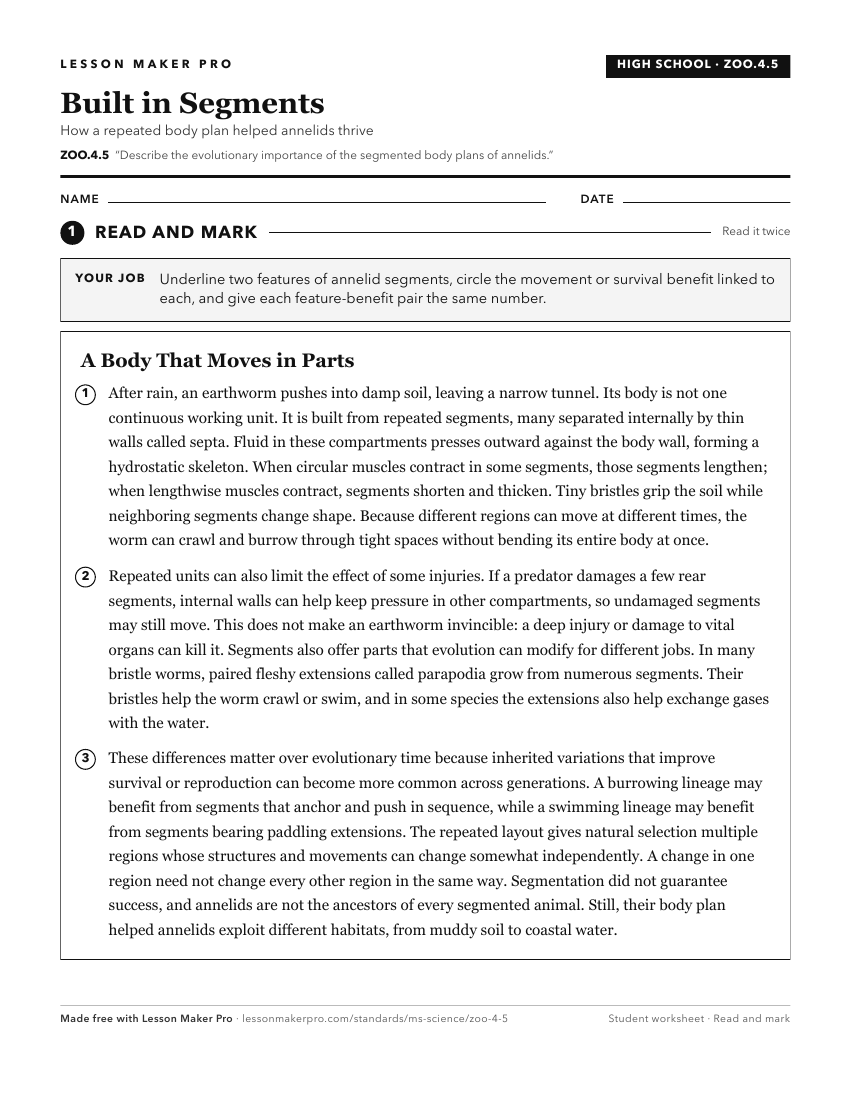
A ready-to-print activity worksheet aligned to ZOO.4.5, with an answer key for the teacher on its own page. No account needed.
PDF, US Letter, prints cleanly in black and white.
Download the worksheetKeep exploring
Related Standards
- ZOO.3.1
Considering the diversity of mollusks, explain how they all share a common body plan (i.e., mantle, visceral mass, and foot).
- ZOO.4
Students will describe the evolution of structure and function of phylum Platyhelminthes, phylum Nematoda, and phylum Annelida.
- ZOO.5.1
Describe the evolutionary advantages of segmented bodies, hard exoskeletons, and jointed appendages to arthropods and how they contribute to arthropods being th...
- ZOO.4.4
Create a model comparing acoelomate, pseudocoelomate, and eucoelomate body plans of Platyhelminthes, Nematoda, and Annelida.
Turn this exact standard into a lesson
Grade, subject, topic, and the complete standard are prefilled. Create one free, no account needed.
Also for this standard:Make a WorksheetMake a QuizMake a Sub Lesson