Mississippi Science ZOO.3.1
The Standard
- ZOO.3
- Students will understand the structure and function of phylum Mollusca, and how they adapt to their environments.
Considering the diversity of mollusks, explain how they all share a common body plan (i.e., mantle, visceral mass, and foot).
2026 Mississippi College- and Career-Readiness Standards for Science · Phylum Mollusca
Teacher's field guide
What This Standard Means
What Students Need to Do
- Students find the same main body parts in snails, clams, and squid. They explain how the foot changes shape for crawling, digging, or grasping, while the mantle covers the internal organs.
What Mastery Looks Like
- A student can label the mantle, visceral mass, and foot on diagrams of a snail, clam, and squid. They can explain that a squid's arms and funnel form from its foot.
Common Misconceptions
- Some students think every mollusk has a shell, so they leave out squid. Others think a squid has no foot or mistake the mantle for the shell itself.
How to Assess It
- Give students unlabeled clam and squid diagrams. Ask them to label the mantle, visceral mass, and foot, then write one sentence about how the feet differ.
Lesson moves
Ways to Teach It
Give pairs clay and snail, clam, and squid photos; have them model each animal and label its mantle, visceral mass, and foot.
Ask students to write why a squid and a clam belong in the same animal group despite looking so different.
Hand out snail, clam, and squid diagrams with one part highlighted; students sort them into mantle, visceral mass, or foot piles.
Show photos of a seafood-counter clam and squid; students mark each foot and explain what it helps the animal do.
Free download
Printable ZOO.3.1 Worksheet
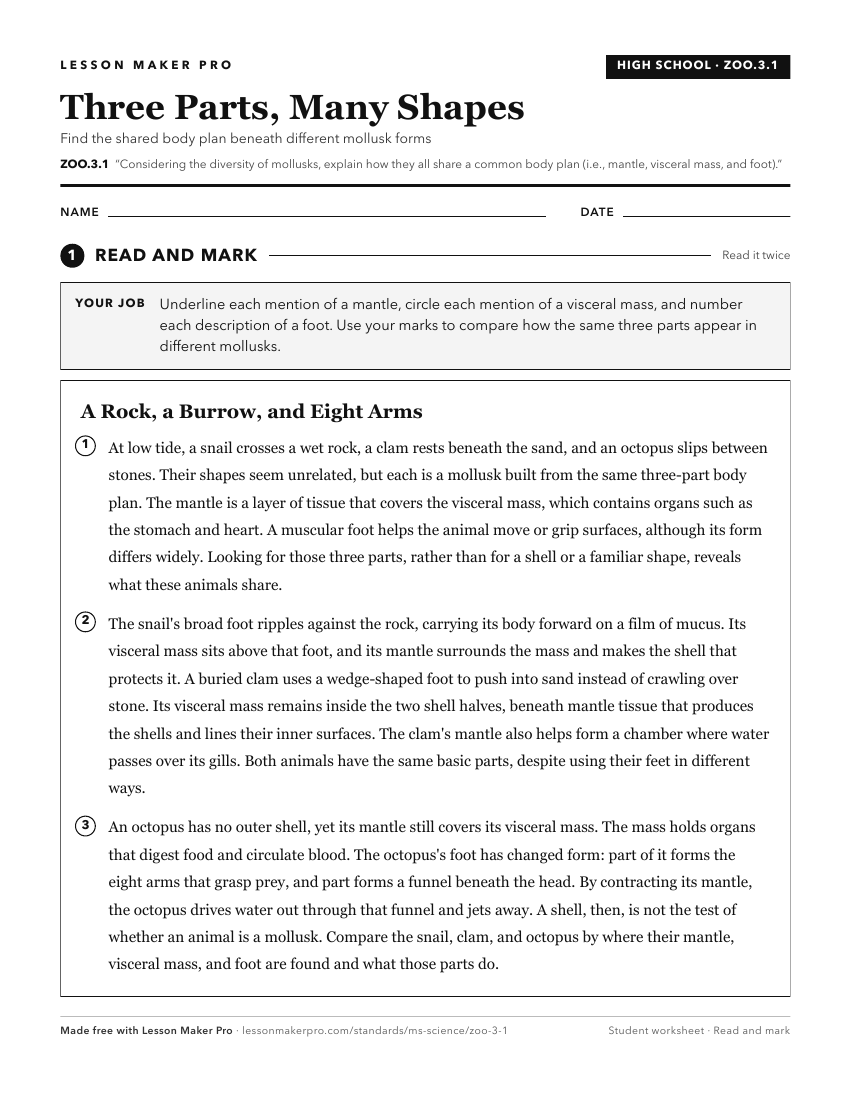
A ready-to-print activity worksheet aligned to ZOO.3.1, with an answer key for the teacher on its own page. No account needed.
PDF, US Letter, prints cleanly in black and white.
Download the worksheetKeep exploring
Related Standards
- ZOO.3
Students will understand the structure and function of phylum Mollusca, and how they adapt to their environments.
- MAQ.6.4
Compare and contrast major body plans (e.g., asymmetry, radial, bilateral symmetry, acoelomate, pseudocoelomate, and eucoelomate).
- ZOO.3.2
Describe why mollusks are classified as eucoelomates.
- ZOO.3.7
Create a model comparing the anatomy of gastropods, bivalves, and cephalopods.
Turn this exact standard into a lesson
Grade, subject, topic, and the complete standard are prefilled. Create one free, no account needed.
Also for this standard:Make a WorksheetMake a QuizMake a Sub Lesson