Mississippi Science ZOO.3
Standard Cluster
Students will understand the structure and function of phylum Mollusca, and how they adapt to their environments. Considering the diversity of mollusks, explain how they all share a common body plan (i.e., mantle, visceral mass, and foot). Describe why mollusks are classified as eucoelomates. Explain how the mantle is used in forming the shell. Describe how the radula is used in feeding. Develop a dichotomous key to contrast characteristics of gastropods, bivalves, and cephalopods. Examine how the unique characteristics of cephalopods lead to survival. Create a model comparing the anatomy of gastropods, bivalves, and cephalopods. Enrichment: Use an engineering design process to model the jet propulsion utilized by cephalopods in mechanical design of fluid systems (e.g., improving hydraulic systems). *
2026 Mississippi College- and Career-Readiness Standards for Science · Phylum Mollusca
Cluster contents
Standards in This Cluster
ZOO.3 is a cluster heading. These are the individual standards under it.
- ZOO.3.1
Considering the diversity of mollusks, explain how they all share a common body plan (i.e., mantle, visceral mass, and foot).
- ZOO.3.2
Describe why mollusks are classified as eucoelomates.
- ZOO.3.3
Explain how the mantle is used in forming the shell.
- ZOO.3.4
Describe how the radula is used in feeding.
- ZOO.3.5
Develop a dichotomous key to contrast characteristics of gastropods, bivalves, and cephalopods.
- ZOO.3.6
Examine how the unique characteristics of cephalopods lead to survival.
- ZOO.3.7
Create a model comparing the anatomy of gastropods, bivalves, and cephalopods.
- ZOO.3.8
Enrichment: Use an engineering design process to model the jet propulsion utilized by cephalopods in mechanical design of fluid systems (e.g., improving hydraul...
Teacher's field guide
What This Cluster Means
What Students Need to Do
- Students find the mantle, visceral mass, and foot in snails, clams, and squid. They explain how the mantle makes a shell, how a radula helps with feeding, and why mollusks have a true coelom. They compare the three groups using a two-choice key.
What Mastery Looks Like
- A student can label the shared body parts on diagrams of a snail, clam, and squid, including the squid’s modified foot. They can explain that the mantle secretes shell material, bivalves lack a radula, and the small true coelom has a lining from mesoderm. Their key correctly separates the three groups, and they can link a squid’s siphon to movement.
Common Misconceptions
- Students may call the shell the mantle, rather than the hard material made by mantle tissue. They may think clams have a radula because many other mollusks do. They may leave slugs out of the group because slugs lack an external shell.
How to Assess It
- Give students pictures of a snail, clam, and squid. Ask them to mark each foot, write a two-step key to identify the animals, and state what makes their coelom a true coelom.
Lesson moves
Ways to Teach It
Give pairs paper outlines of a snail, clam, and squid, then have them add and label the mantle, visceral mass, and foot.
Ask students to write how a clam and squid can share a body plan when one digs and the other swims.
Give groups nine animal photo cards and have them write a two-choice key that identifies each as a gastropod, bivalve, or cephalopod.
Have students squirt water through wide and narrow straws into a tray, then connect the jets to a squid’s siphon.
Free download
Printable ZOO.3 Worksheet
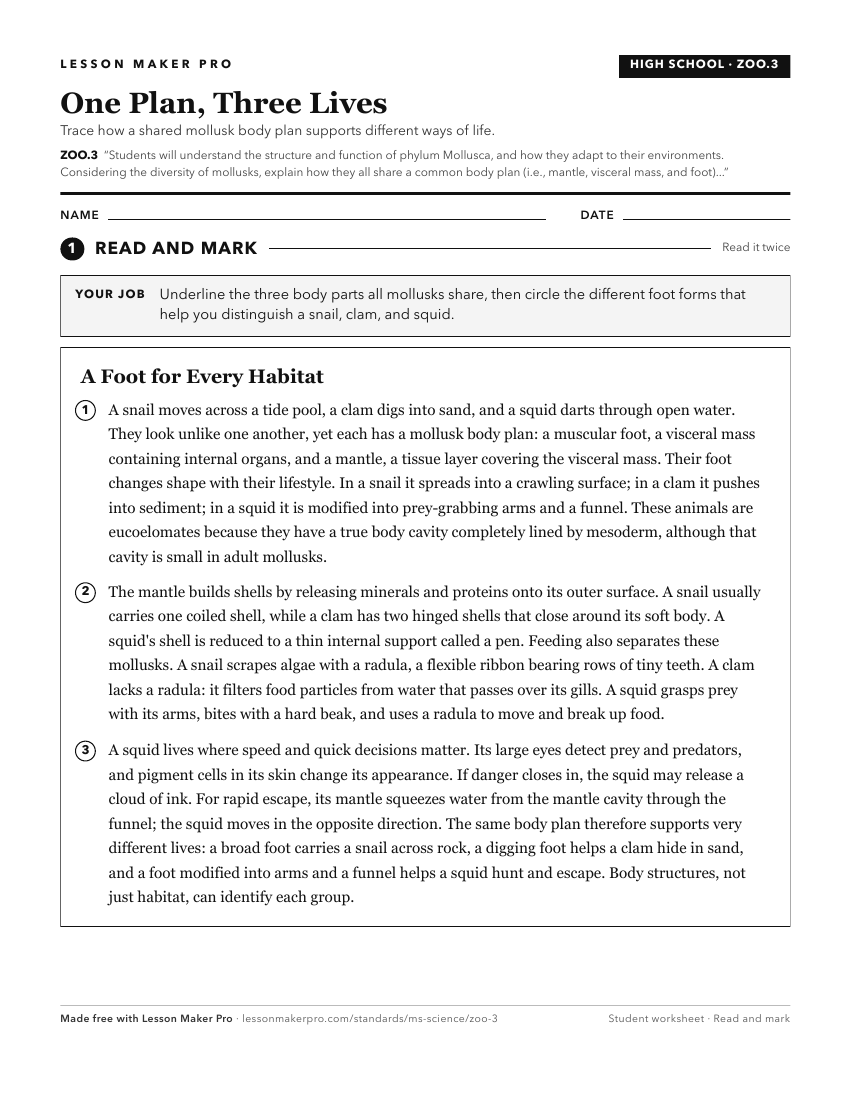
A ready-to-print activity worksheet aligned to ZOO.3, with an answer key for the teacher on its own page. No account needed.
PDF, US Letter, prints cleanly in black and white.
Download the worksheetKeep exploring
Related Standards
- ZOO.10
Students will understand the structure and function of phylum Chordata, class Mammalia, and how they demonstrate the characteristics of living things.
- ZOO.2
Students will understand the structure and function of phylum Porifera and phylum Cnidaria and how each adapts to their environments.
- ZOO.6
Students will understand the structure and function of phylum Echinodermata, and how they demonstrate the characteristics of living things.
- ZOO.5
Students will understand the basic structure and function of phylum Arthropoda, and how they demonstrate the characteristics of living things.
Turn this cluster into a lesson
Grade, subject, topic, and the complete cluster are prefilled. Create one free, no account needed.
Also for this cluster:Make a WorksheetMake a QuizMake a Sub Lesson