Mississippi Science ZOO.3.2
The Standard
- ZOO.3
- Students will understand the structure and function of phylum Mollusca, and how they adapt to their environments.
Describe why mollusks are classified as eucoelomates.
2026 Mississippi College- and Career-Readiness Standards for Science · Phylum Mollusca
Teacher's field guide
What This Standard Means
What Students Need to Do
- Students identify a true coelom as a body cavity lined by mesoderm. They explain that mollusks have a small coelom around the heart, even though much of their internal space is a hemocoel.
What Mastery Looks Like
- Given a mollusk anatomy diagram, a student points to the cavity around the heart and identifies its mesoderm lining. They explain why the larger hemocoel does not count as a true coelom.
Common Misconceptions
- Students may mistake the space inside a shell for a coelom. They may also think the hemocoel is a true coelom, or that a small coelom does not count.
How to Assess It
- Give students a labeled clam diagram. Ask: “Which space shows that this animal is a eucoelomate? Name the tissue that lines it.”
Lesson moves
Ways to Teach It
Build a clay mollusk cross-section, using one color for the mesoderm lining around the heart and another for the hemocoel.
Ask students to write two sentences explaining why a snail qualifies as a eucoelomate despite having a large hemocoel.
Sort cavity diagrams into true coelom and not true coelom piles, then check each choice for a complete mesoderm lining.
Use a labeled clam dissection photo to find the heart's surrounding cavity and explain how a zoologist would classify the clam.
Free download
Printable ZOO.3.2 Worksheet
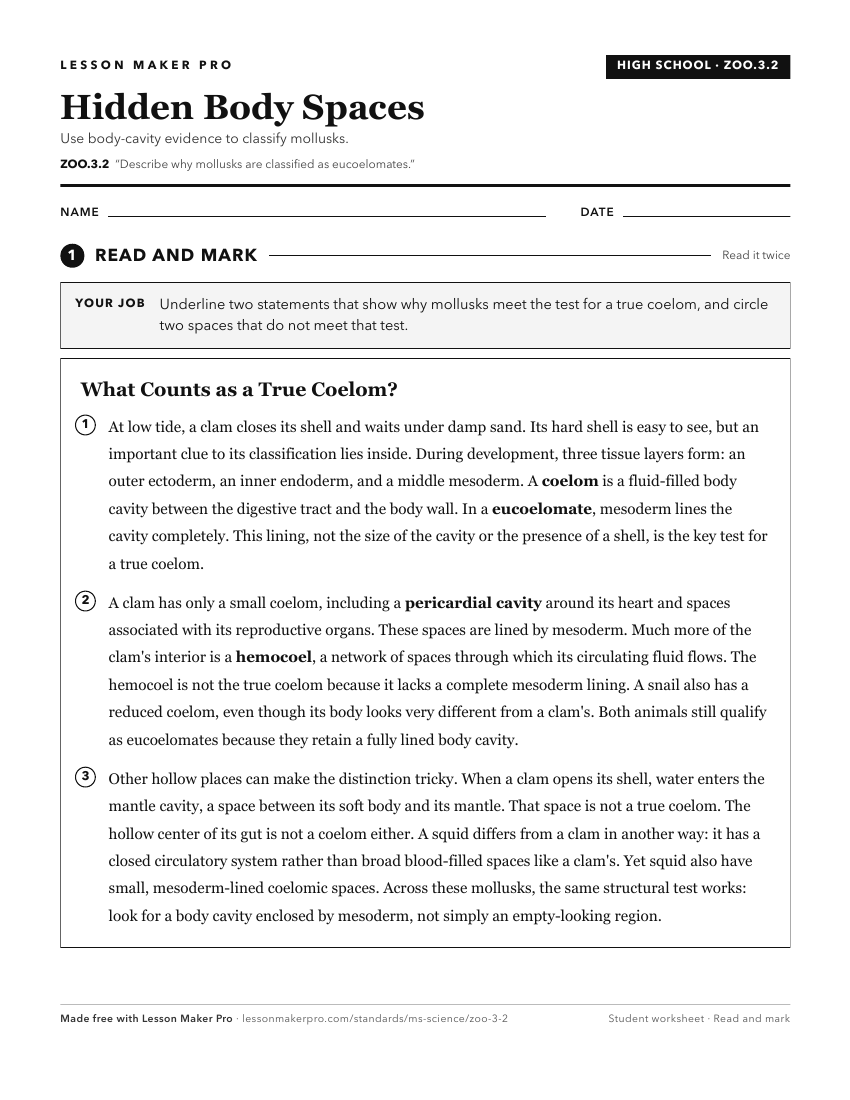
A ready-to-print activity worksheet aligned to ZOO.3.2, with an answer key for the teacher on its own page. No account needed.
PDF, US Letter, prints cleanly in black and white.
Download the worksheetKeep exploring
Related Standards
- ZOO.3
Students will understand the structure and function of phylum Mollusca, and how they adapt to their environments.
- ZOO.3.1
Considering the diversity of mollusks, explain how they all share a common body plan (i.e., mantle, visceral mass, and foot).
- ZOO.4.5
Describe the evolutionary importance of the segmented body plans of annelids.
- ZOO.6
Students will understand the structure and function of phylum Echinodermata, and how they demonstrate the characteristics of living things.
Turn this exact standard into a lesson
Grade, subject, topic, and the complete standard are prefilled. Create one free, no account needed.
Also for this standard:Make a WorksheetMake a QuizMake a Sub Lesson