Mississippi Science ZOO.5.8
The Standard
- ZOO.5
- Students will understand the basic structure and function of phylum Arthropoda, and how they demonstrate the characteristics of living things.
Explain the importance of eusociality in insects, such as ants, bees, and termites.
2026 Mississippi College- and Career-Readiness Standards for Science · Phylum Arthropoda
Teacher's field guide
What This Standard Means
What Students Need to Do
- Students describe how colony members of different generations split reproduction and other jobs. They explain how caring for young, gathering food, and defending the nest help more offspring survive.
What Mastery Looks Like
- A student can label reproductive adults and workers on a termite colony diagram and describe their jobs. They can explain how workers from older generations help raise the young.
Common Misconceptions
- Students may think the queen gives orders to workers or that every bee species lives in a hive. They may call any insect group eusocial, even when its members do not share care of young or divide reproductive jobs.
How to Assess It
- Exit ticket: A termite queen lays eggs, and workers feed the young. Name two traits that make this colony eusocial, then explain how worker care helps the colony survive.
Lesson moves
Ways to Teach It
Give groups queen, worker, larva, food, and nest cards; have them build a colony diagram with arrows showing who feeds larvae.
Ask students to write: What happens to a termite colony if workers stop feeding young? Explain the effect on future colony size.
Run a colony role relay: teams match six task cards to queens, workers, or soldiers, then explain how each task helps offspring survive.
Show a photo of honeybees on a garden flower; have students trace how collected pollen feeds larvae while the visit pollinates plants.
Free download
Printable ZOO.5.8 Worksheet
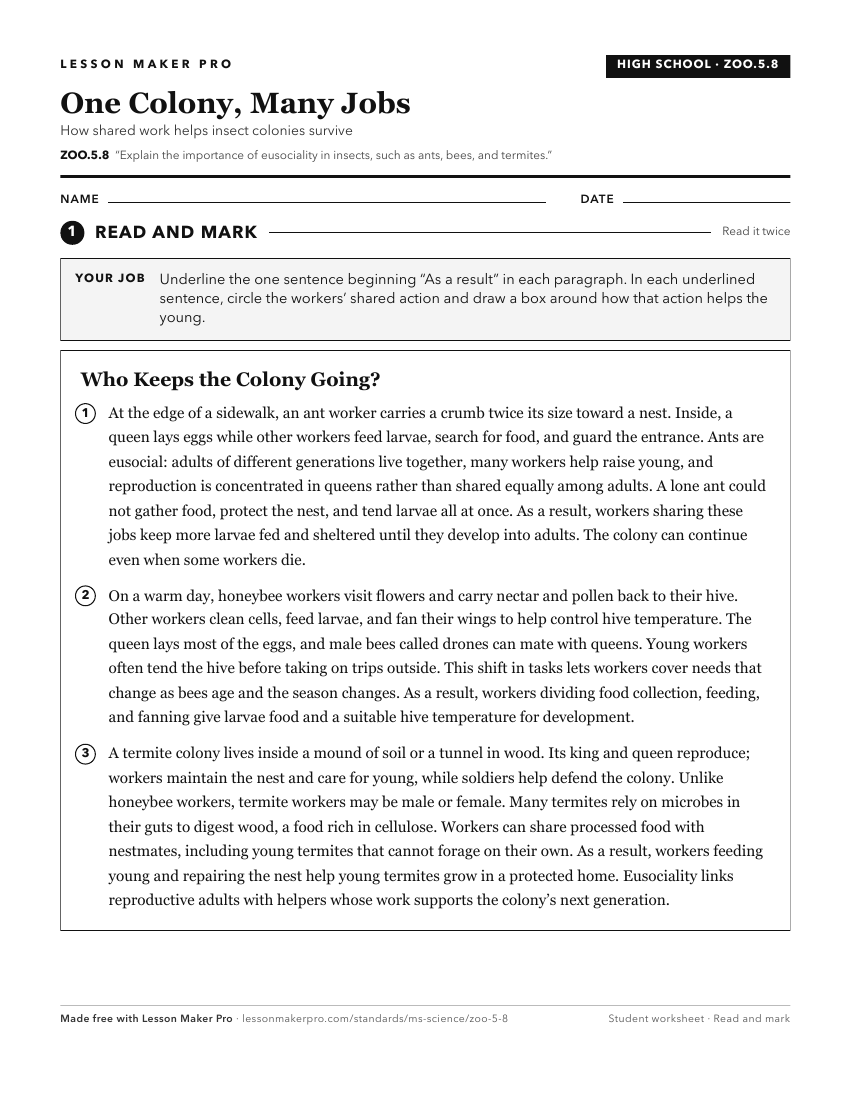
A ready-to-print activity worksheet aligned to ZOO.5.8, with an answer key for the teacher on its own page. No account needed.
PDF, US Letter, prints cleanly in black and white.
Download the worksheetKeep exploring
Related Standards
- ZOO.5.1
Describe the evolutionary advantages of segmented bodies, hard exoskeletons, and jointed appendages to arthropods and how they contribute to arthropods being th...
- L.1.3B.1
Identify the body parts of a pollinating insect (e.g., bee, butterfly) and describe how insects use these parts to gather nectar or disburse pollen. Report find...
- L.1.2.2
Obtain, evaluate, and communicate information through labeled drawings, the life cycle (egg, larva, pupa, adult) of pollinating insects (e.g., bees, butterflies...
- ZOO.5.5
Describe the importance of toxins for arachnids, (i.e., spiders and scorpions).
Turn this exact standard into a lesson
Grade, subject, topic, and the complete standard are prefilled. Create one free, no account needed.
Also for this standard:Make a WorksheetMake a QuizMake a Sub Lesson