Mississippi Science L.1.2.2
The Standard
- L.1.2
- Students will demonstrate an understanding of how living things change in form as they go through the general stages of a life cycle
Obtain, evaluate, and communicate information through labeled drawings, the life cycle (egg, larva, pupa, adult) of pollinating insects (e.g., bees, butterflies).
2026 Mississippi College- and Career-Readiness Standards for Science · Reproduction and Heredity
Teacher's field guide
What This Standard Means
What Students Need to Do
- Students use photos or a short read-aloud to learn how a butterfly or bee grows. They check whether a diagram shows each stage, then draw and label the stages in order.
What Mastery Looks Like
- A student labels egg, larva, pupa, and adult in the right order. Their arrows show that eggs begin the cycle again.
Common Misconceptions
- Students may put the pupa before the larva or label a caterpillar as an adult butterfly. Some mistake a chrysalis for an egg.
How to Assess It
- Ask students to draw a butterfly life cycle with arrows and label egg, larva, pupa, and adult. Check the order and labels.
Lesson moves
Ways to Teach It
Give pairs four butterfly stage photo cards and a paper plate; have them arrange, glue, and label the stages in a circle.
Compare a four-stage diagram with a three-stage diagram; ask which matches the butterfly photos and what stage is missing.
Play a stage-match game: call out egg, larva, pupa, or adult while students hold up the matching bee photo card.
Show two photos of a bee visiting different flowers; students trace its route and label the bee's life-cycle stage.
Free download
Printable L.1.2.2 Worksheet
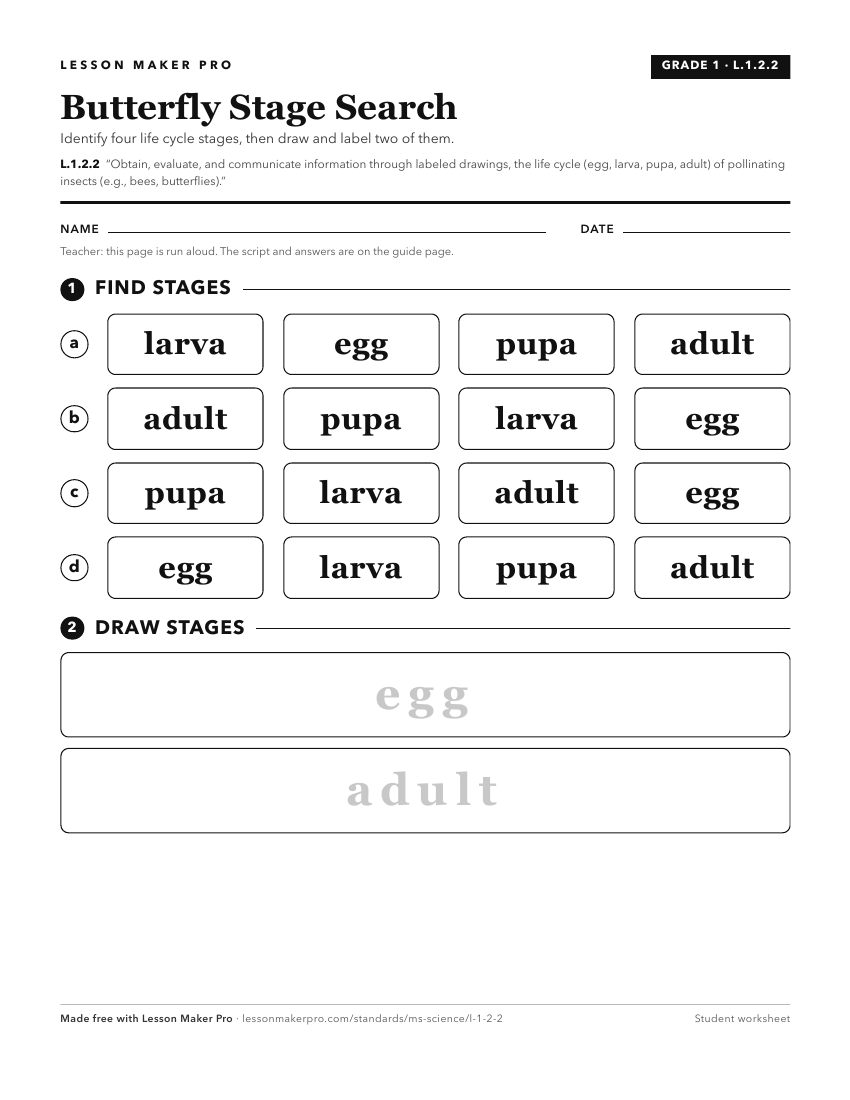
A ready-to-print activity worksheet aligned to L.1.2.2, with an answer key for the teacher on its own page. No account needed.
PDF, US Letter, prints cleanly in black and white.
Download the worksheetKeep exploring
Related Standards
- L.1.3B
Students will demonstrate an understanding of the interdependence of flowering plants and pollinating insects.
- L.1.3B.1
Identify the body parts of a pollinating insect (e.g., bee, butterfly) and describe how insects use these parts to gather nectar or disburse pollen. Report find...
- ZOO.5.4
Identify organisms and characteristics of chelicerates, crustaceans, and insects.
- L.1.2.1
Investigate, using observations and measurements (non-standard units), flowering plants (pumpkins, peas, marigolds, or sunflowers) as they change during the lif...
Turn this exact standard into a lesson
Grade, subject, topic, and the complete standard are prefilled. Create one free, no account needed.
Also for this standard:Make a WorksheetMake a QuizMake a Sub Lesson