Mississippi Science ZOO.4.3
The Standard
- ZOO.4
- Students will describe the evolution of structure and function of phylum Platyhelminthes, phylum Nematoda, and phylum Annelida.
Compare and contrast the characteristics and lifestyles of flatworms, roundworms, and segmented worms.
2026 Mississippi College- and Career-Readiness Standards for Science · Phyla Platyhelminthes, Nematoda, and Annelida
Teacher's field guide
What This Standard Means
What Students Need to Do
- Students sort flatworms, roundworms, and segmented worms by body shape, segments, and digestive openings. They compare worms that live on their own with parasites, linking body traits to where each lives and how it feeds.
What Mastery Looks Like
- A student can identify a planarian, a roundworm, and an earthworm from diagrams and name a body feature that identifies each one. They can explain how an earthworm moves through soil and how a tapeworm gets nutrients from a host without a gut.
Common Misconceptions
- Students may think every worm has segments because earthworms are familiar. They may assume all flatworms and roundworms are parasites, or that tapeworms eat through a mouth.
How to Assess It
- Show sketches of a flat pond worm with one digestive opening, a smooth cylindrical dog parasite, and a ringed soil worm. Ask students to identify each group, cite one body clue, and compare how two get food.
Lesson moves
Ways to Teach It
Use clay and drinking straws to model a planarian, a roundworm, and an earthworm; add segment lines and digestive openings.
Ask: How do an earthworm's segments help it burrow, and why can a tapeworm live without a digestive tract?
Deal photo and fact cards for planarians, tapeworms, roundworms, and earthworms; students match each to a worm group and defend one clue.
Display a compost-bin photo and a dog roundworm fact sheet; students write where each worm lives and how it gets food.
Free download
Printable ZOO.4.3 Worksheet
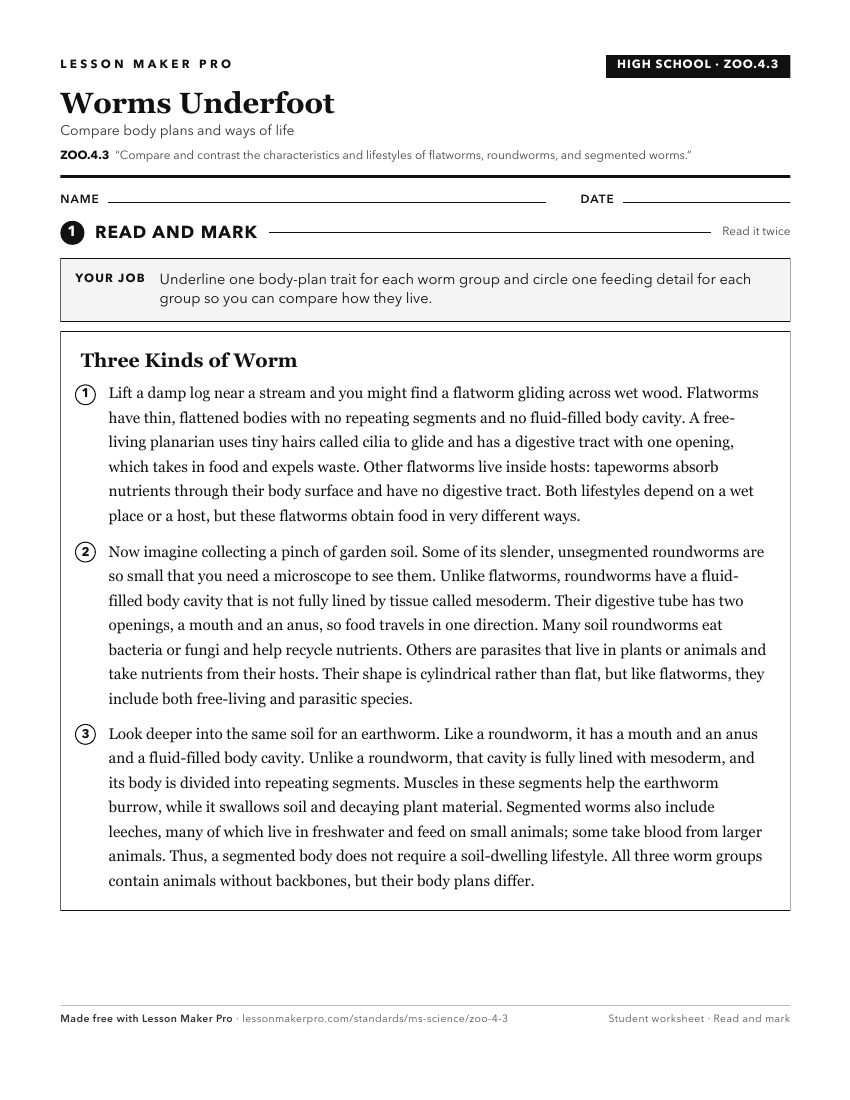
A ready-to-print activity worksheet aligned to ZOO.4.3, with an answer key for the teacher on its own page. No account needed.
PDF, US Letter, prints cleanly in black and white.
Download the worksheetKeep exploring
Related Standards
- ZOO.4
Students will describe the evolution of structure and function of phylum Platyhelminthes, phylum Nematoda, and phylum Annelida.
- MAQ.6.4
Compare and contrast major body plans (e.g., asymmetry, radial, bilateral symmetry, acoelomate, pseudocoelomate, and eucoelomate).
- ZOO.4.7
Enrichment: Design, conduct, and communicate results of an experiment demonstrating the importance of flatworms, roundworms, and annelids for human use (e.g., t...
- ZOO.4.4
Create a model comparing acoelomate, pseudocoelomate, and eucoelomate body plans of Platyhelminthes, Nematoda, and Annelida.
Turn this exact standard into a lesson
Grade, subject, topic, and the complete standard are prefilled. Create one free, no account needed.
Also for this standard:Make a WorksheetMake a QuizMake a Sub Lesson