Mississippi Science ZOO.4.2
The Standard
- ZOO.4
- Students will describe the evolution of structure and function of phylum Platyhelminthes, phylum Nematoda, and phylum Annelida.
Differentiate between parasitic and free living.
2026 Mississippi College- and Career-Readiness Standards for Science · Phyla Platyhelminthes, Nematoda, and Annelida
Teacher's field guide
What This Standard Means
What Students Need to Do
- Students decide whether a worm takes food from a host or feeds independently. They use feeding and life-cycle clues, not just where the worm is found.
What Mastery Looks Like
- A student identifies a tapeworm as parasitic because it takes nutrients from its host. They identify a planarian as free-living because it finds food without a host.
Common Misconceptions
- Students may think every flatworm or roundworm is parasitic. They may call a worm free-living because its eggs develop in soil, even though the adult feeds in a host.
How to Assess It
- Exit ticket: A roundworm's eggs develop in soil, but adults feed in a dog's intestine. Is the adult parasitic or free-living? Give one reason.
Lesson moves
Ways to Teach It
Give pairs cards with feeding clues for planarians, tapeworms, earthworms, and hookworms; have them sort the worms by host dependence.
Ask students to explain in two sentences why finding worm eggs in soil does not prove the adult is free-living.
Play a matching game: teams pair six worm feeding descriptions with parasitic or free-living and defend one choice.
Show a dog dewormer label that lists roundworms beside a garden earthworm photo; ask which worm depends on a host for food.
Free download
Printable ZOO.4.2 Worksheet
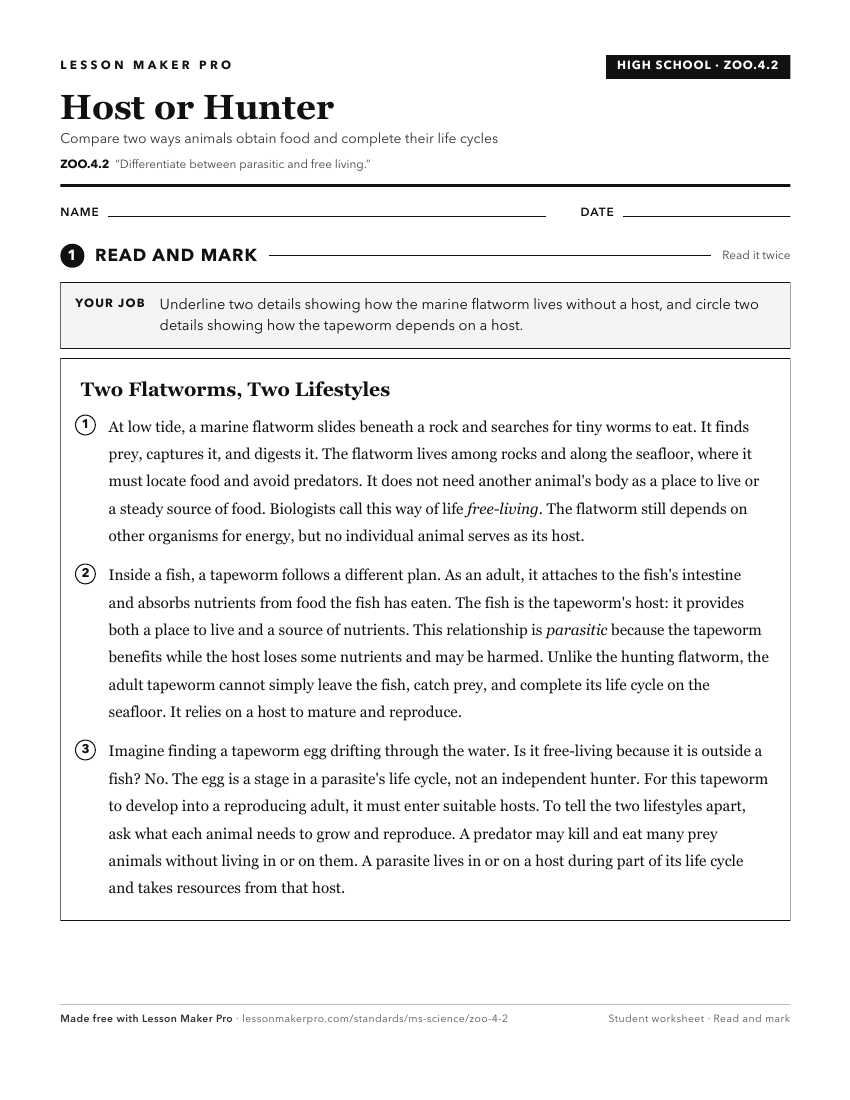
A ready-to-print activity worksheet aligned to ZOO.4.2, with an answer key for the teacher on its own page. No account needed.
PDF, US Letter, prints cleanly in black and white.
Download the worksheetKeep exploring
Related Standards
- MAQ.7.4
Differentiate various life cycles found among animals (e.g., egg, tadpole, and adult stages of the amphibian life cycle; leathery eggs on land in reptiles; hard...
- ZOO.5.4
Identify organisms and characteristics of chelicerates, crustaceans, and insects.
- BIO.1A.1
Develop criteria to differentiate between living and non-living things.
- ZOO.5.7
Differentiate between complete and incomplete metamorphosis in insects’ life cycles.
Turn this exact standard into a lesson
Grade, subject, topic, and the complete standard are prefilled. Create one free, no account needed.
Also for this standard:Make a WorksheetMake a QuizMake a Sub Lesson