Mississippi Science ZOO.4.1
The Standard
- ZOO.4
- Students will describe the evolution of structure and function of phylum Platyhelminthes, phylum Nematoda, and phylum Annelida.
Define and describe the closed circulatory system of an annelid.
2026 Mississippi College- and Career-Readiness Standards for Science · Phyla Platyhelminthes, Nematoda, and Annelida
Teacher's field guide
What This Standard Means
What Students Need to Do
- Students explain that an earthworm's blood stays inside vessels rather than flowing freely around its organs. They identify the dorsal and ventral vessels, aortic arches, and capillaries.
What Mastery Looks Like
- On a diagram, students show blood moving toward the head in the dorsal vessel and toward the tail in the ventral vessel. They explain that aortic arches help pump blood and capillaries exchange materials with tissues.
Common Misconceptions
- Students may draw blood flowing freely through the body cavity. Some think "closed" means oxygen cannot leave the blood vessels. Others assume earthworms breathe through lungs rather than moist skin.
How to Assess It
- Give students an earthworm outline. Ask them to draw and label the dorsal vessel, ventral vessel, aortic arches, and capillaries, add flow arrows, and explain why the system is closed.
Lesson moves
Ways to Teach It
Tape red yarn onto an earthworm outline to model the dorsal vessel, ventral vessel, and connecting arches; add arrows and paper capillaries.
Ask pairs: Why is an earthworm's circulation closed even though oxygen enters through its skin?
Hand out vessel and function cards; partners race to match each card to its place on an earthworm diagram.
Use a photo of an earthworm on wet soil; students trace oxygen from its skin into blood and then to a muscle.
Free download
Printable ZOO.4.1 Worksheet
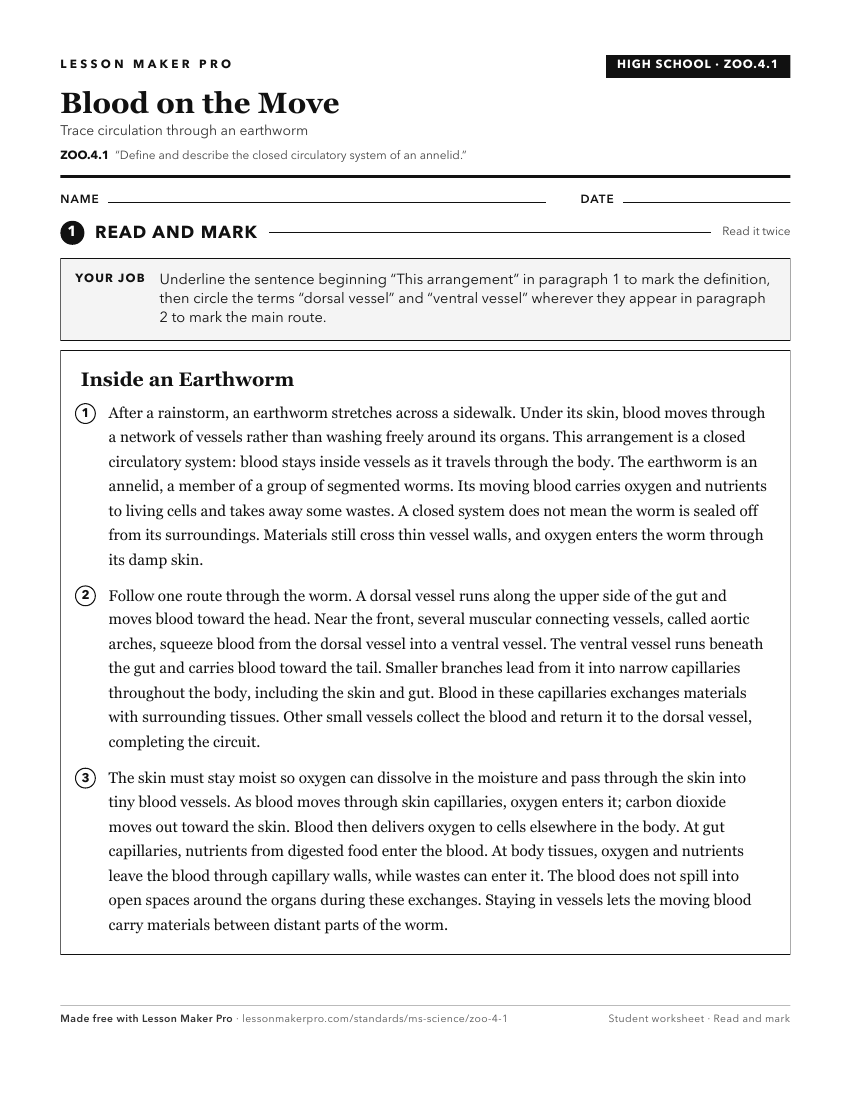
A ready-to-print activity worksheet aligned to ZOO.4.1, with an answer key for the teacher on its own page. No account needed.
PDF, US Letter, prints cleanly in black and white.
Download the worksheetKeep exploring
Related Standards
- ZOO.4
Students will describe the evolution of structure and function of phylum Platyhelminthes, phylum Nematoda, and phylum Annelida.
- ZOO.4.5
Describe the evolutionary importance of the segmented body plans of annelids.
- ZOO.3.2
Describe why mollusks are classified as eucoelomates.
- ZOO.6.5
Describe how the water vascular system is used for locomotion, feeding, and gas exchange.
Turn this exact standard into a lesson
Grade, subject, topic, and the complete standard are prefilled. Create one free, no account needed.
Also for this standard:Make a WorksheetMake a QuizMake a Sub Lesson