Mississippi Science ZOO.4.8
The Standard
- ZOO.4
- Students will describe the evolution of structure and function of phylum Platyhelminthes, phylum Nematoda, and phylum Annelida.
Enrichment: Use an engineering design process to design and construct a system to utilize flatworms, roundworms, or annelids to meet a human need. *
2026 Mississippi College- and Career-Readiness Standards for Science · Phyla Platyhelminthes, Nematoda, and Annelida
Teacher's field guide
What This Standard Means
What Students Need to Do
- Students choose a human problem worms can help solve, such as food waste. They set design limits, build a system, test it, and change it based on the results.
What Mastery Looks Like
- A student builds a compost bin that gives earthworms air, moisture, and suitable food. They compare scrap mass with a no-worm bin, then use the results to explain a design change.
Common Misconceptions
- Students may think any worm can compost scraps, including parasitic roundworms. They may seal the bin to keep moisture in or add meat, which can harm worms and attract pests.
How to Assess It
- Ask students to sketch a bin for composting cafeteria apple peels. Have them label how worms get air and moisture, name one result to measure, and suggest a change if scraps grow mold.
Lesson moves
Ways to Teach It
Teams build a worm bin from a ventilated tub, damp shredded paper, vegetable scraps, and composting earthworms.
Ask, “Why would earthworms work better than parasitic roundworms in a cafeteria scrap bin?” Have students support their answer with two facts.
Give teams three bin cards with different air holes, moisture levels, and foods; have them rank the designs and revise one.
Weigh one day's cafeteria vegetable scraps, then use a provided bin capacity to estimate how many worm bins the school would need.
Free download
Printable ZOO.4.8 Worksheet
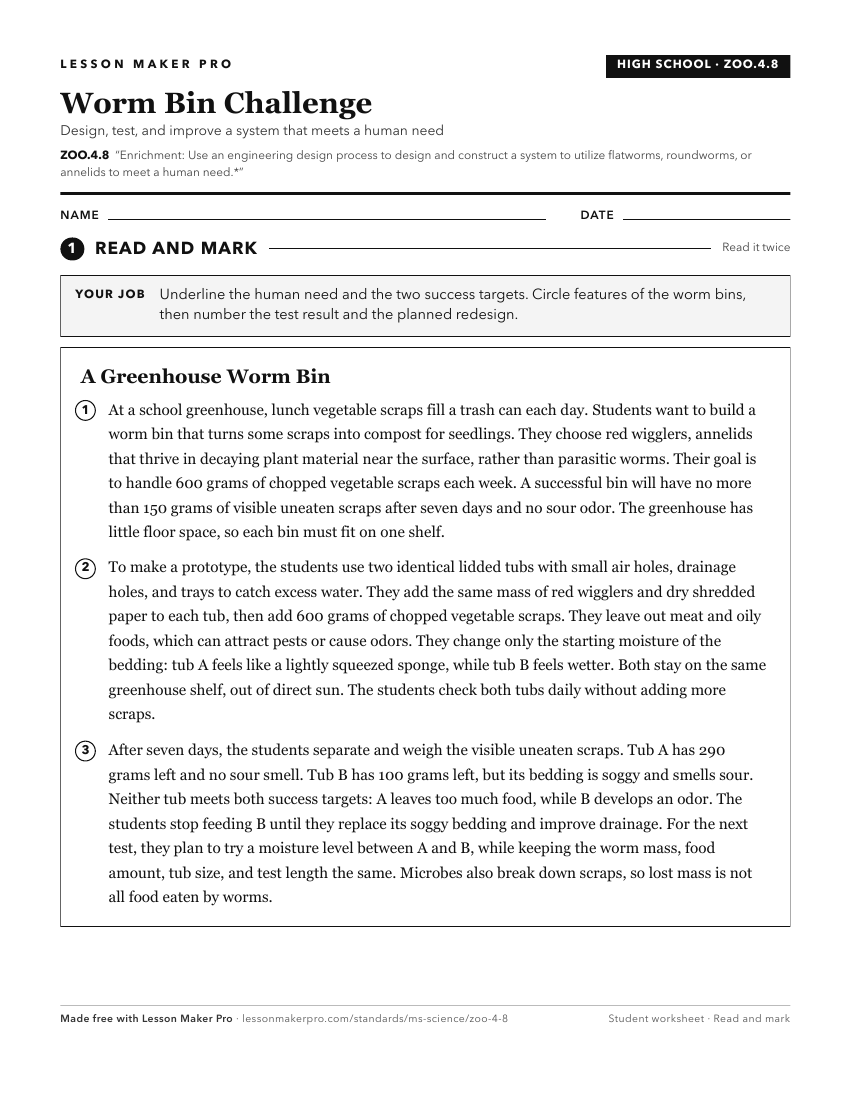
A ready-to-print activity worksheet aligned to ZOO.4.8, with an answer key for the teacher on its own page. No account needed.
PDF, US Letter, prints cleanly in black and white.
Download the worksheetKeep exploring
Related Standards
- ZOO.5.3
Enrichment: Use an engineering design process to develop a biomimicry of an arthropod’s exoskeleton to meet a human need. *
- ZOO.4.7
Enrichment: Design, conduct, and communicate results of an experiment demonstrating the importance of flatworms, roundworms, and annelids for human use (e.g., t...
- ENV.4.5
Enrichment: Use an engineering design process to define a problem, design, construct, evaluate, and improve a device or method to reduce or prevent human impact...
- ZOO.1.6
Enrichment: Use an engineering design process to develop an artificial habitat to meet the requirements of a population that has been impacted by human activity...
Turn this exact standard into a lesson
Grade, subject, topic, and the complete standard are prefilled. Create one free, no account needed.
Also for this standard:Make a WorksheetMake a QuizMake a Sub Lesson