Mississippi Science L.2.1.1
The Standard
- L.2.1
- Students will demonstrate an understanding of the classification of animals based on physical characteristics.
Compare and sort groups of animals with backbones (vertebrates) from groups of animals without backbones (invertebrates).
2026 Mississippi College- and Career-Readiness Standards for Science · Hierarchical Organization
Teacher's field guide
What This Standard Means
What Students Need to Do
- Students sort animals by whether they have a backbone inside their body. They use pictures and simple body diagrams to explain their choices.
What Mastery Looks Like
- Students correctly group familiar animals such as fish, dogs, butterflies, and snails. They can point to a fish's backbone on a diagram and explain why a snail's shell is not a backbone.
Common Misconceptions
- Some students think a shell or hard outer covering is a backbone. Others sort by where animals live or how they move, so they may put fish in the wrong group.
How to Assess It
- Give students photos of a fish, dog, butterfly, and snail, each paired with a simple body diagram. Ask them to sort the four and explain where they put the snail.
Lesson moves
Ways to Teach It
Have students cut out animal photo cards, match each to a body diagram, and sort the pairs into two piles.
Ask, 'A snail has a shell. Does that mean it has a backbone?' Have partners use a snail diagram to explain.
Play a card-flip sort with fish, frog, spider, crab, and earthworm cards, checking each answer against a body diagram.
Have students sketch an ant or bird they see outside, then use a picture guide to decide whether it has a backbone.
Free download
Printable L.2.1.1 Worksheet
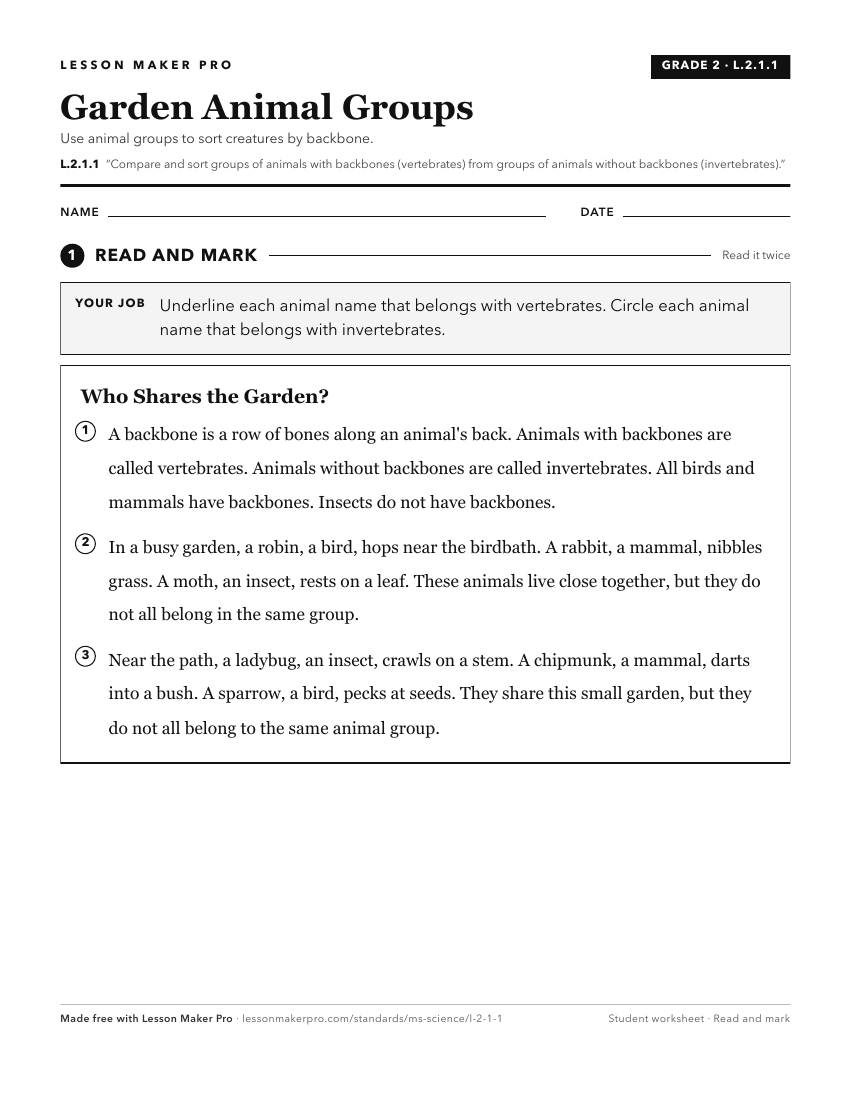
A ready-to-print activity worksheet aligned to L.2.1.1, with an answer key for the teacher on its own page. No account needed.
PDF, US Letter, prints cleanly in black and white.
Download the worksheetKeep exploring
Related Standards
- ZOO.10.5
Dissect representative taxa and compare their internal and external anatomy and complexity.
- ZOO.4.6
Dissect representative taxa and compare their internal and external anatomy and complexity.
- L.2.1.2
Classify vertebrates (mammals, fish, birds, amphibians, and reptiles) based on their physical characteristics.
- L.2.1.3
Compare and contrast physical characteristics that distinguish between classes of vertebrates (i.e., reptiles compared to amphibians).
Turn this exact standard into a lesson
Grade, subject, topic, and the complete standard are prefilled. Create one free, no account needed.
Also for this standard:Make a WorksheetMake a QuizMake a Sub Lesson