Mississippi Science L.3.4.4
The Standard
- L.3.4
- Students will demonstrate an understanding of how adaptations allow animals to satisfy life needs and respond both physically and behaviorally to their environment.
Define and improve a solution to a problem created by environmental changes and any resulting impacts on the types of density and distribution of plant and animal populations living in the environment (e.g., replanting sea oats in coastal areas or developing or preserving wildlife corridors and green belts). Use an engineering design process to define the problem, design, construct, evaluate, and improve the environment. *
2026 Mississippi College- and Career-Readiness Standards for Science · Adaptation and Diversity
Teacher's field guide
What This Standard Means
What Students Need to Do
- Students use maps to see how a change, such as beach erosion, affects how many plants and animals live in an area and where they live. They define a problem, build and test a model solution, then improve it.
What Mastery Looks Like
- A student can compare equal-sized map sections to show where sea oats became less common and where shorebirds moved. They can test a planting pattern, use the results to change it, and explain how it could help.
Common Misconceptions
- Students may count dots on a whole map instead of comparing equal-sized areas when judging crowding. They may think birds stay put when nesting plants disappear, or assume a planting works without testing it.
How to Assess It
- Give students before-and-after erosion maps with sea oat and shorebird dots in equal-sized squares. Ask which square has fewer plants, where birds moved, and what they would test and change in a planting plan.
Lesson moves
Ways to Teach It
Place two sand trays in a clear bin, plant pipe-cleaner sea oats in one, fan both, compare blown sand, shift stems, and retest.
Ask, “If sea oats vanish from this beach map, where could shorebirds nest, and which section now has fewer birds?”
Give pairs before-and-after beach maps to tally sea oats and shorebirds in equal-sized squares, then mark where each population moved.
Show a photo of a dune walkway, then ask students to sketch a rope path that keeps feet off sea oats.
Free download
Printable L.3.4.4 Worksheet
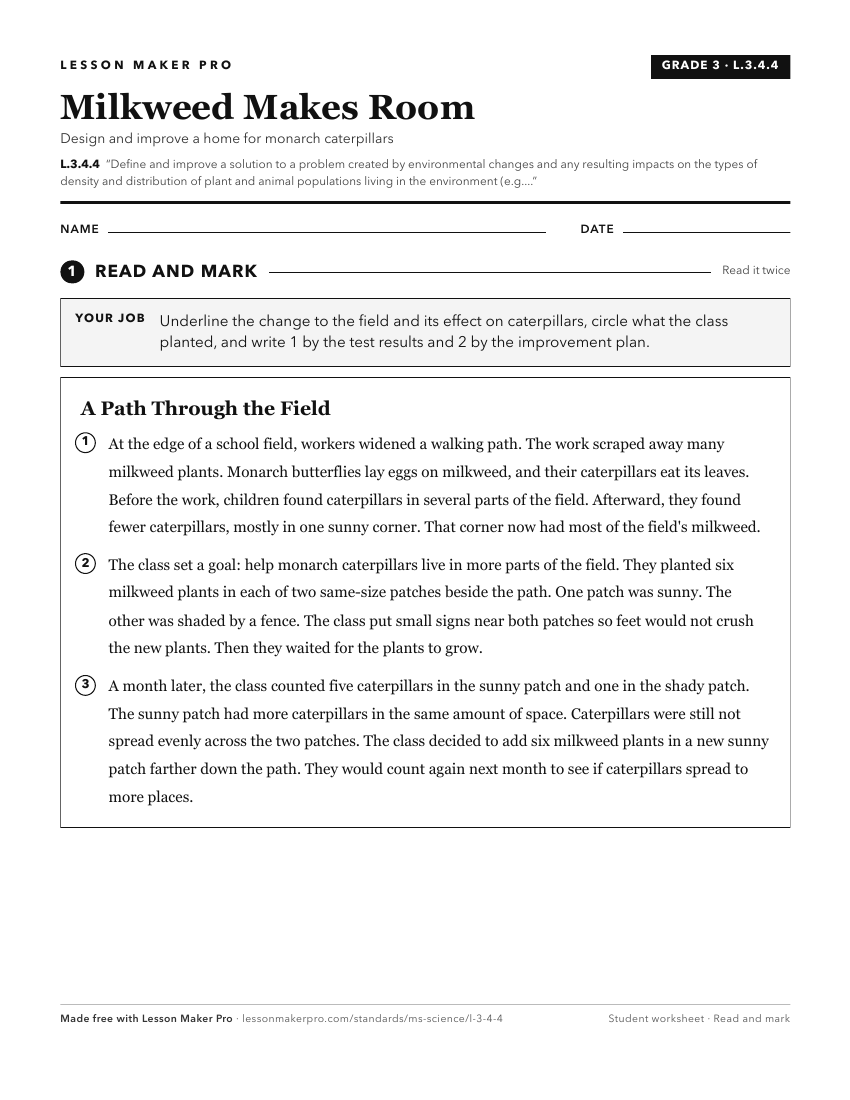
A ready-to-print activity worksheet aligned to L.3.4.4, with an answer key for the teacher on its own page. No account needed.
PDF, US Letter, prints cleanly in black and white.
Download the worksheetKeep exploring
Related Standards
- BIO.5.8
Enrichment: Use an engineering design process to create a solution that addresses changing ecological conditions (e.g., climate change, invasive species, loss o...
- BOT.4.2
Use an engineering design process to define a problem, design, construct, evaluate, and improve a habitat impacted by human interactions. *
- BOT.6.3
Enrichment: Use an engineering design process to define a problem, design, construct, evaluate, and improve a societal concern with the aid of plants (e.g., irr...
- ZOO.10.7
Enrichment: Use an engineering design process to develop a possible solution to an environmental issue that currently exists in an ecosystem. *
Turn this exact standard into a lesson
Grade, subject, topic, and the complete standard are prefilled. Create one free, no account needed.
Also for this standard:Make a WorksheetMake a QuizMake a Sub Lesson