Mississippi Science ZOO.2.5
The Standard
- ZOO.2
- Students will understand the structure and function of phylum Porifera and phylum Cnidaria and how each adapts to their environments.
Enrichment: Use an engineering design process to determine the quantity of water that may be absorbed per unit in a natural sponge versus a synthetic sponge. *
2026 Mississippi College- and Career-Readiness Standards for Science · Phyla Porifera and Cnidaria
Teacher's field guide
What This Standard Means
What Students Need to Do
- Students plan a fair test of how much water natural and synthetic sponges hold. They weigh each sponge dry, soak and drain it, then use the weight gain to find water held per gram of dry sponge. After a trial, they improve the test and repeat it.
What Mastery Looks Like
- A student keeps soak and drain times the same for both sponges. They calculate water held per gram from dry and wet weights, compare results, and explain how they made their test more reliable.
Common Misconceptions
- Students may compare wet weights without subtracting dry weight, or compare different-sized sponges without accounting for size. Some squeeze one sponge harder or drain it longer, then blame the material for the difference.
How to Assess It
- Exit ticket: Assume 1 g of water equals 1 mL. A natural sponge weighs 2 g dry and 12 g after draining; a synthetic sponge weighs 2 g dry and 8 g after draining. How many milliliters did each hold per gram of dry sponge, and what test step must stay the same?
Lesson moves
Ways to Teach It
Cut 1 g pieces of each sponge, soak both for 30 seconds, drain for 10 seconds, then weigh them and repeat the test.
Ask pairs: Why would comparing only wet weights be unfair if the sponges had different dry weights?
Give teams dry and wet weight cards; have them calculate milliliters held per gram and spot a card with an unfair drain time.
For a 30 mL spill, use class results to choose a sponge and calculate how much dry sponge is needed.
Free download
Printable ZOO.2.5 Worksheet
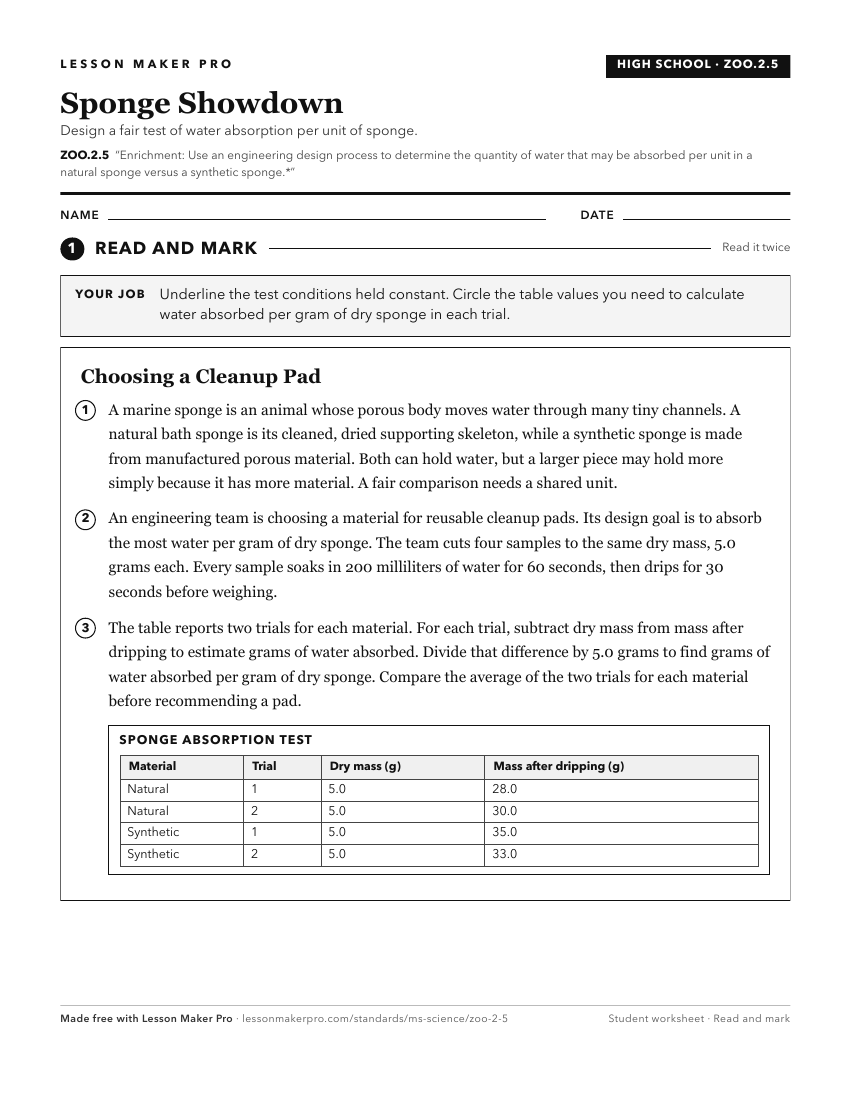
A ready-to-print activity worksheet aligned to ZOO.2.5, with an answer key for the teacher on its own page. No account needed.
PDF, US Letter, prints cleanly in black and white.
Download the worksheetKeep exploring
Related Standards
- ESS.4.4
Enrichment: Use an engineering design process to research, develop, and test models to aid in the responsible management of natural resources (e.g., recycling, ...
- ZOO.6.8
Enrichment: Use an engineering design process to model the water vascular system in hydraulic systems to meet a societal need. *
- ENV.4.5
Enrichment: Use an engineering design process to define a problem, design, construct, evaluate, and improve a device or method to reduce or prevent human impact...
- ZOO.10.7
Enrichment: Use an engineering design process to develop a possible solution to an environmental issue that currently exists in an ecosystem. *
Turn this exact standard into a lesson
Grade, subject, topic, and the complete standard are prefilled. Create one free, no account needed.
Also for this standard:Make a WorksheetMake a QuizMake a Sub Lesson