Mississippi Science HAP.14.5
The Standard
- HAP.14
- Students will investigate the structures and functions of the urinary system, including the cause and effect of diseases and disorders.
Develop and use models to illustrate the path of urine through the urinary tract.
2026 Mississippi College- and Career-Readiness Standards for Science · Urinary System
Teacher's field guide
What This Standard Means
What Students Need to Do
- Students build or label a model that traces urine from a kidney's collecting ducts to the bladder and out of the body. They use arrows to show which way urine moves.
What Mastery Looks Like
- A student can place the collecting duct, calyx, renal pelvis, ureter, bladder, and urethra in order on an unlabeled diagram. They show that each kidney has a ureter, while urine leaves the bladder through one urethra.
Common Misconceptions
- Students often swap the ureter and urethra or draw urine flowing straight from a kidney to the outside. Some confuse the blood vessels entering the kidney with the tubes that carry urine.
How to Assess It
- Give students a blank kidney cross-section and urinary tract diagram. Ask them to label the parts and draw arrows showing urine's route out of the body.
Lesson moves
Ways to Teach It
Use yarn on a paper kidney and urinary tract diagram to trace urine from a collecting duct to the urethra.
Ask students to explain why the diagram shows two ureters but only one urethra.
Give pairs shuffled cards labeled with urinary tract parts; have them order the cards and check against a diagram.
Show a kidney stone diagram and have students mark where a ureter blockage would stop urine before it reaches the bladder.
Free download
Printable HAP.14.5 Worksheet
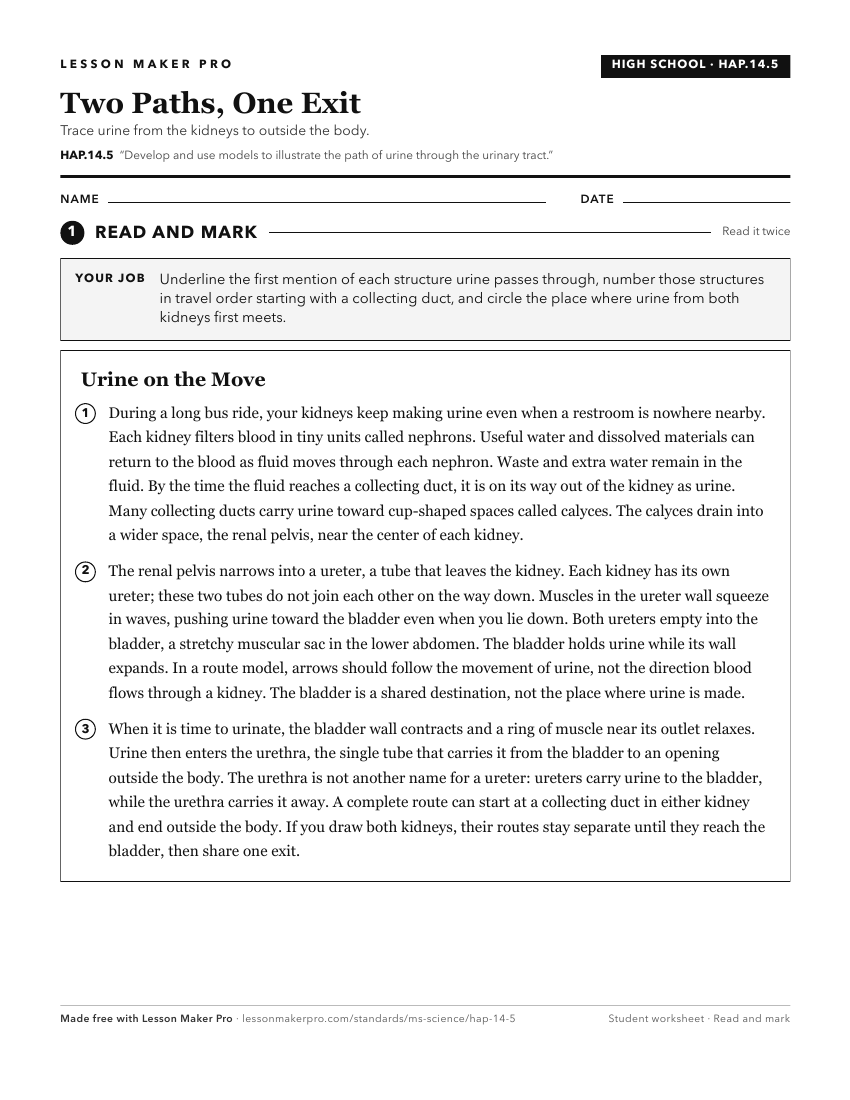
A ready-to-print activity worksheet aligned to HAP.14.5, with an answer key for the teacher on its own page. No account needed.
PDF, US Letter, prints cleanly in black and white.
Download the worksheetKeep exploring
Related Standards
- ENV.1.5
Develop and use models to diagram the flow of nitrogen, carbon, and phosphorus through the environment.
- L.6.1.6
Develop and use models to show relationships among the increasing complexity of multicellular organisms (cells, tissues, organs, organ systems, organisms) and h...
- HAP.12.1
Design and use models to illustrate the functions of the organs of the respiratory system.
- HAP.14
Students will investigate the structures and functions of the urinary system, including the cause and effect of diseases and disorders.
Turn this exact standard into a lesson
Grade, subject, topic, and the complete standard are prefilled. Create one free, no account needed.
Also for this standard:Make a WorksheetMake a QuizMake a Sub Lesson