Mississippi Science HAP.14
Standard Cluster
Students will investigate the structures and functions of the urinary system, including the cause and effect of diseases and disorders. Understand the structure and function of the urinary system in relation to maintenance of homeostasis. Describe the processes of filtration and selective reabsorption within the nephrons as it relates to the formation of urine and excretion of excess materials in the blood. Investigate relationship between urine composition and the maintenance of blood sugar, blood pressure, and blood volume. Enrichment: Conduct a urinalysis to compare the composition of urine from various “patients.” Develop and use models to illustrate the path of urine through the urinary tract. Research and analyze the causes and effects of various pathological conditions and other kidney abnormalities (e.g., kidney stones, urinary tract infections, gout, dialysis, and incontinence).
2026 Mississippi College- and Career-Readiness Standards for Science · Urinary System
Cluster contents
Standards in This Cluster
HAP.14 is a cluster heading. These are the individual standards under it.
- HAP.14.1
Understand the structure and function of the urinary system in relation to maintenance of homeostasis.
- HAP.14.2
Describe the processes of filtration and selective reabsorption within the nephrons as it relates to the formation of urine and excretion of excess materials in...
- HAP.14.3
Investigate relationship between urine composition and the maintenance of blood sugar, blood pressure, and blood volume.
- HAP.14.4
Enrichment: Conduct a urinalysis to compare the composition of urine from various “patients.”
- HAP.14.5
Develop and use models to illustrate the path of urine through the urinary tract.
- HAP.14.6
Research and analyze the causes and effects of various pathological conditions and other kidney abnormalities (e.g., kidney stones, urinary tract infections, go...
Teacher's field guide
What This Cluster Means
What Students Need to Do
- Students trace urine from the nephron through the collecting duct, renal pelvis, ureter, bladder, and urethra. They explain what enters filtrate and why the nephron returns glucose, salts, and water to blood. They use urine results to reason about blood sugar, blood volume, blood pressure, and kidney disorders.
What Mastery Looks Like
- A student can label a nephron and trace urine to the urethra. They can show where filtration occurs and explain why glucose and much of the water return to blood. Given mock urine results, they can suggest a possible cause of glucose, blood, or unusually concentrated urine without treating one result as a diagnosis.
Common Misconceptions
- Students may think blood cells enter the filtrate and are reabsorbed later. They may think everything filtered from blood becomes urine, or that glucose in urine is always normal. They often confuse the ureter, which leads to the bladder, with the urethra, which leads out of the body.
How to Assess It
- Exit ticket: On a nephron sketch, circle where blood is filtered and mark where glucose returns to blood. A mock urine test shows glucose; give one possible reason.
Lesson moves
Ways to Teach It
Use a sieve as a glomerulus: filter small water and glucose beads, block larger blood-cell beads, then return glucose to a blood cup.
Give pairs two synthetic urine reports, one with glucose and one without, and ask what could explain the difference.
Race to place cards in order: glomerulus, tubule, collecting duct, renal pelvis, ureter, bladder, urethra.
Show a mock dehydration report with dark, low-volume urine; ask why reabsorbing more water helps maintain blood volume and pressure.
Free download
Printable HAP.14 Worksheet
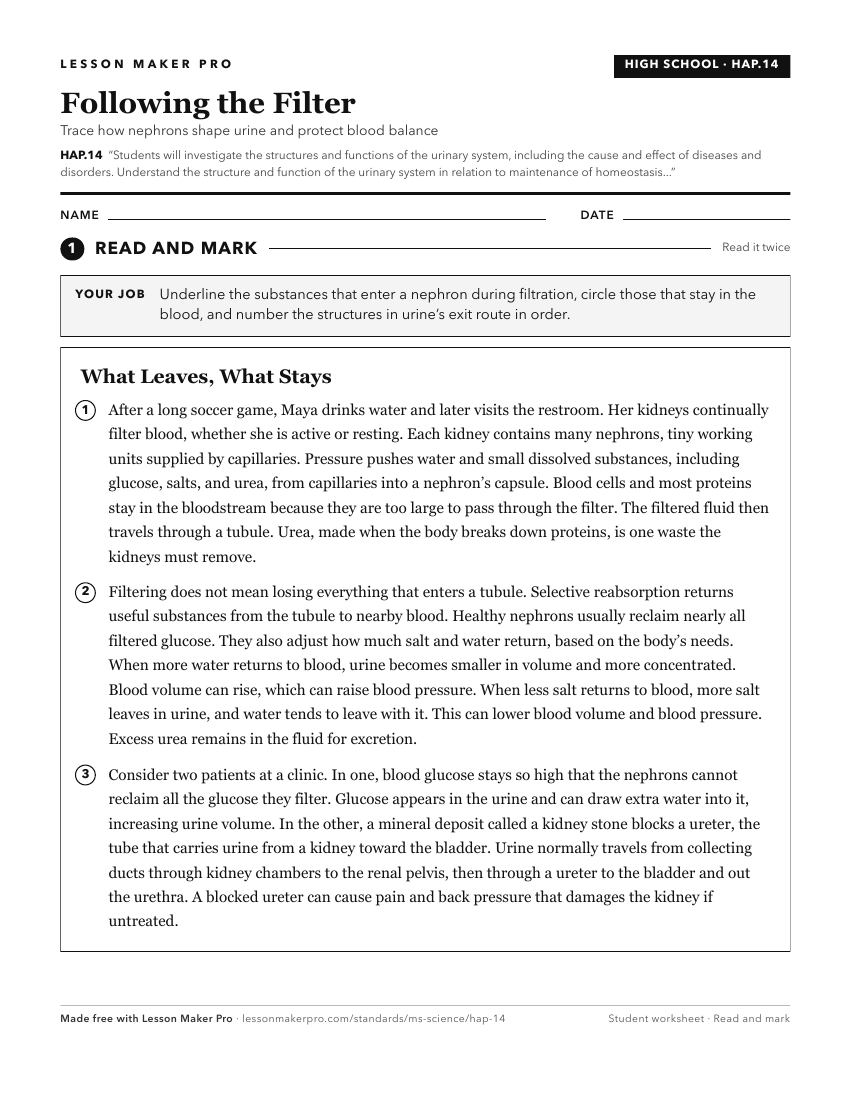
A ready-to-print activity worksheet aligned to HAP.14, with an answer key for the teacher on its own page. No account needed.
PDF, US Letter, prints cleanly in black and white.
Download the worksheetKeep exploring
Related Standards
- HAP.5
Students will investigate the structures and functions of the muscular system, including the cause and effect of diseases and disorders.
- HAP.4
Students will investigate the structures and functions of the skeletal system including the cause and effect of diseases and disorders.
- HAP.8
Students will investigate the structures and functions of the male and female reproductive system, including the cause and effect of diseases and disorders.
- HAP.13
Students will investigate the structures and functions of the digestive system, including the cause and effect of diseases and disorders.
Turn this cluster into a lesson
Grade, subject, topic, and the complete cluster are prefilled. Create one free, no account needed.
Also for this cluster:Make a WorksheetMake a QuizMake a Sub Lesson