Mississippi Science HAP.14.3
The Standard
- HAP.14
- Students will investigate the structures and functions of the urinary system, including the cause and effect of diseases and disorders.
Investigate relationship between urine composition and the maintenance of blood sugar, blood pressure, and blood volume.
2026 Mississippi College- and Career-Readiness Standards for Science · Urinary System
Teacher's field guide
What This Standard Means
What Students Need to Do
- Students compare urine glucose, sodium loss, and volume with blood sugar and blood pressure readings. They explain how the kidneys keep or remove substances and how those choices affect blood volume.
What Mastery Looks Like
- Students explain why glucose is usually absent from urine but can appear when blood sugar is high. They use daily urine volume and sodium loss to explain how fluid loss can lower blood volume and pressure.
Common Misconceptions
- Students may think glucose belongs in urine because it is in blood. They may mistake concentrated urine for a large loss of water, or think urine glucose alone proves someone has diabetes.
How to Assess It
- Exit ticket: A patient has glucose in their urine and passes a large volume of urine. What might this mean for blood sugar, blood volume, and blood pressure? Explain why.
Lesson moves
Ways to Teach It
Use cups labeled filtrate, blood, and urine; move glucose beads to blood with a spoon, then send extras to urine when the spoon limit is reached.
Ask pairs to write an answer to: Why might someone with high blood sugar pass more urine? Use glucose, water, and blood volume.
Give pairs four patient cards showing blood pressure, daily urine volume, and sodium loss; sort them by whether the kidneys are retaining or releasing fluid.
Show a sample urine test strip report from a clinic; ask why a positive glucose result calls for a blood glucose test.
Free download
Printable HAP.14.3 Worksheet
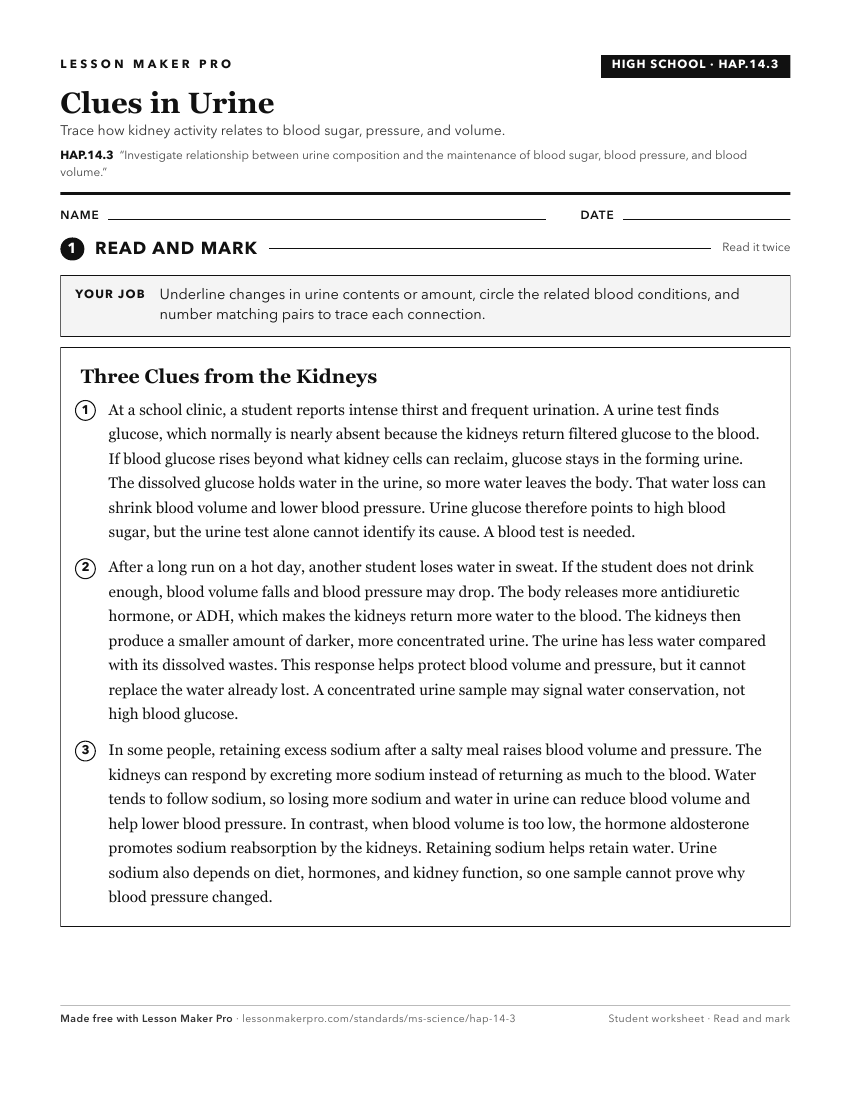
A ready-to-print activity worksheet aligned to HAP.14.3, with an answer key for the teacher on its own page. No account needed.
PDF, US Letter, prints cleanly in black and white.
Download the worksheetKeep exploring
Related Standards
- HAP.14.6
Research and analyze the causes and effects of various pathological conditions and other kidney abnormalities (e.g., kidney stones, urinary tract infections, go...
- HAP.14.4
Enrichment: Conduct a urinalysis to compare the composition of urine from various “patients.”
- HAP.14
Students will investigate the structures and functions of the urinary system, including the cause and effect of diseases and disorders.
- HAP.14.1
Understand the structure and function of the urinary system in relation to maintenance of homeostasis.
Turn this exact standard into a lesson
Grade, subject, topic, and the complete standard are prefilled. Create one free, no account needed.
Also for this standard:Make a WorksheetMake a QuizMake a Sub Lesson