Mississippi Science HAP.14.4
The Standard
- HAP.14
- Students will investigate the structures and functions of the urinary system, including the cause and effect of diseases and disorders.
Enrichment: Conduct a urinalysis to compare the composition of urine from various “patients.”
2026 Mississippi College- and Career-Readiness Standards for Science · Urinary System
Teacher's field guide
What This Standard Means
What Students Need to Do
- Students test simulated urine samples with reagent strips and compare pH, glucose, and protein readings. They record differences between samples without diagnosing a patient.
What Mastery Looks Like
- A student follows the strip instructions and reads each pad at the right time. They identify which samples test positive for glucose or protein and explain why a positive result needs follow-up.
Common Misconceptions
- Students may think all urine has the same composition. They may treat one positive glucose or protein result as proof of a specific disease.
How to Assess It
- Exit ticket: Sample A has pH 6 with no glucose or protein, while Sample B has pH 6 with glucose present and no protein. Name the difference and explain why it does not confirm a diagnosis.
Lesson moves
Ways to Teach It
Test three teacher-prepared simulated urine samples with reagent strips, then record pH, glucose, and protein readings in a table.
Ask students to write what a positive glucose result shows and what it cannot tell them about a patient.
Give pairs three test-strip result cards and three sample tables to match using a dipstick color chart.
Show a home urinalysis strip instruction sheet and ask why reading a strip late could mislead someone using it.
Free download
Printable HAP.14.4 Worksheet
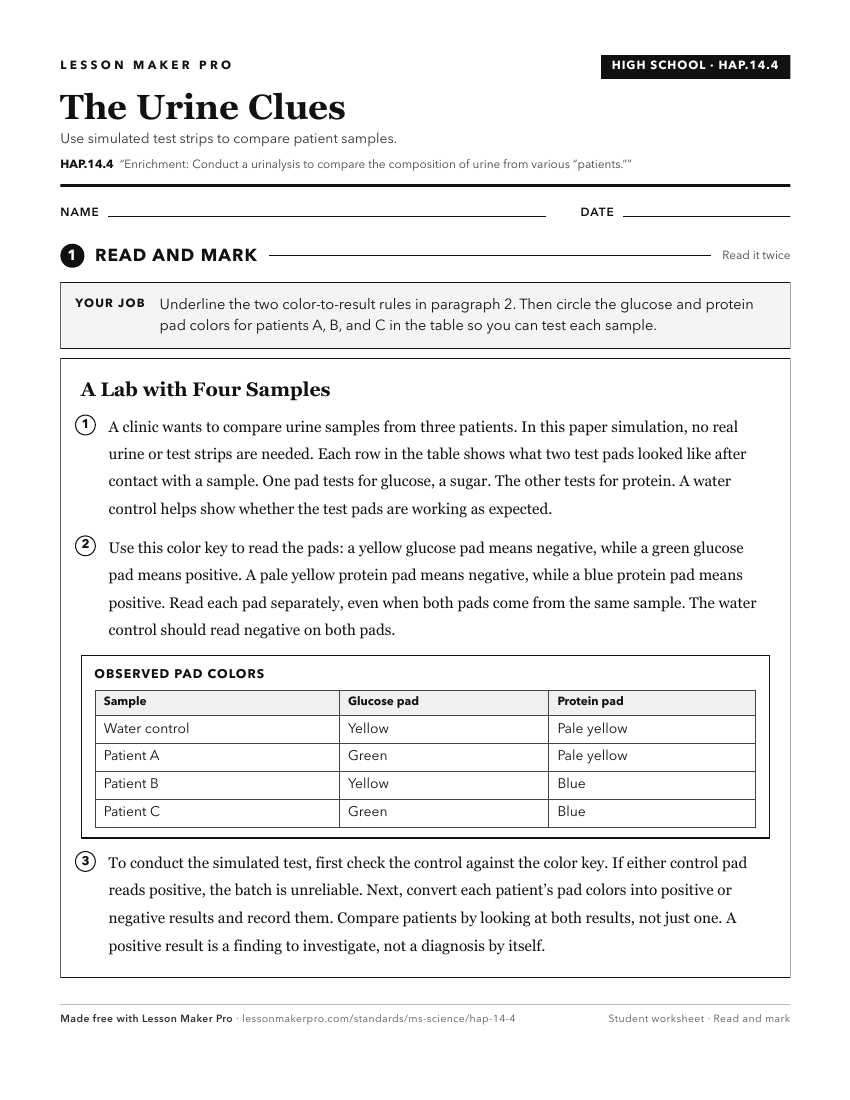
A ready-to-print activity worksheet aligned to HAP.14.4, with an answer key for the teacher on its own page. No account needed.
PDF, US Letter, prints cleanly in black and white.
Download the worksheetKeep exploring
Related Standards
- HAP.9.4
Enrichment: Use an engineering design process to develop effective treatments for blood disorders (e.g., methods to regulate blood cell counts or blood doping t...
- CHE.9.1
Enrichment: Analyze and interpret data to describe the properties of acids, bases, and salts.
- ENV.2.6
Enrichment: Obtain water from a local source (e.g., stream on campus, rainwater, ditch water) to monitor water quality over time, using a spreadsheet program to...
- HAP.14.3
Investigate relationship between urine composition and the maintenance of blood sugar, blood pressure, and blood volume.
Turn this exact standard into a lesson
Grade, subject, topic, and the complete standard are prefilled. Create one free, no account needed.
Also for this standard:Make a WorksheetMake a QuizMake a Sub Lesson