Mississippi Science HAP.14.1
The Standard
- HAP.14
- Students will investigate the structures and functions of the urinary system, including the cause and effect of diseases and disorders.
Understand the structure and function of the urinary system in relation to maintenance of homeostasis.
2026 Mississippi College- and Career-Readiness Standards for Science · Urinary System
Teacher's field guide
What This Standard Means
What Students Need to Do
- Trace urine from the kidneys through the ureters, bladder, and urethra. Explain how nephrons filter blood, return needed water and salts, and remove wastes.
What Mastery Looks Like
- Students can use a nephron diagram to show where blood is filtered and where water returns to the blood. They can explain why dehydration leads to less, more concentrated urine.
Common Misconceptions
- Students may think the bladder makes urine or that the ureters carry urine out of the body. Some think kidneys remove all water from blood instead of returning most of it.
How to Assess It
- On an unlabeled urinary system diagram, have students label the kidneys, ureters, bladder, and urethra. Ask them to explain why a dehydrated person produces less urine.
Lesson moves
Ways to Teach It
Move water, salt, and waste tokens from a blood cup to a nephron cup, then return some water and salt tokens to blood.
Ask, "Why might your urine be darker after soccer practice?" Have students explain what the kidneys do with water.
Give pairs structure cards to sequence urine's route, then have them place a nephron card inside the kidney card.
Compare two sample logs showing water intake, activity, and urine output, then explain how kidney water conservation differs between days.
Free download
Printable HAP.14.1 Worksheet
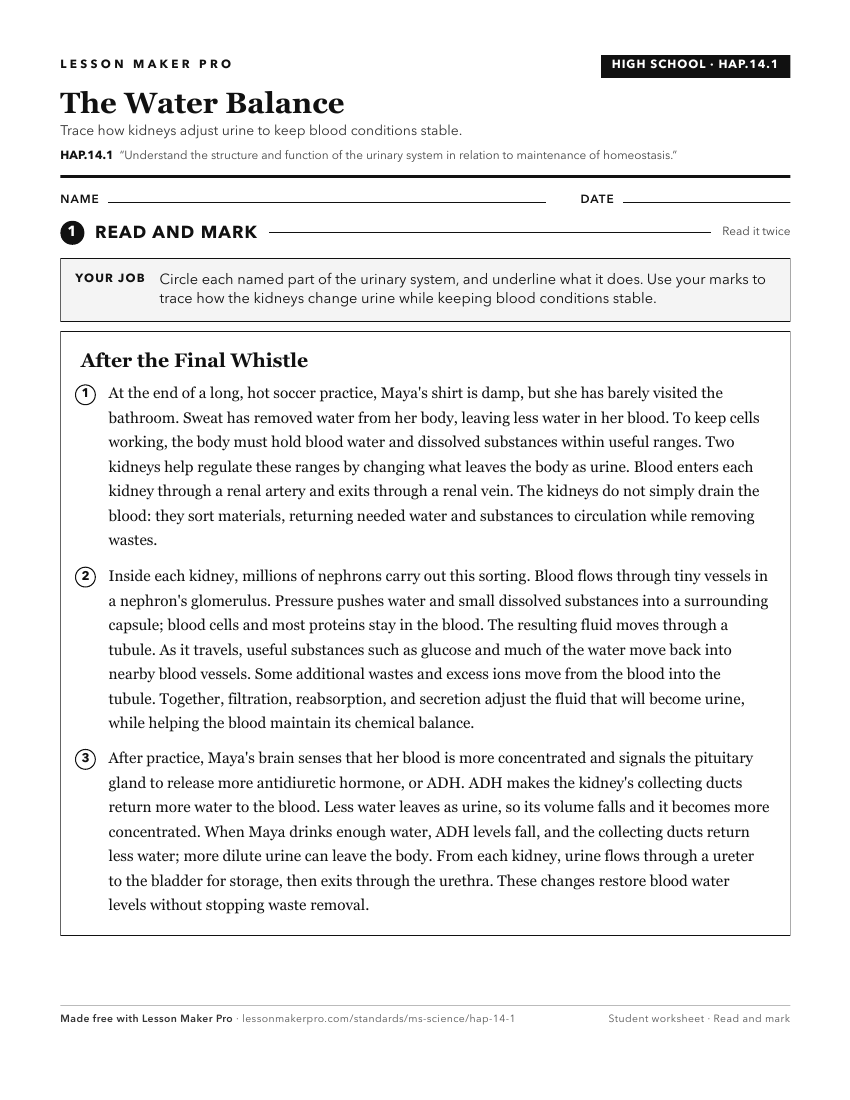
A ready-to-print activity worksheet aligned to HAP.14.1, with an answer key for the teacher on its own page. No account needed.
PDF, US Letter, prints cleanly in black and white.
Download the worksheetKeep exploring
Related Standards
- HAP.14.3
Investigate relationship between urine composition and the maintenance of blood sugar, blood pressure, and blood volume.
- HAP.14
Students will investigate the structures and functions of the urinary system, including the cause and effect of diseases and disorders.
- HAP.4.5
Construct explanations detailing how mechanisms (e.g., Ca2+ regulation) are used by the skeletal system to maintain homeostasis.
- HAP.9
Students will analyze the structure and functions of blood and its role in maintaining homeostasis.
Turn this exact standard into a lesson
Grade, subject, topic, and the complete standard are prefilled. Create one free, no account needed.
Also for this standard:Make a WorksheetMake a QuizMake a Sub Lesson