Mississippi Science HAP.4
Standard Cluster
Students will investigate the structures and functions of the skeletal system including the cause and effect of diseases and disorders. Use models to compare the structure and function of the skeletal system. Develop and use models to identify and classify major bones as part of the appendicular or axial skeleton. Identify and classify types of joints and their movement. Demonstrate an understanding of the growth and development of the skeletal system, differentiating between endochondral and intramembranous ossification. Construct explanations detailing how mechanisms (e.g., Ca2+ regulation) are used by the skeletal system to maintain homeostasis. Research and analyze various pathological conditions (e.g., bone fractures, osteoporosis, bone cancers, various types of arthritis, and carpal tunnel syndrome). Enrichment: Use an engineering design process to develop, model, and test effective treatments for bone disorders (i.e., prosthetics). *
2026 Mississippi College- and Career-Readiness Standards for Science · Skeletal System
Cluster contents
Standards in This Cluster
HAP.4 is a cluster heading. These are the individual standards under it.
- HAP.4.1
Use models to compare the structure and function of the skeletal system.
- HAP.4.2
Develop and use models to identify and classify major bones as part of the appendicular or axial skeleton.
- HAP.4.3
Identify and classify types of joints and their movement.
- HAP.4.4
Demonstrate an understanding of the growth and development of the skeletal system, differentiating between endochondral and intramembranous ossification.
- HAP.4.5
Construct explanations detailing how mechanisms (e.g., Ca2+ regulation) are used by the skeletal system to maintain homeostasis.
- HAP.4.6
Research and analyze various pathological conditions (e.g., bone fractures, osteoporosis, bone cancers, various types of arthritis, and carpal tunnel syndrome).
- HAP.4.7
Enrichment: Use an engineering design process to develop, model, and test effective treatments for bone disorders (i.e., prosthetics). *
Teacher's field guide
What This Cluster Means
What Students Need to Do
- Students sort major bones into the central skeleton or the limbs and their supports. They match joint types to the movements they allow and compare two ways bones form. They explain how bones help control blood calcium and how disorders affect bones or joints.
What Mastery Looks Like
- A student correctly places the skull, ribs, pelvis, and femur on a labeled skeleton. They show how the elbow and hip move and explain that a femur forms from cartilage, while skull bones form within connective tissue. They use a bone density report to explain fracture risk.
Common Misconceptions
- Students may put the pelvis in the central skeleton because it sits near the spine. They may assume every bone starts as cartilage or that all joints move the same way. They may confuse osteoporosis, which weakens bone, with arthritis, which affects joints.
How to Assess It
- Give students a skeleton handout. Ask them to label the skull and femur as central or limb bones, name the hip joint and its movements, then explain what happens when blood calcium drops.
Lesson moves
Ways to Teach It
Use colored tape to tag bones on a classroom skeleton, then compare elbow, hip, and neck movement with a partner.
Show diagrams of a developing skull and femur. Ask students to write which forms within connective tissue and which replaces cartilage.
Play a bone-sort relay with cards naming ribs, vertebrae, clavicle, pelvis, and femur, then check each team's groups against a skeleton chart.
Give students a mock bone density report and a score key. Ask them why a person with low bone density might fracture a hip after a minor fall.
Free download
Printable HAP.4 Worksheet
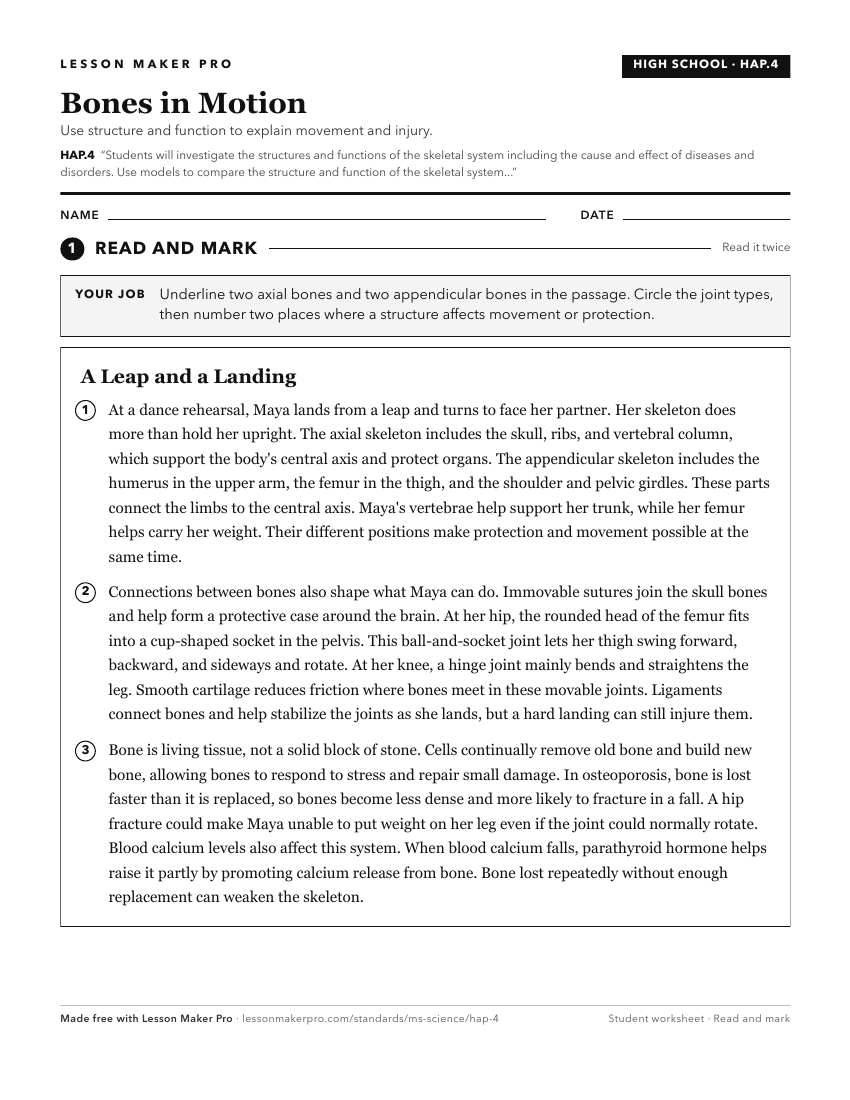
A ready-to-print activity worksheet aligned to HAP.4, with an answer key for the teacher on its own page. No account needed.
PDF, US Letter, prints cleanly in black and white.
Download the worksheetKeep exploring
Related Standards
- HAP.5
Students will investigate the structures and functions of the muscular system, including the cause and effect of diseases and disorders.
- HAP.13
Students will investigate the structures and functions of the digestive system, including the cause and effect of diseases and disorders.
- HAP.14
Students will investigate the structures and functions of the urinary system, including the cause and effect of diseases and disorders.
- HAP.6
Students will investigate the structures and functions of the nervous system, including the cause and effect of diseases and disorders.
Turn this cluster into a lesson
Grade, subject, topic, and the complete cluster are prefilled. Create one free, no account needed.
Also for this cluster:Make a WorksheetMake a QuizMake a Sub Lesson