Mississippi Science HAP.4.1
The Standard
- HAP.4
- Students will investigate the structures and functions of the skeletal system including the cause and effect of diseases and disorders.
Use models to compare the structure and function of the skeletal system.
2026 Mississippi College- and Career-Readiness Standards for Science · Skeletal System
Teacher's field guide
What This Standard Means
What Students Need to Do
- Use a skeleton model and a bone cutaway to compare bones, joints, and marrow. Explain how these parts protect organs, support weight, help movement, and make blood cells.
What Mastery Looks Like
- A student can explain why ribs surround the lungs, how the femur helps bear weight, and where blood cells are made. They point to features on each model to support their answers.
Common Misconceptions
- Students may think all bones do the same job. Some think bones move without muscles, or that bones are solid all the way through.
How to Assess It
- On a printed skeleton, circle the ribs and femur. Describe one shape difference and explain how each shape helps the bone do its job.
Lesson moves
Ways to Teach It
Build a paper skeleton with brass fasteners at the elbows and knees, then compare those moving joints with the fixed skull.
Show a skeleton diagram and ask, 'Why are ribs curved around the lungs while the femur is long?'
Hand out cards labeled skull, rib, femur, and vertebra; have students match each bone to a job and defend one match.
Show a knee brace photo; have students mark the femur, tibia, and knee joint on a skeleton and explain what the brace limits.
Free download
Printable HAP.4.1 Worksheet
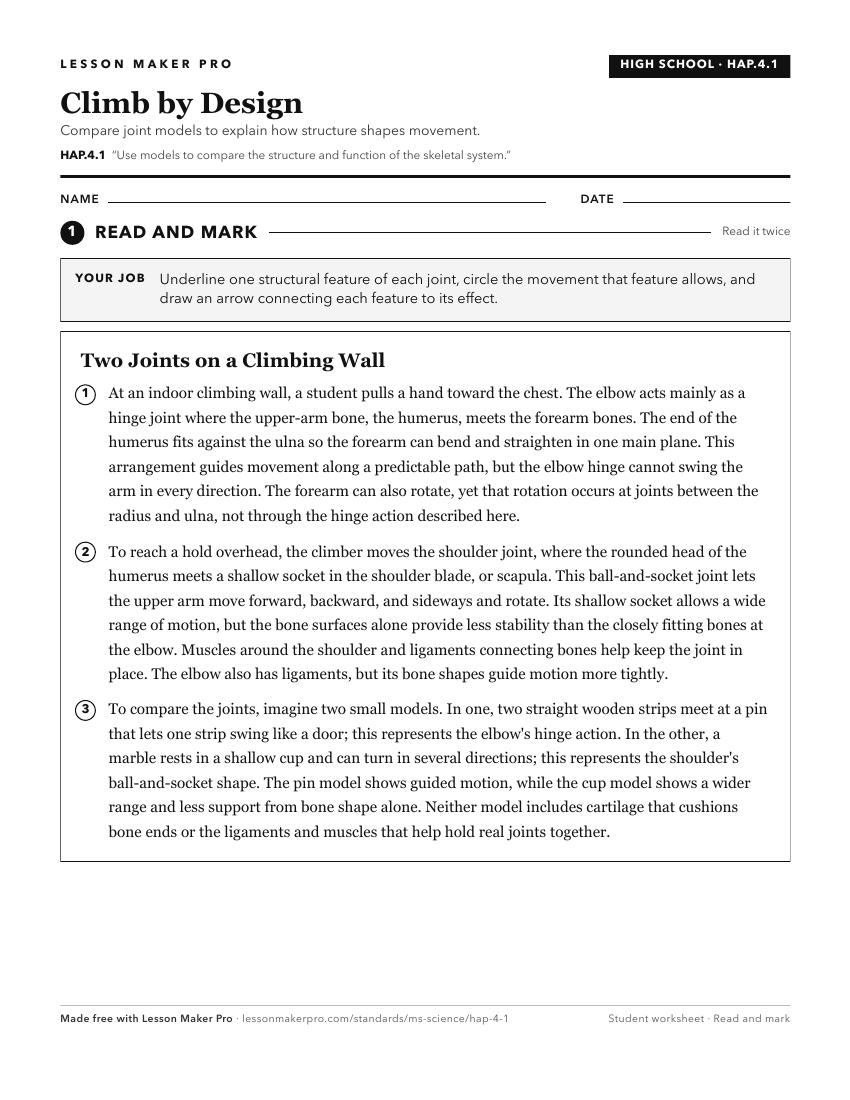
A ready-to-print activity worksheet aligned to HAP.4.1, with an answer key for the teacher on its own page. No account needed.
PDF, US Letter, prints cleanly in black and white.
Download the worksheetKeep exploring
Related Standards
- L.4.1.3
Construct models of organ systems (e.g., circulatory, digestive, respiratory, muscular, skeletal, nervous) to demonstrate both the unique function of the system...
- HAP.5.4
Use models to locate the major muscles and investigate the movements controlled by each muscle.
- HAP.5.1
Develop and use models to illustrate muscle structure, muscle locations and groups, actions, origins, and insertions.
- HAP.4.2
Develop and use models to identify and classify major bones as part of the appendicular or axial skeleton.
Turn this exact standard into a lesson
Grade, subject, topic, and the complete standard are prefilled. Create one free, no account needed.
Also for this standard:Make a WorksheetMake a QuizMake a Sub Lesson