Mississippi Science L.4.1.3
The Standard
- L.4.1
- Students will demonstrate an understanding of the organization, functions, and interconnections of the major human body systems.
Construct models of organ systems (e.g., circulatory, digestive, respiratory, muscular, skeletal, nervous) to demonstrate both the unique function of the system and how multiple organs and organ systems work together to accomplish more complex functions.
2026 Mississippi College- and Career-Readiness Standards for Science · Hierarchical Organization
Teacher's field guide
What This Standard Means
What Students Need to Do
- Build a model of a body system and label what its organs do. Show how that system works with another, such as the lungs supplying oxygen to blood that travels to muscles.
What Mastery Looks Like
- A student can trace oxygen from the lungs through blood vessels to a working muscle. They can explain that the lungs move oxygen into blood and the heart pumps blood through vessels.
Common Misconceptions
- Students may say the heart makes oxygen or that lungs pump blood. Some draw oxygen going straight from the lungs to muscles, without traveling in blood.
How to Assess It
- Give students a blank body outline. Ask them to draw lungs, a heart, blood vessels, and a leg muscle, then add oxygen arrows and write what the lungs and heart each do.
Lesson moves
Ways to Teach It
Use a paper body outline, cutout lungs and heart, and yarn blood vessels to model oxygen moving from lungs to muscle.
Ask, 'Why can't the heart alone deliver oxygen to a running leg?' Have pairs explain what the lungs and blood vessels do.
Give pairs cards labeled windpipe, lungs, heart, blood vessels, and muscles; have them sort by system and connect the cards with oxygen arrows.
After walking up stairs, count breaths and pulse beats, then use the model to explain why both rates rise.
Free download
Printable L.4.1.3 Worksheet
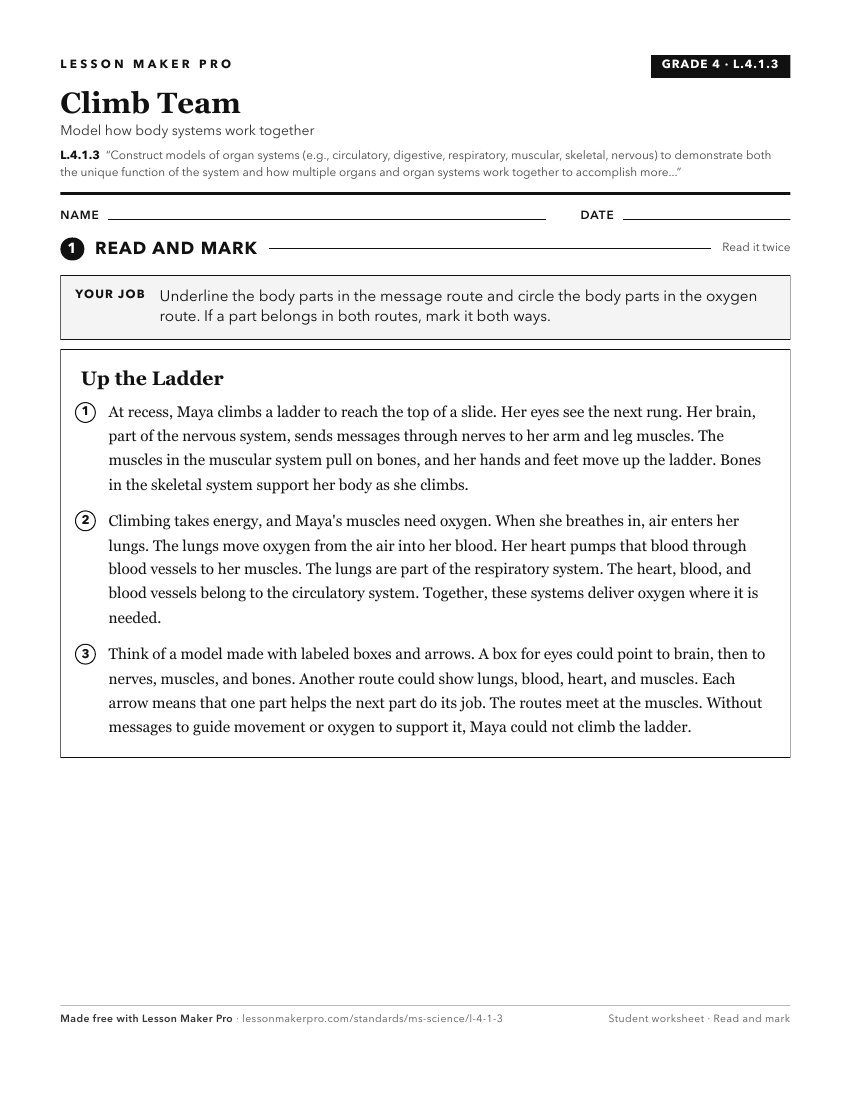
A ready-to-print activity worksheet aligned to L.4.1.3, with an answer key for the teacher on its own page. No account needed.
PDF, US Letter, prints cleanly in black and white.
Download the worksheetKeep exploring
Related Standards
- HAP.2.2
Construct a model to demonstrate how the structural organization of cells in a tissue relates to the specialized function of that tissue.
- L.6.1.6
Develop and use models to show relationships among the increasing complexity of multicellular organisms (cells, tissues, organs, organ systems, organisms) and h...
- HAP.12.1
Design and use models to illustrate the functions of the organs of the respiratory system.
- HAP.10.1
Design and use models to investigate the functions of the organs of the cardiovascular system.
Turn this exact standard into a lesson
Grade, subject, topic, and the complete standard are prefilled. Create one free, no account needed.
Also for this standard:Make a WorksheetMake a QuizMake a Sub Lesson