Mississippi Science HAP.12.1
The Standard
- HAP.12
- Students will investigate the structures and functions of the respiratory system, including the cause and effect of diseases and disorders.
Design and use models to illustrate the functions of the organs of the respiratory system.
2026 Mississippi College- and Career-Readiness Standards for Science · Respiratory System
Teacher's field guide
What This Standard Means
What Students Need to Do
- Students design and use a model to trace air from the nose or mouth through the trachea and bronchi to the alveoli. They show how diaphragm movement brings air in and out, and where gases move between air and blood.
What Mastery Looks Like
- A student can explain how the nose filters air, the airways carry it, and the alveoli exchange gases with blood. They can use a model to show why air enters when the diaphragm moves down and name something the model cannot show.
Common Misconceptions
- Students may say the diaphragm moves up when they inhale or that the lungs pull air in by themselves. They may put gas exchange in the bronchi instead of the alveoli.
How to Assess It
- On an exit ticket, have students sketch a bottle lung model and label the trachea, bronchi, lungs, and diaphragm. Ask them to show what happens when the bottom balloon is pulled down and mark where gas exchange occurs in real lungs.
Lesson moves
Ways to Teach It
Sketch and build a bottle lung model with two balloons on Y-shaped straws, then pull the balloon stretched across its cut base.
Ask students why pulling the bottom balloon fills the inner balloons and what the model leaves out about alveoli.
Give pairs organ cards and function cards; have them match nose, trachea, bronchi, alveoli, and diaphragm, then trace an inhaled breath.
Show an asthma inhaler photo; have students trace the medicine's path to the bronchioles and explain how opening those tubes changes airflow.
Free download
Printable HAP.12.1 Worksheet
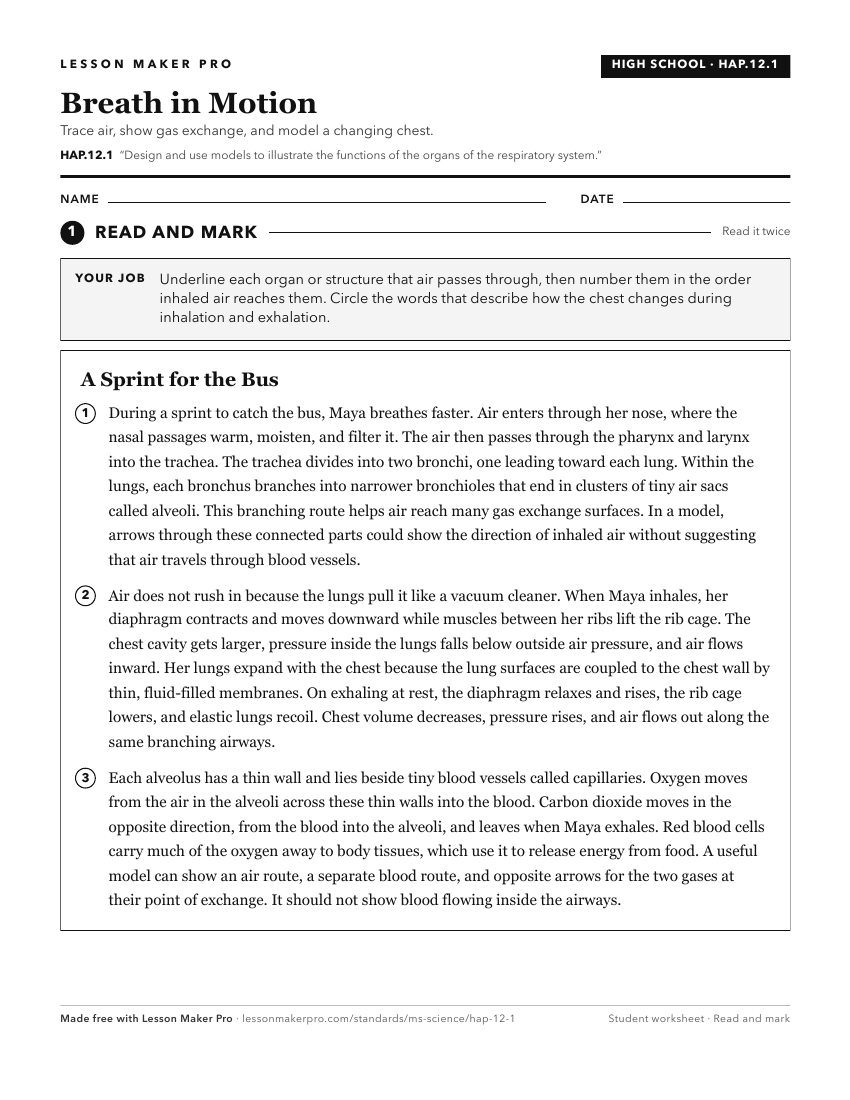
A ready-to-print activity worksheet aligned to HAP.12.1, with an answer key for the teacher on its own page. No account needed.
PDF, US Letter, prints cleanly in black and white.
Download the worksheetKeep exploring
Related Standards
- L.4.1.3
Construct models of organ systems (e.g., circulatory, digestive, respiratory, muscular, skeletal, nervous) to demonstrate both the unique function of the system...
- HAP.12.4
Enrichment: Use an engineering design process to develop a model of the mechanisms that support breathing and illustrate the inverse relationship between volume...
- HAP.4.1
Use models to compare the structure and function of the skeletal system.
- HAP.10.1
Design and use models to investigate the functions of the organs of the cardiovascular system.
Turn this exact standard into a lesson
Grade, subject, topic, and the complete standard are prefilled. Create one free, no account needed.
Also for this standard:Make a WorksheetMake a QuizMake a Sub Lesson