Mississippi Science HAP.5.4
The Standard
- HAP.5
- Students will investigate the structures and functions of the muscular system, including the cause and effect of diseases and disorders.
Use models to locate the major muscles and investigate the movements controlled by each muscle.
2026 Mississippi College- and Career-Readiness Standards for Science · Muscular System
Teacher's field guide
What This Standard Means
What Students Need to Do
- Students locate major muscles on a body model. They move the elbow, knee, and ankle to see which muscles help produce each motion.
What Mastery Looks Like
- A student can point to the biceps, triceps, quadriceps, hamstrings, and calf muscles. They can show a movement each helps produce and explain that a contracting muscle pulls on bones.
Common Misconceptions
- Students may think the biceps straightens the elbow or that the quadriceps bends the knee. They may also think muscles push bones instead of pulling on them.
How to Assess It
- Give students a blank front and back body outline. Ask them to label the biceps, triceps, quadriceps, and hamstrings, then write one joint movement each helps produce.
Lesson moves
Ways to Teach It
Place sticky notes for four major muscles on a life-size body outline, then have students act out each muscle's movement.
Ask students to explain in two sentences why bending and straightening the elbow use different muscles.
Give pairs muscle cards and movement cards to match, then have them demonstrate each matched movement.
Have students step onto one stair and identify when their quadriceps straighten the knee and their calf muscles help push off.
Free download
Printable HAP.5.4 Worksheet
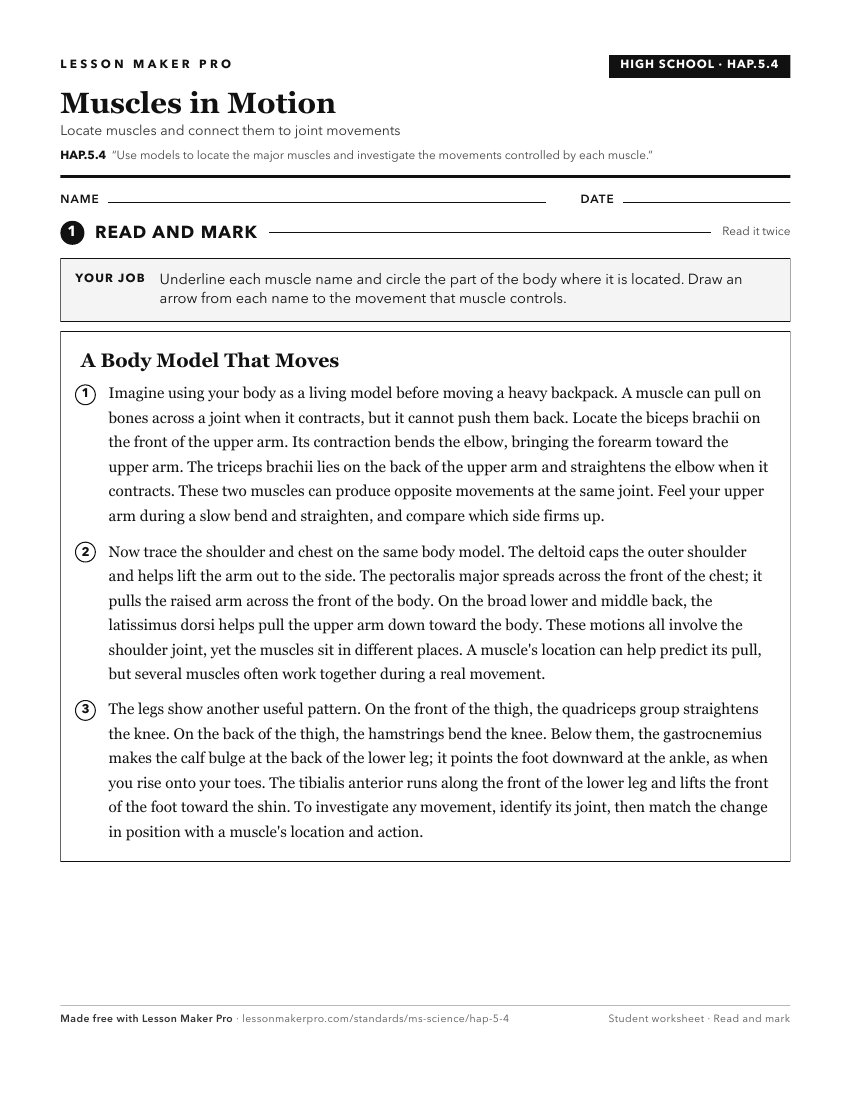
A ready-to-print activity worksheet aligned to HAP.5.4, with an answer key for the teacher on its own page. No account needed.
PDF, US Letter, prints cleanly in black and white.
Download the worksheetKeep exploring
Related Standards
- HAP.4.1
Use models to compare the structure and function of the skeletal system.
- HAP.5.1
Develop and use models to illustrate muscle structure, muscle locations and groups, actions, origins, and insertions.
- HAP.4.2
Develop and use models to identify and classify major bones as part of the appendicular or axial skeleton.
- HAP.10.1
Design and use models to investigate the functions of the organs of the cardiovascular system.
Turn this exact standard into a lesson
Grade, subject, topic, and the complete standard are prefilled. Create one free, no account needed.
Also for this standard:Make a WorksheetMake a QuizMake a Sub Lesson