Mississippi Science HAP.4.3
The Standard
- HAP.4
- Students will investigate the structures and functions of the skeletal system including the cause and effect of diseases and disorders.
Identify and classify types of joints and their movement.
2026 Mississippi College- and Career-Readiness Standards for Science · Skeletal System
Teacher's field guide
What This Standard Means
What Students Need to Do
- Students identify joints as fibrous, cartilaginous, or synovial. They sort synovial joints by type and match each type to movements such as bending, turning, or sliding.
What Mastery Looks Like
- A student can identify a skull suture as immovable and the joint between two vertebral bodies as slightly movable. They can name the elbow as a hinge joint and the shoulder as a ball-and-socket joint, then demonstrate how each moves.
Common Misconceptions
- Students may think every joint moves or that every movable joint works like an elbow. They may also confuse bending at the elbow with rotation at the upper neck.
How to Assess It
- Exit ticket: Classify a skull suture, the joint between two vertebral bodies, the elbow, and the shoulder as fibrous, cartilaginous, or synovial. State how each moves, and name the synovial joint types at the elbow and shoulder.
Lesson moves
Ways to Teach It
Make an elbow hinge with paper strips and a fastener, then make a shoulder joint with a clay ball and a small cup.
Ask: Why can your shoulder move in more directions than your elbow? Name both joint types in your answer.
Give pairs cards labeled skull suture, vertebral bodies, elbow, shoulder, and upper neck; have them sort by joint class and match movements.
Have students stand up from a chair, then label their hip and knee joint types and describe how each moves.
Free download
Printable HAP.4.3 Worksheet
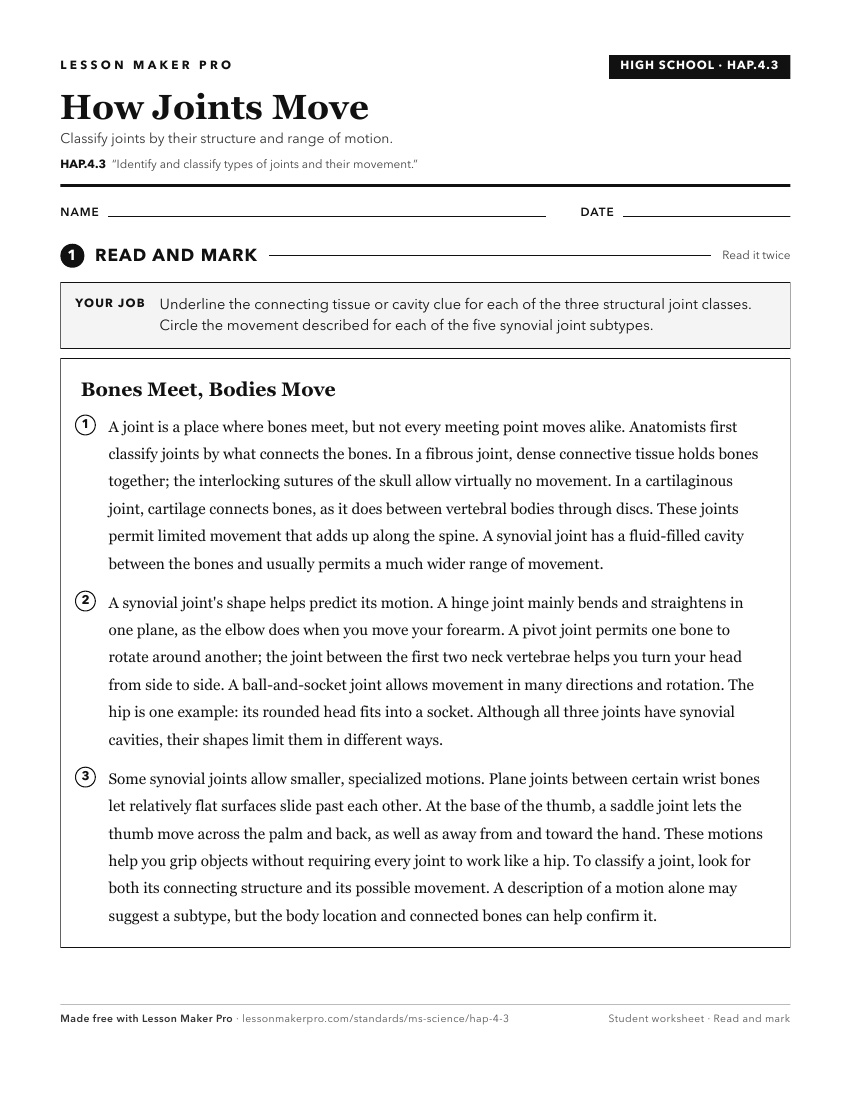
A ready-to-print activity worksheet aligned to HAP.4.3, with an answer key for the teacher on its own page. No account needed.
PDF, US Letter, prints cleanly in black and white.
Download the worksheetKeep exploring
Related Standards
- HAP.4.1
Use models to compare the structure and function of the skeletal system.
- HAP.5.4
Use models to locate the major muscles and investigate the movements controlled by each muscle.
- HAP.5.1
Develop and use models to illustrate muscle structure, muscle locations and groups, actions, origins, and insertions.
- HAP.4.2
Develop and use models to identify and classify major bones as part of the appendicular or axial skeleton.
Turn this exact standard into a lesson
Grade, subject, topic, and the complete standard are prefilled. Create one free, no account needed.
Also for this standard:Make a WorksheetMake a QuizMake a Sub Lesson