Mississippi Science HAP.4.4
The Standard
- HAP.4
- Students will investigate the structures and functions of the skeletal system including the cause and effect of diseases and disorders.
Demonstrate an understanding of the growth and development of the skeletal system, differentiating between endochondral and intramembranous ossification.
2026 Mississippi College- and Career-Readiness Standards for Science · Skeletal System
Teacher's field guide
What This Standard Means
What Students Need to Do
- Students trace how a cartilage model becomes bone in the femur and how a skull bone forms directly in embryonic connective tissue. They explain how growth plates let long bones lengthen and what happens when those plates close.
What Mastery Looks Like
- Given a femur and a parietal skull bone, a student names each bone's starting tissue. They show where the femur lengthens as cartilage grows and is replaced by bone.
Common Misconceptions
- Students may think every bone starts as cartilage. They may also think a femur gets longer by stretching existing bone rather than adding new bone at its growth plates.
How to Assess It
- On an exit ticket, ask students to name the starting tissue for a femur and a parietal skull bone, then mark where the femur lengthens on a diagram.
Lesson moves
Ways to Teach It
Use three clay colors for connective tissue, cartilage, and bone; model a femur's cartilage stage and a skull plate forming without cartilage.
Ask students to write: Why can a teenager's femur lengthen, but an adult's femur usually cannot?
Give pairs femur, parietal bone, tibia, and frontal bone cards; have them sort by starting tissue and explain each choice.
Show a pediatric knee X-ray with an open growth plate; ask how an injury there could affect future leg length.
Free download
Printable HAP.4.4 Worksheet
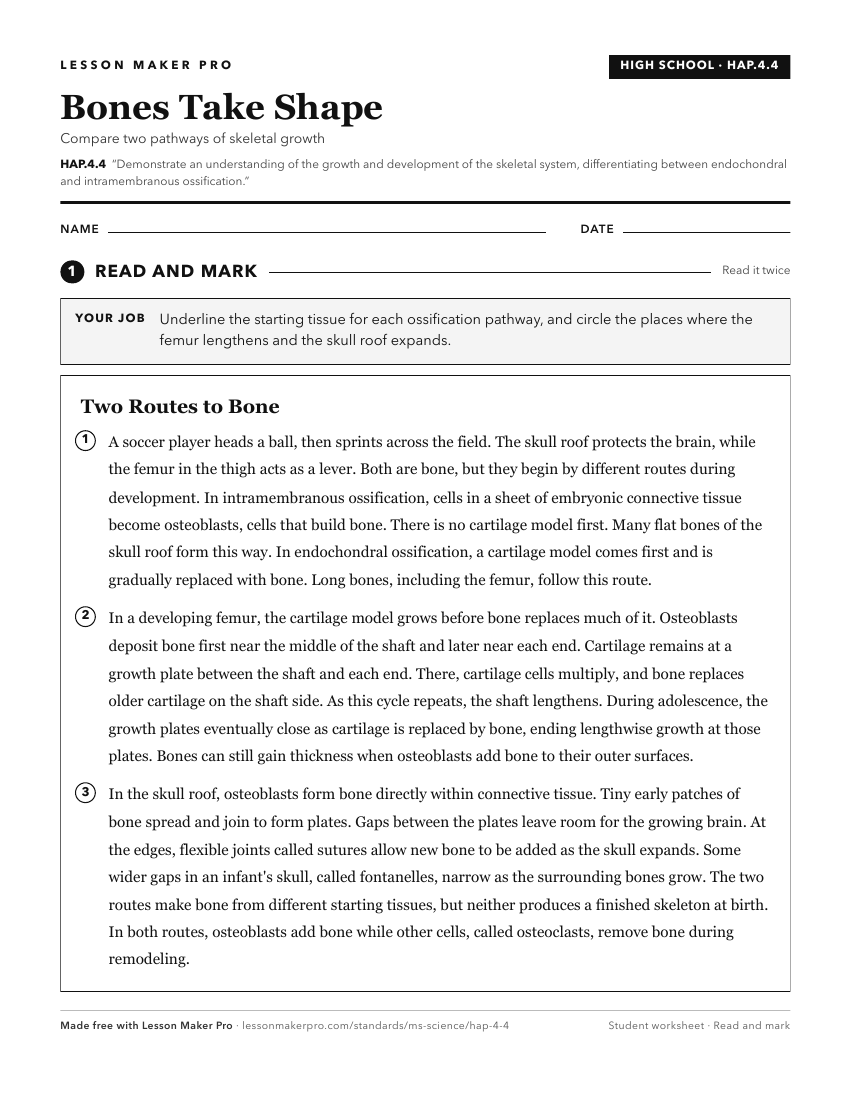
A ready-to-print activity worksheet aligned to HAP.4.4, with an answer key for the teacher on its own page. No account needed.
PDF, US Letter, prints cleanly in black and white.
Download the worksheetKeep exploring
Related Standards
- ZOO.7
Students will understand the structure and function of phylum Chordata, classes Chondrichthyes and Osteichthyes, and how they demonstrate the characteristics of...
- HAP.2
Students will demonstrate an understanding of the relationship of cells and tissues that form complex structures of the body.
- HAP.4.1
Use models to compare the structure and function of the skeletal system.
- HAP.4.2
Develop and use models to identify and classify major bones as part of the appendicular or axial skeleton.
Turn this exact standard into a lesson
Grade, subject, topic, and the complete standard are prefilled. Create one free, no account needed.
Also for this standard:Make a WorksheetMake a QuizMake a Sub Lesson