Mississippi Science HAP.4.6
The Standard
- HAP.4
- Students will investigate the structures and functions of the skeletal system including the cause and effect of diseases and disorders.
Research and analyze various pathological conditions (e.g., bone fractures, osteoporosis, bone cancers, various types of arthritis, and carpal tunnel syndrome).
2026 Mississippi College- and Career-Readiness Standards for Science · Skeletal System
Teacher's field guide
What This Standard Means
What Students Need to Do
- Students research fractures, osteoporosis, bone cancer, types of arthritis, and carpal tunnel syndrome. They compare affected structures, symptoms, risk factors, and treatments, then use evidence to explain a likely diagnosis.
What Mastery Looks Like
- Students can explain why osteoporosis raises fracture risk without calling it a fracture. Given a patient case, they name the likely condition and affected structure, then support their choice with symptoms or test results.
Common Misconceptions
- Students may think osteoporosis is a type of fracture. They may treat all arthritis as the same disease or think carpal tunnel syndrome damages bone rather than compressing a nerve.
How to Assess It
- Exit ticket: A patient has tingling in the thumb, index, and middle fingers. Is carpal tunnel syndrome or osteoarthritis more likely? Name the affected structure and give one clue.
Lesson moves
Ways to Teach It
Build a wrist tunnel with clay bones, a paper strip ligament, and a pipe cleaner nerve, then show how crowding compresses the nerve.
Using printed condition sheets, ask students why osteoporosis may go unnoticed until a fracture while osteoarthritis often causes joint pain.
Give groups six patient cards and six condition cards, including bone cancer and rheumatoid arthritis; have them match pairs and defend each choice.
Give students a sample bone density report with reference ranges; ask them to flag a low T-score and explain the fracture risk.
Free download
Printable HAP.4.6 Worksheet
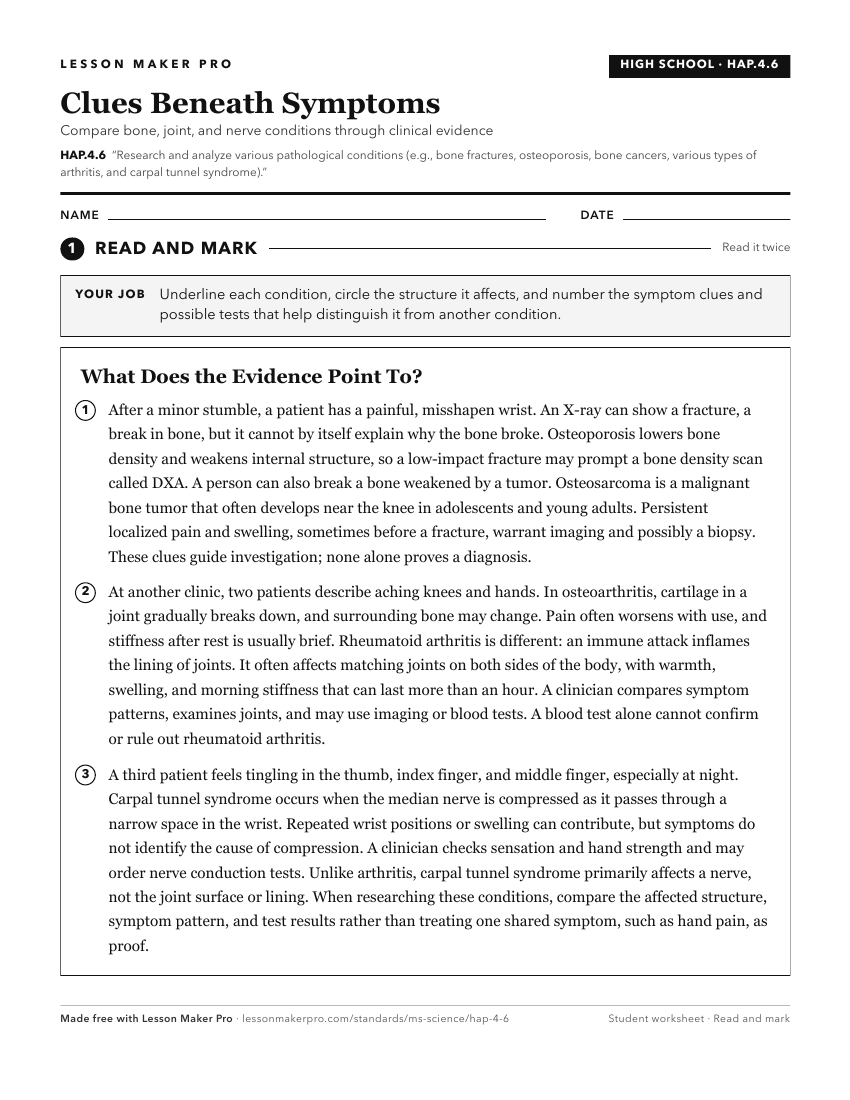
A ready-to-print activity worksheet aligned to HAP.4.6, with an answer key for the teacher on its own page. No account needed.
PDF, US Letter, prints cleanly in black and white.
Download the worksheetKeep exploring
Related Standards
- HAP.10.6
Research and analyze the effects of various pathological conditions (e.g., hypertension, myocardial infarction, mitral valve prolapses, varicose veins, and arrh...
- HAP.5.7
Research and analyze the causes and effects of various pathological conditions, (e.g., fibromyalgia, muscular dystrophy, cerebral palsy, muscle cramps/strains, ...
- HAP.7.4
Research and analyze the effects of various pathological conditions (e.g., diabetes mellitus, pituitary dwarfism, Graves’ disease, Cushing’s syndrome, hypothyro...
- HAP.6.8
Research and analyze the causes and effects of various pathological conditions (e.g., addiction, depression, schizophrenia, Alzheimer’s, sports-related chronic ...
Turn this exact standard into a lesson
Grade, subject, topic, and the complete standard are prefilled. Create one free, no account needed.
Also for this standard:Make a WorksheetMake a QuizMake a Sub Lesson