Mississippi Science HAP.10.6
The Standard
- HAP.10
- Students will investigate the structures and functions of the cardiovascular system, including the cause and effect of diseases and disorders.
Research and analyze the effects of various pathological conditions (e.g., hypertension, myocardial infarction, mitral valve prolapses, varicose veins, and arrhythmia).
2026 Mississippi College- and Career-Readiness Standards for Science · Cardiovascular System
Teacher's field guide
What This Standard Means
What Students Need to Do
- Use reliable health sources to study cardiovascular conditions. Explain how each affects blood flow or heart function, then connect that change to symptoms and risks.
What Mastery Looks Like
- Students can explain why long-term high blood pressure strains the heart and vessels, while a blocked coronary artery can injure heart muscle. They can distinguish those problems from valve trouble, irregular rhythms, and blood pooling in leg veins. They support each explanation with a source.
Common Misconceptions
- Students may think a heart attack means the heart stops, or that every irregular rhythm is a heart attack. They may mistake high blood pressure for a blocked artery. They may assume mitral valve prolapse always causes severe leakage or confuse leg-vein valves with heart valves.
How to Assess It
- Exit ticket: “A coronary artery is blocked, but the heart’s rhythm is normal. What happens to the heart muscle, and why is this not an arrhythmia?” Ask students to cite one fact from the class handout.
Lesson moves
Ways to Teach It
Use yarn on a heart diagram to trace coronary blood flow; cover one artery with tape and mark the heart muscle that loses oxygen.
Ask, “How does blood flowing backward through a leaky mitral valve differ from pooling behind faulty valves in leg veins?”
Give students five condition cards and five blood-flow effect cards; have them match each pair and defend one match with evidence.
Give students a sample weeklong blood pressure log and an American Heart Association chart; ask what the readings suggest and what needs confirmation.
Free download
Printable HAP.10.6 Worksheet
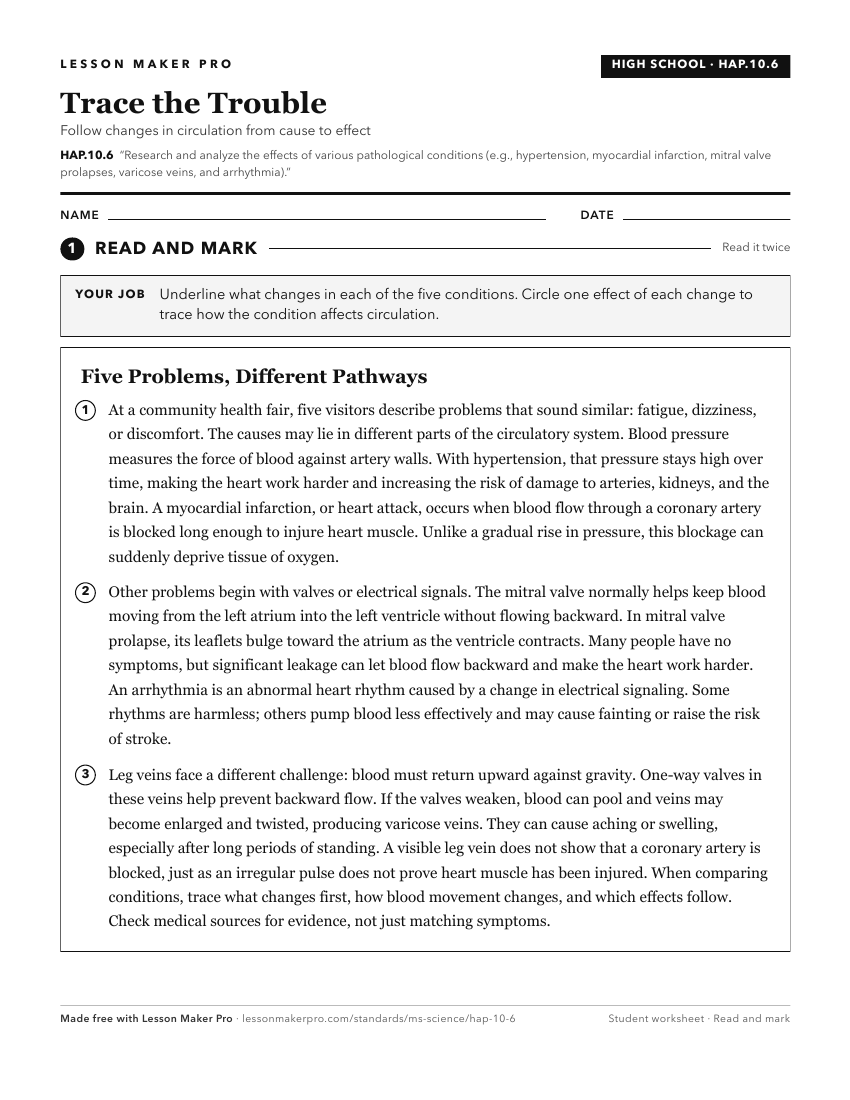
A ready-to-print activity worksheet aligned to HAP.10.6, with an answer key for the teacher on its own page. No account needed.
PDF, US Letter, prints cleanly in black and white.
Download the worksheetKeep exploring
Related Standards
- HAP.13.7
Research and analyze the causes and effects of various pathological conditions (e.g., GERD/acid reflux, stomach ulcers, lactose intolerance, irritable bowel syn...
- HAP.12.5
Research and analyze the causes and effects of various pathological conditions (e.g., asthma, bronchitis, pneumonia, and COPD).
- HAP.9.3
Research and analyze the causes and effects of various pathological conditions (e.g., anemia, malaria, leukemia, hemophilia, and blood doping).
- HAP.7.4
Research and analyze the effects of various pathological conditions (e.g., diabetes mellitus, pituitary dwarfism, Graves’ disease, Cushing’s syndrome, hypothyro...
Turn this exact standard into a lesson
Grade, subject, topic, and the complete standard are prefilled. Create one free, no account needed.
Also for this standard:Make a WorksheetMake a QuizMake a Sub Lesson