Mississippi Science HAP.5
Standard Cluster
Students will investigate the structures and functions of the muscular system, including the cause and effect of diseases and disorders. Develop and use models to illustrate muscle structure, muscle locations and groups, actions, origins, and insertions. Describe the structure and function of the skeletal muscle fiber and the motor unit. Explain the molecular mechanism of muscle contraction and relaxation. Use models to locate the major muscles and investigate the movements controlled by each muscle. Compare and contrast the anatomy and physiology of the three types of muscle tissue. Use technology to plan and conduct an investigation that demonstrates the physiology of muscle contraction, muscle fatigue, or muscle tone. Collect and analyze data to interpret results, then explain and communicate conclusions. Research and analyze the causes and effects of various pathological conditions, (e.g., fibromyalgia, muscular dystrophy, cerebral palsy, muscle cramps/strains, and tendonitis). Enrichment: Use an engineering design process to develop effective ergonomic devices to prevent muscle fatigue and strain (e.g., carpal tunnel, exoskeletons for paralysis, or training plans to prevent strains/sprains/cramps). *
2026 Mississippi College- and Career-Readiness Standards for Science · Muscular System
Cluster contents
Standards in This Cluster
HAP.5 is a cluster heading. These are the individual standards under it.
- HAP.5.1
Develop and use models to illustrate muscle structure, muscle locations and groups, actions, origins, and insertions.
- HAP.5.2
Describe the structure and function of the skeletal muscle fiber and the motor unit.
- HAP.5.3
Explain the molecular mechanism of muscle contraction and relaxation.
- HAP.5.4
Use models to locate the major muscles and investigate the movements controlled by each muscle.
- HAP.5.5
Compare and contrast the anatomy and physiology of the three types of muscle tissue.
- HAP.5.6
Use technology to plan and conduct an investigation that demonstrates the physiology of muscle contraction, muscle fatigue, or muscle tone. Collect and analyze ...
- HAP.5.7
Research and analyze the causes and effects of various pathological conditions, (e.g., fibromyalgia, muscular dystrophy, cerebral palsy, muscle cramps/strains, ...
- HAP.5.8
Enrichment: Use an engineering design process to develop effective ergonomic devices to prevent muscle fatigue and strain (e.g., carpal tunnel, exoskeletons for...
Teacher's field guide
What This Cluster Means
What Students Need to Do
- Students locate major muscles and show how their origins and insertions move joints. They model how motor units make muscle fibers contract and relax. They compare the three muscle tissues and use evidence to explain fatigue and muscle disorders.
What Mastery Looks Like
- A student identifies the biceps origin on the scapula and insertion on the radius, then predicts elbow movement. They explain how a motor neuron triggers calcium release, myosin pulls actin using ATP, and the fiber relaxes. They distinguish skeletal, cardiac, and smooth muscle and use evidence to explain fatigue or a disorder.
Common Misconceptions
- Students may think muscles push bones instead of pulling them. They may mistake a motor unit for one fiber or think ATP is needed only during contraction. They may assume all muscle tissue is voluntary or that fatigue always comes from lactic acid.
How to Assess It
- On an arm diagram showing the biceps, label its origin and insertion, draw the forearm's movement during contraction, and name the roles of calcium and ATP in contraction and relaxation.
Lesson moves
Ways to Teach It
Use string and a paper hinge arm to model biceps attachments; have pairs move the forearm by pulling the string.
Show three muscle tissue micrographs and ask, "Which type lines the intestine, and what features support your choice?"
Give teams muscle cards and body diagrams; have them match each muscle to its location, attachments, and joint action.
Use a phone timer and spreadsheet to graph clothespin squeezes in four 30-second rounds, then connect declining counts to repetitive work.
Free download
Printable HAP.5 Worksheet
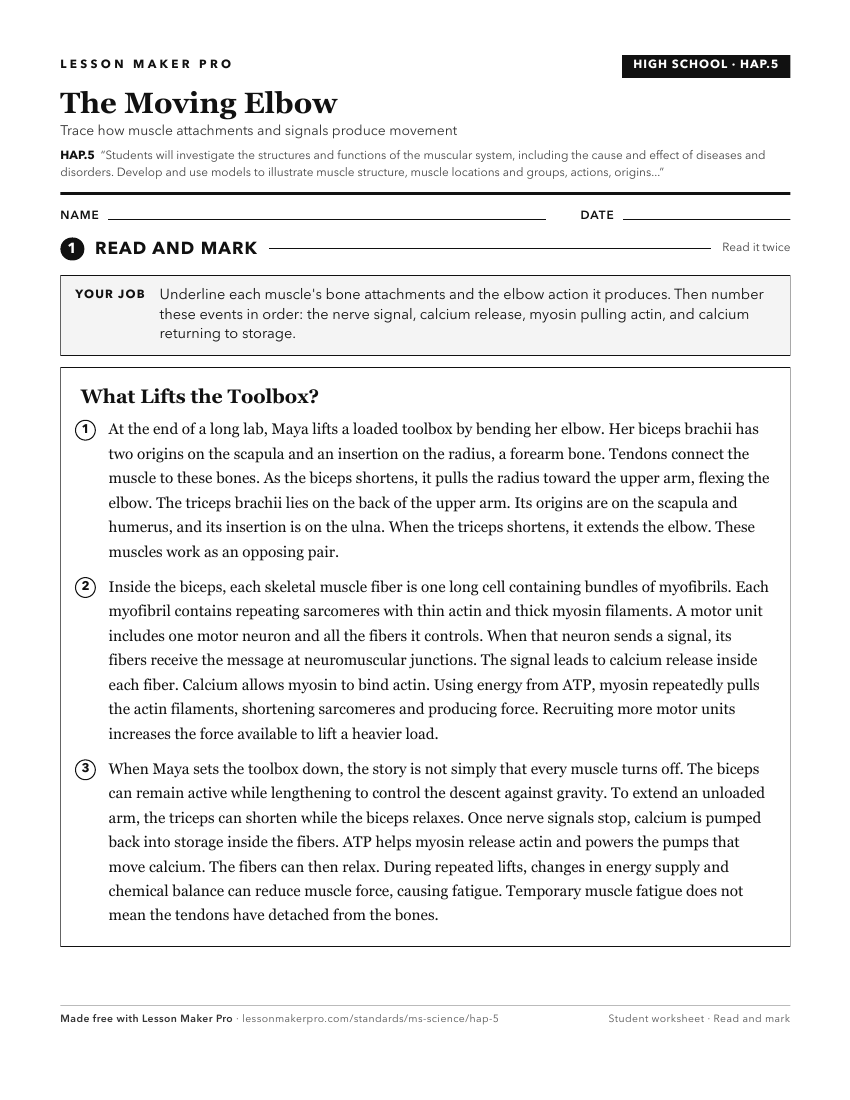
A ready-to-print activity worksheet aligned to HAP.5, with an answer key for the teacher on its own page. No account needed.
PDF, US Letter, prints cleanly in black and white.
Download the worksheetKeep exploring
Related Standards
- HAP.4
Students will investigate the structures and functions of the skeletal system including the cause and effect of diseases and disorders.
- HAP.13
Students will investigate the structures and functions of the digestive system, including the cause and effect of diseases and disorders.
- HAP.10
Students will investigate the structures and functions of the cardiovascular system, including the cause and effect of diseases and disorders.
- HAP.6
Students will investigate the structures and functions of the nervous system, including the cause and effect of diseases and disorders.
Turn this cluster into a lesson
Grade, subject, topic, and the complete cluster are prefilled. Create one free, no account needed.
Also for this cluster:Make a WorksheetMake a QuizMake a Sub Lesson