Mississippi Science ZOO.2.1
The Standard
- ZOO.2
- Students will understand the structure and function of phylum Porifera and phylum Cnidaria and how each adapts to their environments.
Differentiate among asymmetry, radial symmetry, and bilateral symmetry in an animal’s body plan.
2026 Mississippi College- and Career-Readiness Standards for Science · Phyla Porifera and Cnidaria
Teacher's field guide
What This Standard Means
What Students Need to Do
- Students look at an animal’s body shape and find ways to divide it into matching halves. They tell apart no matching division, several divisions through a central axis, and one division into left and right sides.
What Mastery Looks Like
- A student can label an irregular sponge, a jellyfish, and a butterfly by body symmetry. They can show why the sponge has no matching division, the jellyfish has several, and the butterfly has one.
Common Misconceptions
- Students may call a jellyfish bilateral because one division makes matching halves, without checking for others. They may assume a roughly round sponge is radial or judge symmetry by color instead of body shape.
How to Assess It
- Show sketches of an irregular sponge, a jellyfish viewed from above, and a butterfly. Ask students to name each symmetry type and draw matching-half lines where possible.
Lesson moves
Ways to Teach It
Cut out top-view jellyfish, butterfly, and irregular sponge diagrams; fold each to find matching halves.
Show three animal sketches and ask, “Which has no matching division, one, or several? What in the sketch proves it?”
Sort 12 animal picture cards by symmetry, then trade one card with a partner and explain its placement.
Use aquarium exhibit photos to mark possible dividing lines on an irregular sponge, a jellyfish, and a fish.
Free download
Printable ZOO.2.1 Worksheet
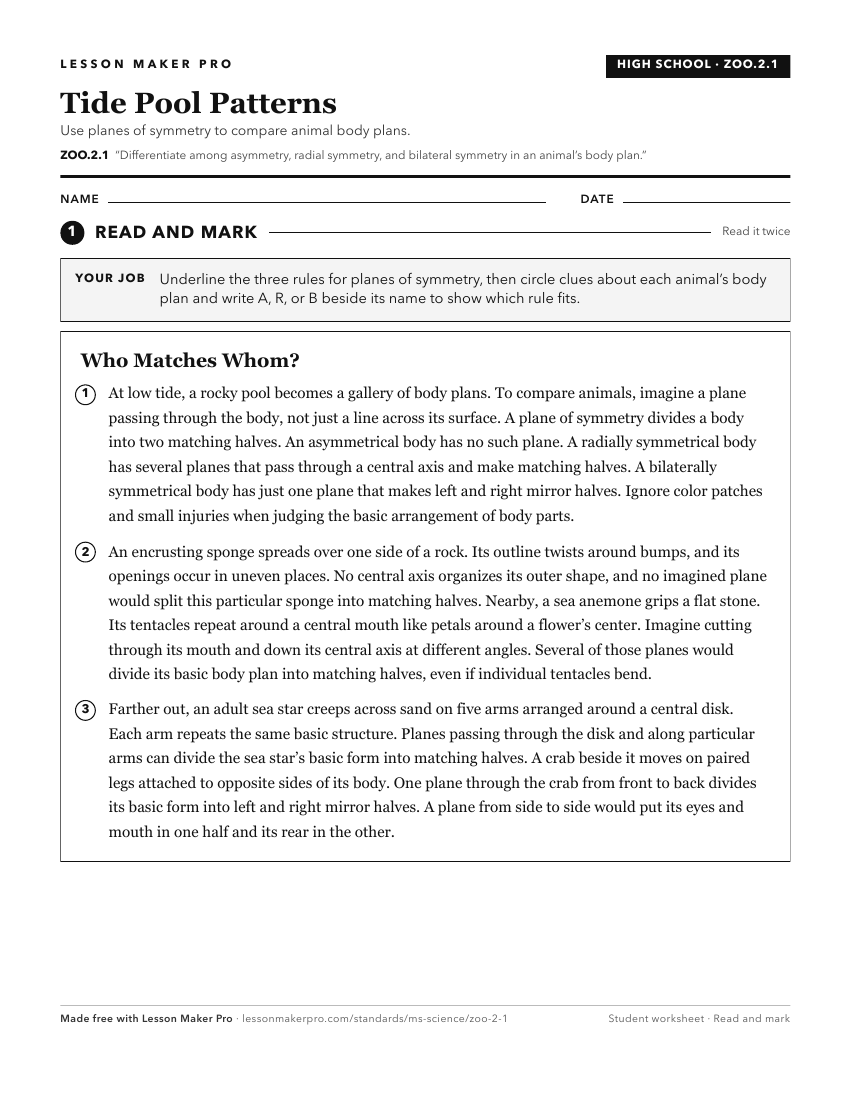
A ready-to-print activity worksheet aligned to ZOO.2.1, with an answer key for the teacher on its own page. No account needed.
PDF, US Letter, prints cleanly in black and white.
Download the worksheetKeep exploring
Related Standards
- ZOO.8.1
Understand the evolution of tetrapods and the development of the structure and function of body systems and life cycles.
- MAQ.6.4
Compare and contrast major body plans (e.g., asymmetry, radial, bilateral symmetry, acoelomate, pseudocoelomate, and eucoelomate).
- ZOO.4.4
Create a model comparing acoelomate, pseudocoelomate, and eucoelomate body plans of Platyhelminthes, Nematoda, and Annelida.
- MAQ.7.4
Differentiate various life cycles found among animals (e.g., egg, tadpole, and adult stages of the amphibian life cycle; leathery eggs on land in reptiles; hard...
Turn this exact standard into a lesson
Grade, subject, topic, and the complete standard are prefilled. Create one free, no account needed.
Also for this standard:Make a WorksheetMake a QuizMake a Sub Lesson