Mississippi Science ZOO.2.3
The Standard
- ZOO.2
- Students will understand the structure and function of phylum Porifera and phylum Cnidaria and how each adapts to their environments.
Describe the importance of phylum Porifera in aquatic habitats.
2026 Mississippi College- and Career-Readiness Standards for Science · Phyla Porifera and Cnidaria
Teacher's field guide
What This Standard Means
What Students Need to Do
- Students explain how sponges pump water through their bodies and capture food particles. They describe how sponges release nutrients and provide shelter for small aquatic animals.
What Mastery Looks Like
- Given a reef photo, a student can explain how a sponge gets food and how another animal might use it for shelter. They can predict what would change if the sponges disappeared.
Common Misconceptions
- Students may think sponges are plants or that they soak up water like kitchen sponges. They may also assume sponges remove all pollution, rather than feeding on particles carried by water.
How to Assess It
- Exit ticket: A rocky reef loses most of its sponges. Name two changes other organisms might notice, and explain how each change follows from what sponges do.
Lesson moves
Ways to Teach It
Fit a coffee filter over a syringe tip, draw in water with paper flecks, and inspect trapped pieces as a model of sponge feeding.
Ask pairs: If a reef lost its sponges, what would happen to animals sheltering in them and particles in the water?
Play a matching game with cards showing sponge actions, such as trapping particles, and effects, such as less suspended food in the water.
Show a photo of sponges growing on pier pilings, then ask why nearby shrimp might use them for shelter.
Free download
Printable ZOO.2.3 Worksheet
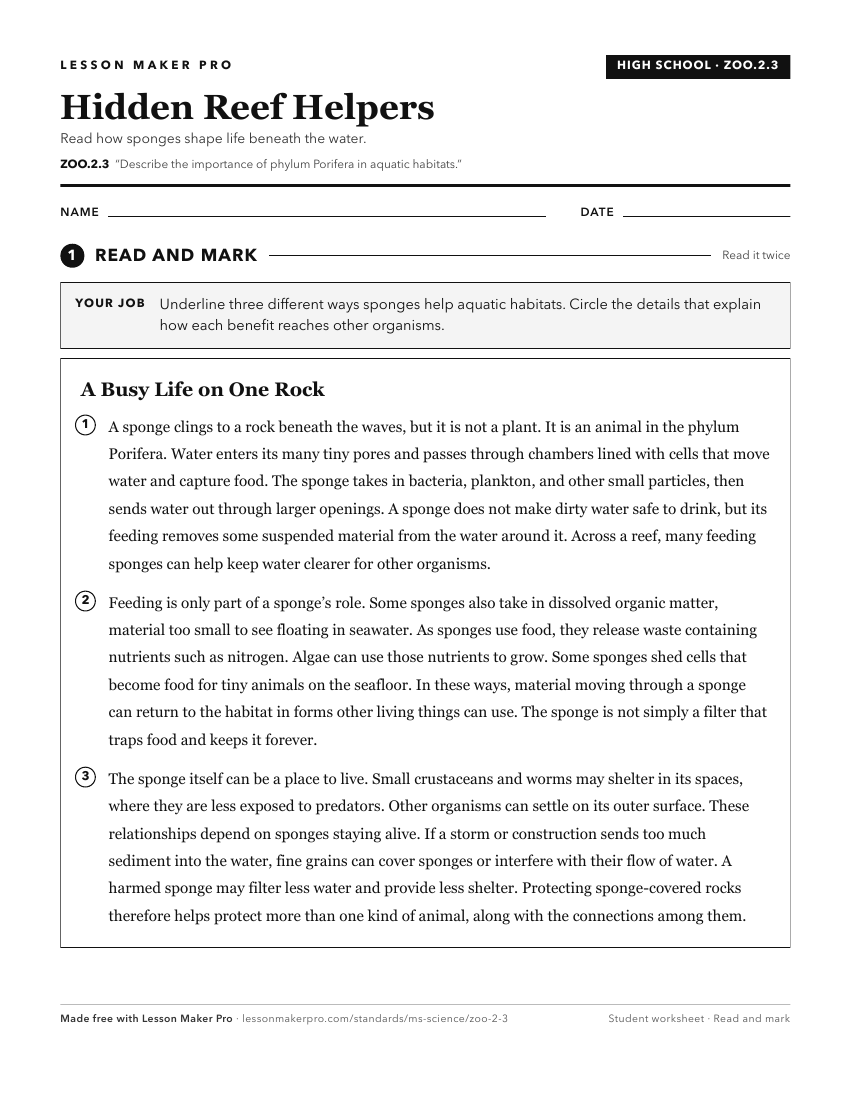
A ready-to-print activity worksheet aligned to ZOO.2.3, with an answer key for the teacher on its own page. No account needed.
PDF, US Letter, prints cleanly in black and white.
Download the worksheetKeep exploring
Related Standards
- ZOO.3
Students will understand the structure and function of phylum Mollusca, and how they adapt to their environments.
- MAQ.6.1
Characterize aquatic representatives of the following taxa: Protozoa (e.g., foraminiferans, radiolarians, amoeba, and paramecium), Porifera, Cnidaria, Platyhelm...
- ZOO.2
Students will understand the structure and function of phylum Porifera and phylum Cnidaria and how each adapts to their environments.
- MAQ.4.2
Recognize representative examples of plants and animals that would be specifically adapted to the aquatic ecosystems and identify adaptations necessary to survi...
Turn this exact standard into a lesson
Grade, subject, topic, and the complete standard are prefilled. Create one free, no account needed.
Also for this standard:Make a WorksheetMake a QuizMake a Sub Lesson