Mississippi Science ZOO.2.2
The Standard
- ZOO.2
- Students will understand the structure and function of phylum Porifera and phylum Cnidaria and how each adapts to their environments.
Identify the anatomy and physiology of a sponge, including how specialized cells within sponges work cooperatively without forming tissues to capture and digest food.
2026 Mississippi College- and Career-Readiness Standards for Science · Phyla Porifera and Cnidaria
Teacher's field guide
What This Standard Means
What Students Need to Do
- Trace water entering pores and leaving the osculum. Explain how choanocytes move water and capture food. Show how amoebocytes digest and carry nutrients, even though sponges have no true tissues.
What Mastery Looks Like
- A student labels the main parts on a sponge diagram and draws separate paths for water and food. They explain what each cell does and why working together does not make the cells a tissue.
Common Misconceptions
- Some students think water enters through the osculum. Others give the sponge a mouth and stomach, or assume that cells working together must form true tissues.
How to Assess It
- Exit ticket: Label a pore, osculum, choanocyte, and amoebocyte on a blank sponge outline, then draw water and food paths and explain where food is digested.
Lesson moves
Ways to Teach It
Add paper choanocytes and amoebocytes to a hole-punched cup, then move paper food dots and water arrows along their separate paths.
Ask students to write two sentences explaining how a sponge feeds without a stomach or true tissues.
Give pairs cell and body-part cards, then have them race to arrange the water route and food route separately.
Show an aquarium filter and ask students to name one similarity and one difference between its filter media and a living sponge.
Free download
Printable ZOO.2.2 Worksheet
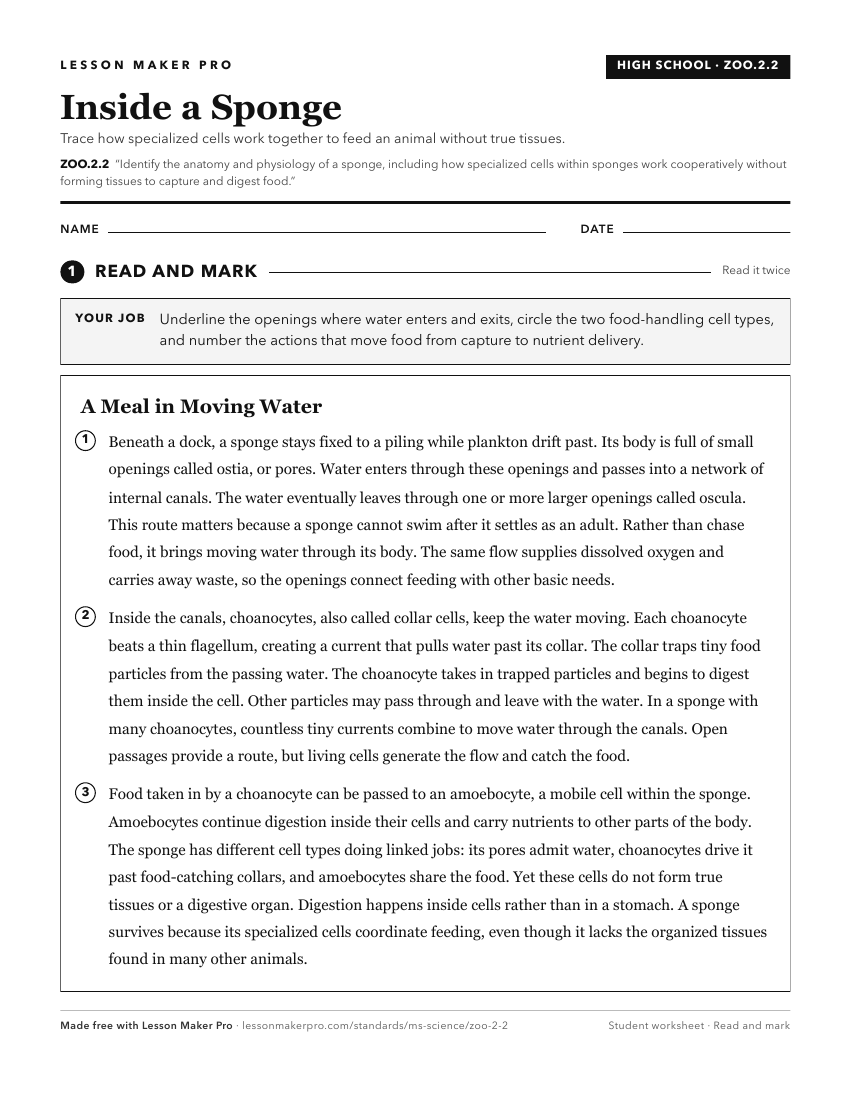
A ready-to-print activity worksheet aligned to ZOO.2.2, with an answer key for the teacher on its own page. No account needed.
PDF, US Letter, prints cleanly in black and white.
Download the worksheetKeep exploring
Related Standards
- MAQ.6.6
Dissect representative taxa (e.g., clam and squid), collect data, compare their internal and external anatomy, analyze, explain, and communicate results.
- HAP.13.2
Use models to describe structural adaptations present in each organ of the tract and correlate the structures to specific processing of food at each stage (e.g....
- HAP.2.2
Construct a model to demonstrate how the structural organization of cells in a tissue relates to the specialized function of that tissue.
- ZOO.2.4
Create a model, either physical or digital, illustrating the anatomy of a sponge, tracing the flow of water.
Turn this exact standard into a lesson
Grade, subject, topic, and the complete standard are prefilled. Create one free, no account needed.
Also for this standard:Make a WorksheetMake a QuizMake a Sub Lesson