Mississippi Science HAP.13.2
The Standard
- HAP.13
- Students will investigate the structures and functions of the digestive system, including the cause and effect of diseases and disorders.
Use models to describe structural adaptations present in each organ of the tract and correlate the structures to specific processing of food at each stage (e.g., types of teeth; muscular, elastic wall and mucous lining of the stomach; villi and microvilli of the small intestine; and sphincters along the digestive tract).
2026 Mississippi College- and Career-Readiness Standards for Science · Digestive System
Teacher's field guide
What This Standard Means
What Students Need to Do
- Students make a model that traces food from mouth to anus. They link teeth, muscle, mucus, villi, and sphincters to chewing, movement, protection, absorption, and flow control. They show where water is absorbed and waste is stored.
What Mastery Looks Like
- A clear model shows incisors cutting, molars grinding, and esophageal muscle pushing food. It shows stomach muscle churning food while mucus protects the stomach wall. It places nutrient absorption at villi and microvilli, water absorption in the large intestine, and waste storage in the rectum.
Common Misconceptions
- Students may say the stomach absorbs most nutrients, rather than the small intestine. They may think villi break food apart or that sphincters push food forward. Muscle moves food, while sphincters open and close to control its passage.
How to Assess It
- Give students a blank digestive tract diagram. Ask them to label teeth, stomach muscle and mucus, villi and microvilli, and two sphincters, then write what each feature does.
Lesson moves
Ways to Teach It
Use clay teeth, a zip bag stomach, fringed-paper villi, and clothespin sphincters to model food's path and each part's job.
Show drawings of a smooth and a fringed small intestine; ask students which would absorb more nutrients and why.
Give pairs organ cards and structure cards; have them match each pair to a food-processing job and explain one match aloud.
Give students 'Burning when lying down after dinner' and ask them to mark the sphincter behind acid reflux on a digestive diagram.
Free download
Printable HAP.13.2 Worksheet
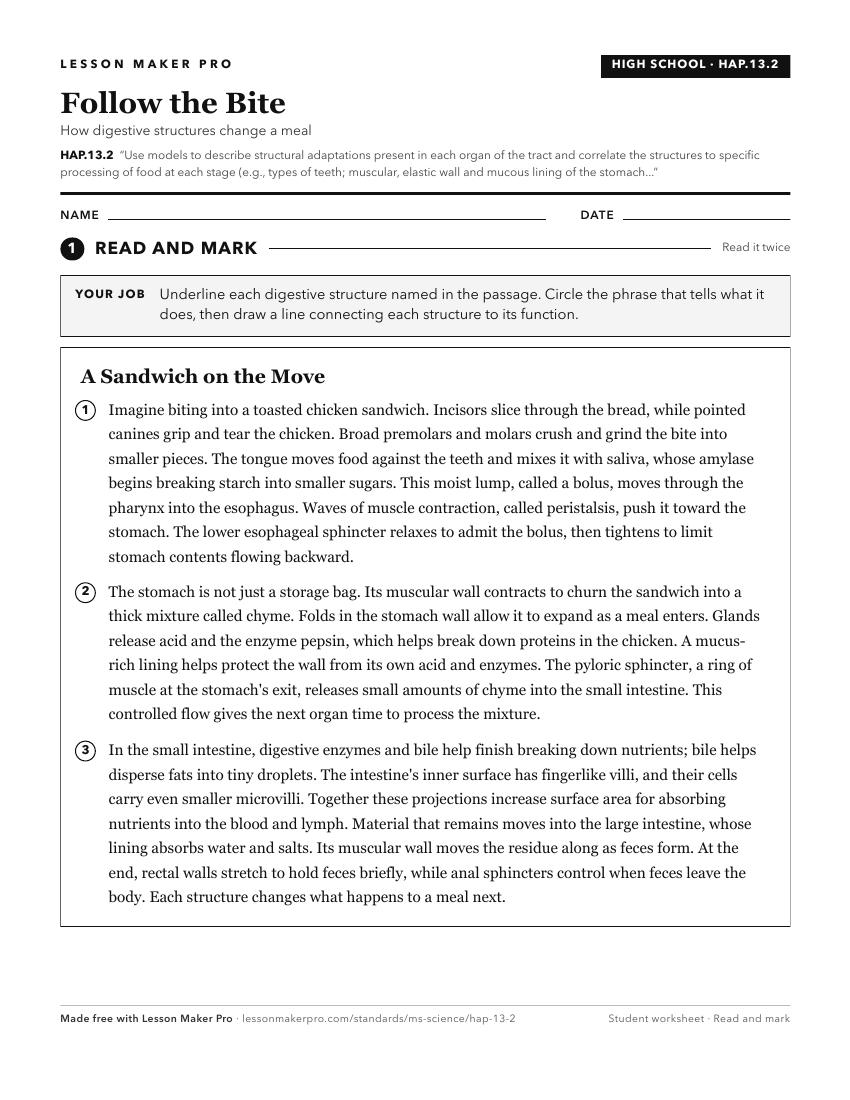
A ready-to-print activity worksheet aligned to HAP.13.2, with an answer key for the teacher on its own page. No account needed.
PDF, US Letter, prints cleanly in black and white.
Download the worksheetKeep exploring
Related Standards
- L.4.1.3
Construct models of organ systems (e.g., circulatory, digestive, respiratory, muscular, skeletal, nervous) to demonstrate both the unique function of the system...
- HAP.2.2
Construct a model to demonstrate how the structural organization of cells in a tissue relates to the specialized function of that tissue.
- L.6.1.6
Develop and use models to show relationships among the increasing complexity of multicellular organisms (cells, tissues, organs, organ systems, organisms) and h...
- HAP.13.1
Analyze the structure-function relationship in organs of the digestive system.
Turn this exact standard into a lesson
Grade, subject, topic, and the complete standard are prefilled. Create one free, no account needed.
Also for this standard:Make a WorksheetMake a QuizMake a Sub Lesson