Virginia SOL S.3
SOL Standard (Skills Cluster)
The student will apply history and social science skills to the content by analyzing and interpreting information sources including, but not limited to artifacts, primary and secondary sources, charts, graphs, and diagrams; applying geographic skills to identify and understand geographic features and connections; developing questions, demonstrating curiosity, and engaging in critical thinking and analysis; using evidence to construct timelines, classify events, and distinguish fact from opinion; comparing and contrasting people, places, and events; identifying cause-and-effect relationships to clarify and explain content; using economic decision-making models to make informed economic decisions; practicing civility, respect, hard work, honesty, trustworthiness, and responsible citizenship skills; and using content vocabulary to demonstrate learning through oral and written products.
Virginia Standards of Learning for History and Social Science
Cluster contents
Skills in This Standard
S.3 is a Standards of Learning history and social science standard. These are the skills expectations under it.
- S.3.a
analyzing and interpreting information sources including, but not limited to artifacts, primary and secondary sources, charts, graphs, and diagrams
- S.3.b
applying geographic skills to identify and understand geographic features and connections
- S.3.c
developing questions, demonstrating curiosity, and engaging in critical thinking and analysis
- S.3.d
using evidence to construct timelines, classify events, and distinguish fact from opinion
- S.3.e
comparing and contrasting people, places, and events
- S.3.f
identifying cause-and-effect relationships to clarify and explain content
- S.3.g
using economic decision-making models to make informed economic decisions
- S.3.h
practicing civility, respect, hard work, honesty, trustworthiness, and responsible citizenship skills
- S.3.i
using content vocabulary to demonstrate learning through oral and written products
Teacher's field guide
What This Cluster Means
What Students Need to Do
- Students examine artifacts, texts, maps, charts, graphs, and diagrams to find information and draw supported conclusions. They ask questions, locate places, sequence events, compare examples, and explain causes and effects. They make reasoned economic choices and communicate with accurate vocabulary, respect, and honesty.
What Mastery Looks Like
- A student can identify useful source details and explain what those details show. The student can separate fact from opinion, sequence events, compare cases, and connect a cause to an effect. Answers use accurate vocabulary and evidence rather than guesses.
Common Misconceptions
- Students may treat every old-looking picture as a primary source or assume secondary sources are less trustworthy. They may label statements they agree with as facts and disputed statements as opinions. They may confuse sequence with cause, overlook map keys and scale, or give conclusions without evidence.
How to Assess It
- Give students a historical image, a caption containing facts and opinions, and a small map. Ask them to list one fact, identify one opinion, write one supported conclusion, and explain one location connection.
Lesson moves
Ways to Teach It
Give pairs artifact photos, map cards, and short source cards to sort by source type, then require one evidence-based observation per card.
Students answer whether a town made a fair choice, cite two details from a short scenario, and respond respectfully to a classmate.
Run a timeline relay where teams order event cards, match each cause to an effect, and flag fact or opinion statements.
Give each group a $30 class-party budget and price list, then have them choose items and explain each tradeoff.
Free download
Printable S.3 Worksheet
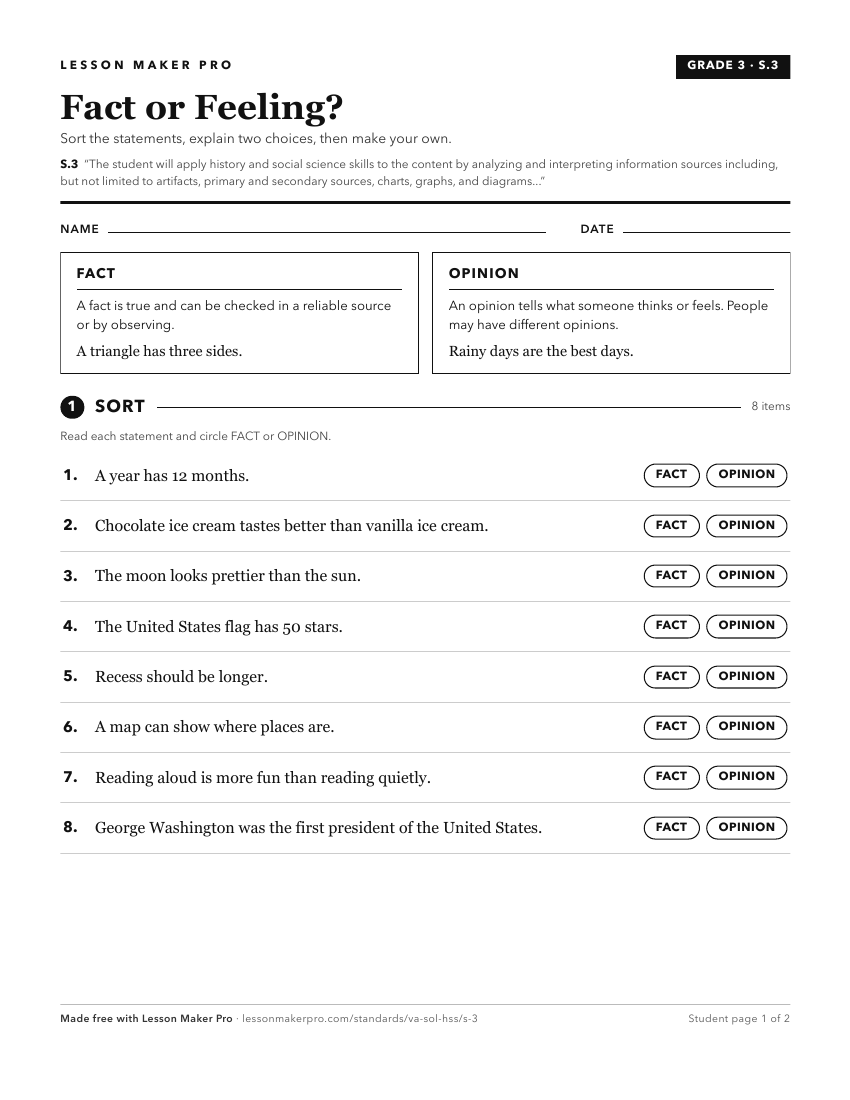
A ready-to-print activity worksheet aligned to S.3, with an answer key for the teacher on its own page. No account needed.
PDF, US Letter, prints cleanly in black and white.
Download the worksheetKeep exploring
Related Standards
Turn this cluster into a lesson
Grade, subject, topic, and the complete cluster are prefilled. Create one free, no account needed.
Also for this cluster:Make a WorksheetMake a QuizMake a Sub Lesson